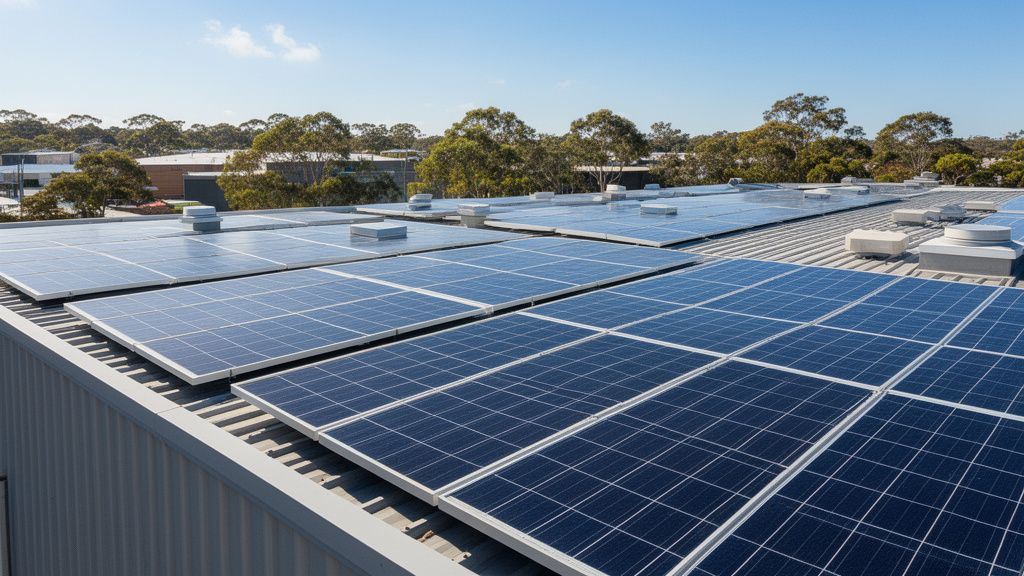
TL;DR: The Australian Government is expanding the Small-scale Renewable Energy Scheme (SRES) from a 100 kW cap to 1 MW starting October 1, 2026. This reform will slash commercial solar installation costs by approximately 20 percent, targeting an estimated 80 gigawatts of untapped rooftop potential on factories, farms, and warehouses, ultimately strengthening grid security and reducing volatile energy bills.
The Paradox of Australian Rooftop Solar and the 'Missing Middle'
Australia is widely recognized as a global leader in residential solar energy. Statistical and industry data show that residential rooftop solar capacity across the country stands at a staggering 22 gigawatts (GW), with approximately one in three Australian homes hosting solar panels. This massive grassroots adoption has successfully insulated millions of households from volatile retail energy markets, lowered household bills, and established a clean energy foundation.
However, this residential success highlights a stark contrast: Australia's commercial and industrial sectors represent a massive, untapped solar resource. Industry estimates indicate that the potential rooftop photovoltaic (PV) capacity on Australian factories, warehouses, agricultural sheds, and other large commercial premises exceeds 80 GW. Yet, despite this enormous potential, businesses have installed only about 5.6 GW of solar. Furthermore, the vast majority of these commercial installations consist of smaller systems below 100 kW in size.
This glaring gap between residential achievements and commercial stagnation is what Energy Minister Chris Bowen has termed the 'missing middle' of the national energy transition. In a landmark address, Minister Bowen acknowledged this discrepancy: 'Utility scale solar is going well. Rooftop household solar continues to break records. But, to be very frank, there is a missing middle in Australia’s energy transition.' To bridge this gap, the federal government is launching major regulatory updates to make solar adoption highly accessible and financially viable for mid-sized commercial entities.
The August 2026 SRES Reform: Slashing Installation Costs by 20 Percent
To address the 'missing middle' and tap into the estimated 80 GW of commercial rooftop potential, the Albanese Government announced a major policy reform to the Small-scale Renewable Energy Scheme (SRES). Under this new initiative, the installation cap for systems covered under the SRES will be expanded from the historical limit of 100 kW up to 1 MW. This change allows businesses, agricultural operations, and community facilities to install solar setups that are up to ten times larger than previously permitted under the rebate scheme, matching their actual physical footprints and energy needs.
By expanding the scheme to 1 MW, the federal government will effectively slash the upfront cost of installing medium-sized solar systems by approximately 20 percent. This substantial cost reduction makes large-scale rooftop solar financially viable for medium-scale operations that were previously locked out of government rebates. The expanded SRES is expected to commence officially on October 1, 2026, subject to the finalization of the necessary regulations.
This policy is highly anticipated by manufacturing plants, logistics warehouses, and large-scale agricultural enterprises, which consume substantial amounts of daytime electricity. By lowering the entry barrier for larger commercial systems, the government aims to catalyze the next major wave of solar installations, matching the momentum previously seen only in utility-scale developments and residential rooftops.
How the SRES Framework Delivers Savings Without Bureaucracy
The Small-scale Renewable Energy Scheme (SRES) is one of Australia’s most successful, safe, and enduring renewable energy programs, having consistently supported solar upgrades across the country since 2011. Additionally, the program has successfully overseen the roll-out of the Cheaper Home Batteries program, which has registered more than 490,000 installations since 2025.
Rather than relying on direct taxpayers' grants or complex subsidies, the SRES operates as a market-driven mechanism. Each eligible solar installation generates small-scale technology certificates (STCs), which are then traded on an open market. This allows the upfront cost of the system to be discounted at the point of sale. The scheme is administered directly by the federal Clean Energy Regulator, keeping it entirely separate from various state-run solar rebates.
Because the SRES uses an existing and proven framework, the expansion to 1 MW requires no new bureaucracy or red tape. The expansion is designed to be budget-neutral. While the SRES has always carried a small compliance cost for energy retailers, this cost is structured to continue reducing each year through to 2030. The federal government expects that the incremental compliance costs resulting from adding these larger 100 kW to 1 MW systems will be extremely low, estimated to be in the order of only $1 to $2 per year per user.


This efficient delivery mechanism comes at a critical time. Increased renewable generation continues to exert downward pressure on the market, with wholesale energy prices falling by 47 percent in the most recent quarter. The expanded SRES will continue this trend by introducing cheap, decentralized commercial generation directly into the system.
Broader Economic and Grid-Level Benefits of Commercial Solar
Transitioning Australia's commercial sector to solar energy offers extensive economic benefits that extend far beyond individual business balance sheets. When a business, logistics center, or retail complex generates its own clean electricity on-site, it reduces its reliance on grid electricity, effectively shielding its operating expenses from highly volatile global energy markets.
Lower energy bills directly improve productivity and competitiveness across vital industrial sectors, including manufacturing, agriculture, retail, transport, and logistics. Because these industries are core components of the national supply chain, the operational savings achieved by businesses will flow through to everyday Australian households in the form of lower costs for essential goods and services.
Furthermore, generating clean energy directly where it is consumed offers significant structural benefits for the physical electrical grid. When large businesses produce their own power, it reduces the overall load on transmission lines, smoothing out peak demand periods for all consumers. This localized generation reduces the grid's reliance on expensive network infrastructure upgrades, lowering distribution costs for everyone.
To maximize these benefits, the federal government is working to improve network connection processes for mid-scale solar projects. This will be achieved through targeted rule change requests and enhancements to the existing regulatory framework, ensuring distribution networks provide fast approvals for larger installations.
Industry Reactions: The SEC and ACF Support the Reform
The expansion of the SRES has been widely welcomed by environmental groups, energy experts, and industry bodies. The Smart Energy Council (SEC) recently highlighted the massive unrealized potential of the commercial and industrial sector in a major policy report. Rob Potter, the SEC’s head of policy and advocacy and a lead author of the report, noted that the SRES expansion provides the precise stimulus the industry has been waiting for: 'Over 10 million Australians have slashed their power bills with solar, now it’s businesses turn to do the same. This is just the kickstart that the commercial and industrial sector needed. It didn’t need huge subsidies. It didn’t need huge grants. It just needed a little bit of a nudge, which is what the minister has delivered.'
Similarly, the Australian Conservation Foundation (ACF) has praised the policy for aligning economic productivity with environmental protection. Annika Reynolds, the ACF’s national climate policy adviser, stated: 'ACF has long championed the expansion of federal schemes to better unlock rooftop solar for commercial premises. Rooftop solar is a win-win – it’s good for nature, and good for people.'
By leveraging existing policy structures, the government’s SRES reform offers a practical, non-bureaucratic pathway to accelerate the national transition to renewable energy.
Key Takeaways
- Cap Increase: The SRES cap is expanding from 100 kW to 1 MW, allowing commercial systems up to ten times larger to qualify for rebates.
- Cost Reduction: This policy reform is expected to lower the cost of installing medium-sized solar systems by approximately 20 percent.
- Targeting the 'Missing Middle': Currently, businesses have installed only 5.6 GW of solar, compared to 22 GW on residential roofs, leaving over 80 GW of potential untapped commercial rooftop space.
- Commencement Date: The expanded SRES is expected to begin on October 1, 2026, subject to final regulations.
- Administrative Efficiency: Administered by the Clean Energy Regulator, the expansion is budget-neutral and adds an estimated compliance cost of only $1 to $2 per year.
- Broader Savings: By lowering operating costs in transport, manufacturing, and retail, the savings will flow down to Australian households.
- Grid Stability: Localized commercial generation reduces grid strain, demand peaks, and the need for expensive network expansions.
Related Guides
- Understanding the New SRES Framework: How the 1 MW Cap Slashes Solar Installation Costs
- Agrisolar Opportunities in Australia: Integrating Agriculture and Clean Energy
- Selecting the Right Solar and Storage Brand: A Review of Australian Market Offerings
- Designing Your Ideal System: Off-Grid, Hybrid, and Custom Home Solar Solutions


