TL;DR: Transitioning to a completely independent off-grid solar and battery system requires careful calculation of household electricity usage, appliance startup currents, and seasonal variations. Grounded in professional engineering standards, this comprehensive guide outlines how solar panels, battery storage, and automatic backup generators work together to deliver reliable, year-round power for modern residences.
Understanding Off-Grid Solar for Modern Homes
Stand-alone power systems have evolved into sophisticated, reliable options for a variety of residential settings. Modern off-grid systems designed by Solar Link Australia are engineered to provide reliable electricity for family homes, rural residences, eco homes, and remote properties where a conventional grid connection is completely unavailable, highly unreliable, or too expensive to install.
By carefully balancing solar panels, battery storage, inverter capacity, and automatic backup generators, an off-grid home can comfortably operate the same types of modern appliances found in standard grid-connected suburban residences. However, achieving this level of reliability requires moving away from generic estimations and instead designing the system around how the household actually uses electricity.
Assessing Whole-Home Energy and Load Demands
The number of occupants in a home is not enough to determine the correct system size. Complete system engineering must examine the property's unique appliance selection, lifestyle habits, seasonal usage variations, and the specific time of day electricity is consumed. To design a successful off-grid system, home energy demands must be categorized into distinct load types:
- Everyday Essentials: These represent the constant baseline loads of the home. They include fridges, freezers, lighting systems, televisions, entertainment equipment, computers, and internet infrastructure.
- Home Systems: These are regular household utility loads, including water and pressure pumps, washing machines, clothes dryers, electric ovens, and induction cooktops.
- High-Energy Loads: These demand significant power and require robust system capacity. Examples include heat-pump hot-water systems, split-system air conditioning, ducted air conditioning, and pool or spa equipment.
- Additional Loads: These are intermittent but demanding power draws, such as workshop tools and electric vehicle charging.
The Residential Off-Grid Energy Assessment
Before recommending or installing a stand-alone power system, Solar Link Australia performs a detailed energy assessment of the home. This assessment balances solar production, battery storage capacity, and inverter output by evaluating the following critical factors:
- Estimated daily electricity consumption: The total kilowatt-hours (kWh) required by the household over a 24-hour period.
- Maximum simultaneous loads: The peak wattage draw if multiple high-demand appliances are turned on at the same time.
- Motor and compressor starting currents: The initial surge of electricity required to start appliances like pumps, fridges, and air conditioners.
- Daytime versus overnight usage: Assessing when the bulk of the power is consumed to optimize direct solar use versus battery storage.
- Winter and summer consumption: Evaluating seasonal shifts, as heating and cooling requirements change throughout the year.
- Property location: Understanding geographic solar exposure and climate conditions.
- Roof orientation and shading: Evaluating potential locations for solar modules to maximize sun exposure.
- Available solar installation area: Sizing the physical space available for solar panel placement.
- Water pumping requirements: Assessing the electricity needed to run water and pressure pumps.
- Heating and cooling methods: Identifying thermal loads like air conditioning units.
- Cooking appliances: Assessing energy-heavy appliances like electric ovens and induction cooktops.
- Hot-water system: Designing for high-energy draws from heat-pump or electric water heaters.
- Future appliances: Accounting for planned household expansions or new energy requirements.
- Generator preferences: Planning the integration of auxiliary backup power options.
Solar Array Generation and Sizing Considerations
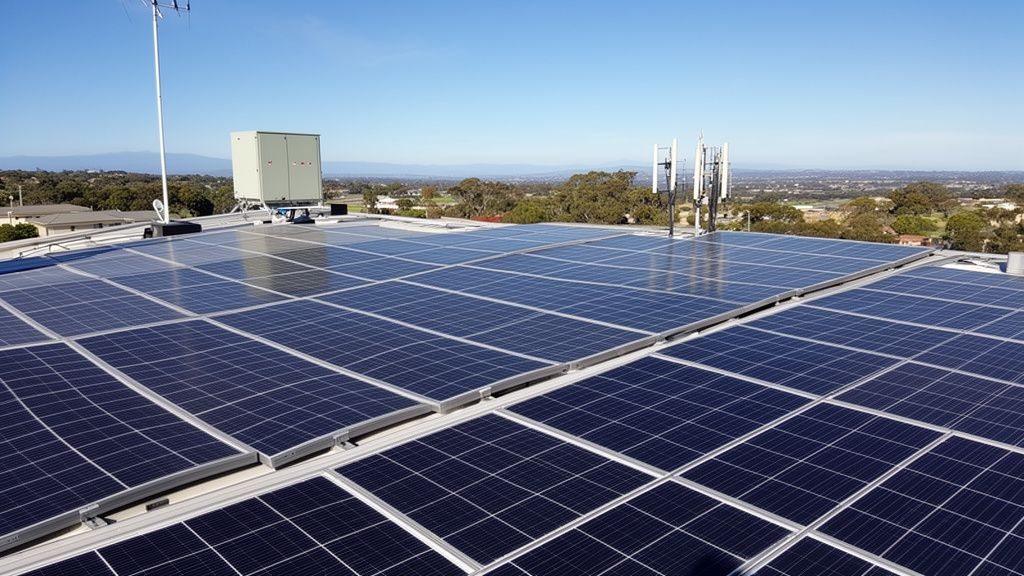
The solar array is the primary engine of an off-grid system. It must be designed to produce enough electricity to power the home's daytime loads while simultaneously generating a surplus to fully replenish the battery bank. Designing a highly optimized solar array achieves several critical goals:

- Improves winter performance: Ensuring the home has sufficient generation during short, overcast winter days.
- Recharges the battery faster: Maximizing solar generation windows to return the battery bank to full charge early in the day.
- Reduces generator use: Minimizing the reliance on fuel-powered backup generators.
- Supports more daytime appliances: Allowing high-energy tasks to be performed directly during peak production times.
- Improves recovery after cloudy weather: Quickly bringing storage levels back to normal after consecutive storm events.
- Allows flexible loads to operate directly from solar: Permitting opportunistic power use, like running a pool pump or washing machine, directly from active generation without discharging the battery.
In cases where roof space is limited or poorly oriented, ground-mounted solar arrays are considered to ensure optimal positioning and system performance.
Battery Storage: Usable Capacity and Essential Metrics
The battery bank is the heart of off-grid living, supplying electricity whenever active solar generation is insufficient or unavailable. To ensure uninterrupted power, battery capacity must support overnight consumption, early-morning electricity use, periods of cloudy weather, high-demand operational periods, essential appliances, and emergency reserve requirements.
When evaluating battery storage, system designers must focus on usable capacity rather than nameplate capacity alone. Additional technical metrics that dictate performance and long-term reliability include:
- Maximum discharge output: The peak amount of power the battery can safely deliver at any single moment.
- Battery charge rate: How quickly the battery can safely absorb incoming solar power.
- Battery temperature range: The environmental conditions in which the battery can operate efficiently without losing performance.
- Cycle life and warranty: The expected operating lifespan and manufacturer-backed support.
- Expandability: The ability to add more storage modules if household energy needs grow.
- Inverter compatibility: Ensuring seamless communication between the battery cells and the system's power inverter.
- Remote monitoring: Software tools that allow homeowners and support technicians to track battery state-of-charge and system health from anywhere.
To meet these rigorous criteria, modern lithium battery options are standard for permanent residential off-grid systems.
Integrating Automatic Generator Backup Systems
A professionally integrated backup generator provides a critical layer of safety and energy security for a permanent off-grid home. The generator is not intended to run daily; rather, it serves as a safety net during prolonged periods of bad weather, exceptional household electricity consumption, or system maintenance.
An advanced, automated control system allows the battery inverter to manage the generator directly by:
- Detecting when the battery state-of-charge drops to a low level.
- Starting the generator automatically without manual user intervention.
- Supplying power directly to the household while simultaneously recharging the battery back to a safe level.
Key Takeaways
- Sizing is Load-Driven: Off-grid systems must be engineered around individual lifestyle patterns, seasonal demands, starting currents, and specific appliance choices rather than just occupant numbers.
- Usable Capacity Matters: Sizing off-grid storage requires analyzing usable capacity, maximum discharge rates, temperature tolerances, and inverter compatibility rather than basic nameplate capacity.
- Solar Optimization: Designing a robust solar array improves winter generation, speeds up battery recharge windows, and directly powers daytime loads, reducing generator runtime.
- Automated Backup Protection: Integrating an automatic generator backup ensures long-term energy security during extended cloud cover or periods of high energy demand.
Related Guides
- The SRES Solar Battery Inspection Program: Safety, Compliance, and Industry Regulation
- Navigating Solar Feed-in Tariffs and Retailer Electricity Contracts in New South Wales
- Major Hybrid Energy and Large-Scale Solar Projects Transforming Australia's Grid
- Evaluating Residential Solar Packages: Panel Sizing, Storage Sizing, and Energy Needs