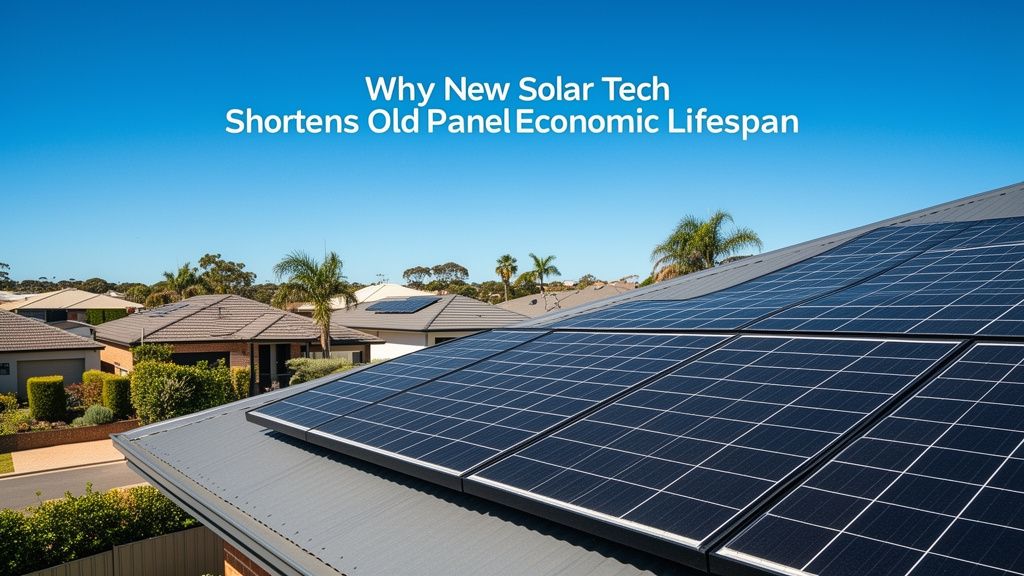
TL;DR: While solar panels boast lengthy 25-30 year performance warranties, rapid advancements in solar technology, including increased efficiency and plummeting costs, are making older, perfectly functional systems economically obsolete much sooner. For Australian homeowners, this means upgrading to a new system often provides a superior return on investment long before their existing panels physically stop working.
What Is the Traditional Expected Lifespan of an Australian Solar Panel System?
A typical solar panel system in Australia traditionally comes with a performance warranty of 25 to 30 years, guaranteeing a certain minimum output level over that period. This warranty usually stipulates that panels will still produce 80-85% of their original rated power after 25 years. While the physical components, like the silicon cells and glass, might last much longer—some panels from the 1970s are still generating electricity—their efficiency degrades naturally by about 0.5-0.7% per year. This means a 6.6kW system installed a decade ago, which might have started at 6.6kW peak output, could now only be performing at around 6.2-6.3kW, impacting your daily energy savings and the overall payback period.
Understanding Performance Warranties vs. Product Lifespan
It's crucial to distinguish between a panel's performance warranty and its product lifespan. The performance warranty, as mentioned, guarantees a certain percentage of power output over time and protects against excessive degradation. In contrast, the product warranty typically covers manufacturing defects for a shorter period, usually 10-15 years. A panel might physically endure beyond its performance warranty, but its diminishing output means it's producing significantly less energy, making it less cost-effective compared to newer, more powerful alternatives. This distinction is key to understanding when an upgrade might be more beneficial than simply waiting for a panel to "die."
The Reality of Degradation Over Two Decades
Even with panels designed to last, the cumulative effect of degradation significantly impacts financial returns. Consider a 6.6kW system installed 15 years ago, likely featuring 250W panels. With a 0.5% annual degradation, its output might be down by 7.5% today, meaning it's performing closer to 6.1kW. Over two decades, this could mean an annual loss of hundreds of kilowatt-hours (kWh) compared to its original capacity, directly translating to higher electricity bills. This reduction in performance, while expected, erodes the initial investment's value and makes the prospect of new, higher-performing technology increasingly appealing.
How Are Rapid Technological Advancements Impacting Older Solar Systems?
Rapid advancements in solar panel technology are driving down costs, increasing efficiency, and improving aesthetics, which collectively reduce the economic viability of perfectly functional older systems. The industry has seen exponential growth in efficiency, with standard panels now often exceeding 22% efficiency, compared to 15-18% for panels just 5-10 years ago. This means newer panels can generate significantly more power from the same roof space. Coupled with manufacturing innovations like PERC, N-Type, TopCon, and HJT cell technologies, the cost-per-watt has dramatically plummeted, making new systems incredibly affordable. For an Australian homeowner, this translates to more bang for their buck, faster payback periods, and greater energy independence than ever before.
The Efficiency and Cost Revolution
The solar industry has undergone a massive efficiency and cost revolution. Where a 5kW system might have required 20 standard 250W panels a decade ago, a modern 5kW system can be achieved with just 12-14 high-efficiency 400W+ panels, freeing up valuable roof space or allowing for a larger system size in the same footprint. This miniaturisation, alongside economies of scale in manufacturing, has seen the average cost of a 6.6kW system drop from around $10,000-$15,000 (after rebates) five years ago to often $5,000-$8,000 today. This significant price reduction for higher performance makes the investment in new solar incredibly attractive, even if current panels are still "working."
Aesthetic and Smart Home Integration Improvements
Beyond raw performance, new solar technology offers significant aesthetic and integration benefits that older systems simply can't match. Modern panels are often all-black, sleeker, and less obtrusive, blending seamlessly with contemporary home designs. Many new systems integrate more effectively with smart home ecosystems, allowing for detailed energy monitoring, optimisation, and even direct control via apps. Advances in inverter technology, such as micro-inverters or power optimisers, are also becoming standard, enhancing individual panel performance and making systems more resilient to shading. These features offer a level of sophistication and convenience that old systems lack, further strengthening the case for upgrading.


Is It Economically Rational to Replace an Older, Still-Functional Solar System?
It is often economically rational to replace an older, still-functional solar system because the increased efficiency and lower costs of new technology can deliver a significantly better return on investment and energy savings. While it might seem counterintuitive to replace something that still works, the financial calculus often favours an upgrade. For example, replacing a 10-year-old 5kW system that might have cost $10,000-$12,000 (after rebates) with a new, larger 6.6kW system costing $6,000-$8,000 could lead to an output increase of 30-40% for less initial outlay. This higher output, coupled with improved self-consumption and potentially better feed-in tariffs, accelerates the payback period of the new system considerably, making it a sound financial decision.
The Economics of Upgrading for Improved ROI
The return on investment (ROI) for a new solar system is often compelling enough to justify decommissioning an older one. An outdated 5kW system (with 250W panels) might be generating 5,000-6,000 kWh annually, while a modern 6.6kW system (with 400W+ panels) could easily produce 8,000-10,000 kWh in the same location. Considering average electricity prices around $0.30/kWh and current feed-in tariffs (e.g., $0.05-$0.15/kWh), that extra output translates directly to hundreds, if not thousands, of dollars in annual savings. The faster a new system pays for itself (often 3-5 years for well-sized systems), the quicker you begin reaping pure profit from your clean energy investment.
Government Rebates and the Future-Proofing Advantage
Australian homeowners upgrading their solar systems can still benefit from government incentives, such as Small-scale Technology Certificates (STCs), which effectively act as an upfront discount on the system cost. These rebates significantly reduce the initial investment, making the upgrade even more financially appealing. Furthermore, installing a new system is an opportunity to future-proof your home. Modern inverters are typically battery-ready, allowing seamless integration with home battery storage for greater energy independence. They also offer better compatibility with EV charging solutions and smart home energy management, positioning your household to benefit from emerging energy technologies and potentially higher future energy costs.
Key Takeaways
- Solar panels often have a physical lifespan exceeding their economic viability due to rapid technological advancements.
- New solar technology offers significantly higher efficiency, lower cost-per-watt, and enhanced aesthetics compared to older systems.
- Upgrading an older, still-functional solar system can yield a much faster return on investment and greater long-term savings due to increased energy output.
- Consider current government rebates like STCs and the opportunity to future-proof your home with battery-ready and smart-integrated systems when evaluating an upgrade.
Read More
For a comprehensive overview, check out our master guide: Read the Full Guide Here.


