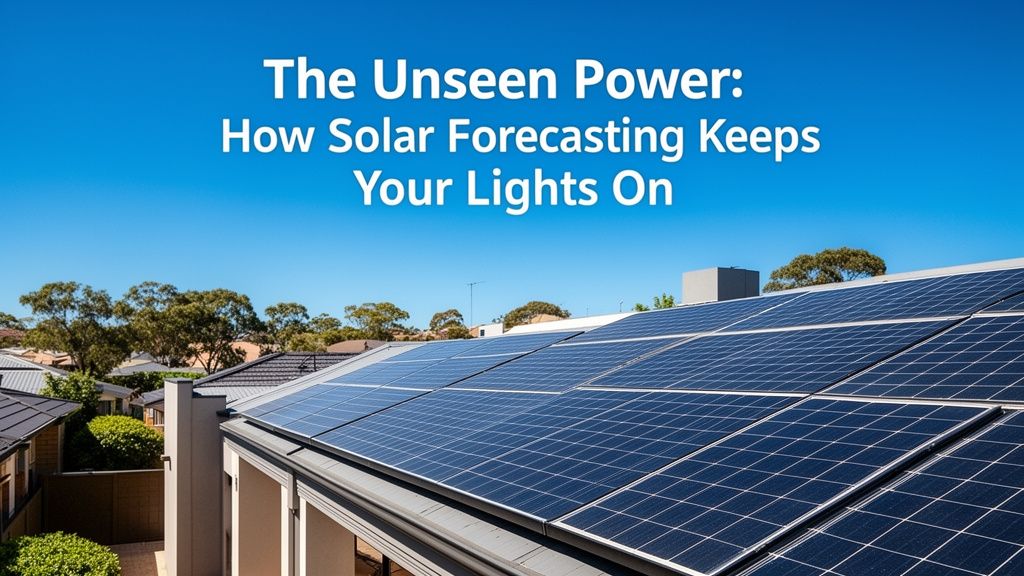
The Unseen Power: How Solar Forecasting Keeps Your Lights On
G'day, Australia! It’s no secret we’re obsessed with the sun – and increasingly, with harnessing its incredible power. Our sunburnt country leads the world in rooftop solar adoption, with over 3.6 million systems soaking up those rays. It’s a fair dinkum Aussie success story, driving down emissions and power bills for countless households and businesses.
But here’s a challenge you might not have considered: the sun, as brilliant as it is, isn’t always predictable. Clouds drift, storms brew, and night eventually falls. This variability, while natural, poses a significant hurdle for our energy grid. Imagine trying to balance a seesaw with someone constantly jumping on and off – that’s a bit like what grid operators face when managing a huge influx of intermittent solar power.
So, how do we keep the lights on, the air con humming, and the kettle boiling when the sun decides to play hide-and-seek? The answer lies in a sophisticated, often unseen technology: solar forecasting.
The Sunny Side of the Street, and Its Shadows
Australia’s vast open spaces and plentiful sunshine make it perfect for solar energy. However, this also means our grid has to handle massive swings in electricity generation. On a bright, clear day, solar farms and rooftops pump out gigawatts of power. But a sudden cloudburst, a widespread dust storm, or even a bushfire haze can drastically reduce output in moments.
These fluctuations can create headaches for grid stability. Too much sudden power can overload the system, leading to outages. Too little, and we risk blackouts. Traditionally, grid operators relied on large, controllable power stations (like gas or coal) to quickly ramp up or down to meet demand. With the growing share of solar, we need smarter ways to anticipate these changes.
What Exactly is Solar Forecasting?
At its core, solar forecasting is the art and science of predicting how much electricity solar panels will generate at a specific time and location in the future. It’s far more intricate than simply checking the weather app on your phone.
Think of it as a super-powered crystal ball for solar energy. It doesn't just say "sunny tomorrow"; it provides detailed, hourly or even minute-by-minute predictions of solar irradiance (the power of the sun’s light) and, consequently, the expected output of solar energy systems across the country.
Peering into the Future: The Tech Behind the Prediction
So, how do these wizards of watts perform their magic? Solar forecasting uses a powerful combination of technologies and data sources:
- Satellite Imagery: Geosynchronous satellites constantly beam down high-resolution images of cloud cover and atmospheric conditions. This data is crucial for tracking cloud movements and predicting their impact on ground-level solar radiation.
- Ground-Based Sensors: Networks of sensors, known as pyranometers, measure the actual solar irradiance hitting the earth's surface in real-time. This ground truth helps to calibrate and verify the satellite data and models.
- Numerical Weather Prediction Models: These are the same complex computer models the Bureau of Meteorology (BOM) uses to predict general weather patterns. Solar forecasting integrates these models, focusing specifically on elements that affect solar generation, such as cloud opacity, aerosol content, and temperature.
- Artificial Intelligence and Machine Learning: This is where things get really clever. AI algorithms analyse historical solar generation data, weather patterns, and actual grid behaviour to identify subtle patterns and improve prediction accuracy over time. They can learn from past mistakes and refine forecasts in real-time, adapting to local microclimates and specific plant characteristics.
- Real-Time Data Integration: All these data streams are continuously fed into powerful computers that run complex algorithms, allowing for constant updates and refinements of forecasts, from a few minutes ahead to several days in advance.
Why This Aussie Innovation Matters for Your Power Bill (and Your Cuppa)
Solar forecasting isn't just an interesting scientific endeavour; it's a critical tool for maintaining a reliable and affordable energy supply in Australia. Here's why it directly impacts you:


- Grid Stability and Preventing Blackouts: By accurately predicting solar output, grid operators (like the Australian Energy Market Operator, AEMO) can anticipate periods of low or high solar generation. This allows them to proactively adjust the output from other power sources, like gas turbines or hydro dams, to ensure a constant, stable supply of electricity. This reduces the risk of imbalances that can lead to costly and inconvenient blackouts.
- Optimising Energy Dispatch: Knowing when the sun will shine brightest means operators can make smarter decisions about when to fire up traditional power plants or when to schedule maintenance. This avoids unnecessary starts and stops of fossil fuel generators, saving fuel and reducing operational costs.
- Smarter Battery Management: As more homes and businesses install batteries, and as large-scale battery projects come online, solar forecasting becomes essential. It helps determine the optimal times to charge batteries (when solar is abundant and cheap) and discharge them (when solar drops and demand is high), maximising their value and efficiency.
- Lower Wholesale Prices: By allowing for more efficient grid management and better integration of renewable energy, solar forecasting helps to smooth out price volatility in the wholesale electricity market. These savings can, over time, translate into more stable or even lower retail power bills for consumers.
- Enabling More Renewables: Ultimately, accurate solar forecasting gives grid operators the confidence to integrate even more solar power into our national energy mix. It’s a key enabler for Australia’s transition to a cleaner, more sustainable energy future.
The Future is Bright: Australian Leadership in Solar Forecasting
Australia is at the forefront of solar forecasting research and deployment, with organisations like CSIRO and the BOM continually refining models and technologies. As our energy grid evolves with more renewables, battery storage, and smart home systems, solar forecasting will become even more sophisticated and integrated. It’s an exciting example of how cutting-edge technology is solving real-world problems and quietly supporting our modern way of life.
Keeping the Lights On, One Forecast at a Time
So, the next time you flick on a switch and the lights glow, spare a thought for the unseen power working behind the scenes. Solar forecasting, with its intricate dance of satellites, sensors, and supercomputers, is the silent hero ensuring that Australia's abundant sunshine translates into reliable, affordable power for everyone. It’s helping us navigate the challenges of a renewable future, one predicted ray of sunshine at a time.
Read More
For a comprehensive overview, check out our master guide: Read the Full Guide Here.