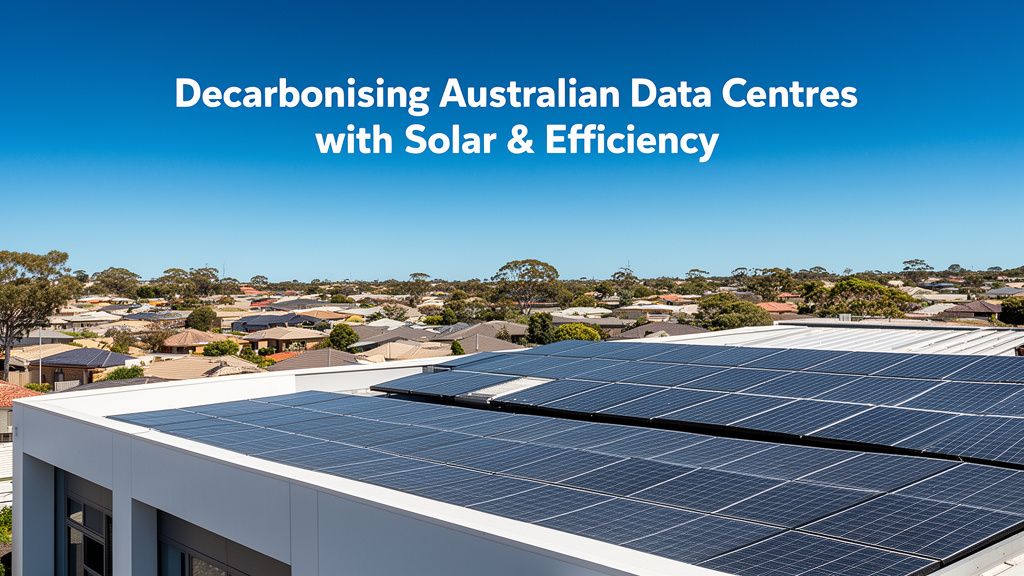
TL;DR: Data centres are massive energy consumers globally and in Australia, contributing significantly to carbon emissions and water usage. Transitioning these facilities to renewable energy sources like solar, alongside implementing advanced cooling and hardware efficiency, is crucial for drastically reducing their environmental footprint and achieving a sustainable digital future.
Why Are Data Centres a Major Environmental Concern in Australia?
Data centres are significant energy consumers, contributing substantially to Australia's carbon emissions due to their continuous operation and intensive cooling demands. These digital powerhouses, which underpin everything from streaming services to cloud computing, often run 24/7, requiring vast amounts of electricity. In Australia, where a significant portion of our grid still relies on fossil fuels, this translates directly into a large carbon footprint for every gigabyte of data processed or stored. Beyond electricity, the sheer scale of modern data centres presents challenges related to water consumption for cooling and the accumulation of electronic waste. As our reliance on digital infrastructure grows, so too does the imperative to address these environmental impacts proactively, especially in a country with abundant renewable resources like ours.
The Energy Guzzlers of the Digital Age
The continuous operation of servers, storage systems, and network equipment within data centres demands colossal amounts of electricity. A typical large data centre can consume as much power as a small town, with some hyperscale facilities drawing hundreds of megawatts. In Australia, an average commercial data centre might pay upwards of $200,000 to $500,000 per month on electricity bills, reflecting their intense power needs. This energy isn't just for computing; a substantial portion, often around 30-50%, is used for cooling to prevent equipment from overheating. This constant energy draw, especially when sourced from a grid still heavily reliant on coal-fired power stations, makes data centres a key contributor to greenhouse gas emissions, directly contradicting Australia's climate targets.
Water Consumption and E-Waste Challenges
Beyond electricity, data centres are also significant consumers of water, primarily for cooling purposes. Many facilities use evaporative cooling systems or rely on municipal water supplies to chill their hardware, with some larger centres consuming millions of litres annually – comparable to the water use of thousands of Australian households. This puts pressure on local water resources, particularly in drought-prone regions. Furthermore, the rapid obsolescence of IT hardware leads to a substantial e-waste problem. Servers, storage units, and networking gear are frequently upgraded, generating tonnes of electronic scrap containing hazardous materials that require careful disposal. This cycle of consumption and disposal underscores the need for more sustainable hardware lifecycles and recycling initiatives within the industry.
How Can Australian Solar Energy Power Data Centres More Sustainably?
Australian solar energy offers a direct pathway to decarbonising data centre operations by providing a clean, renewable power source for their intensive energy needs. Given Australia's abundant sunshine, leveraging solar power is a natural and highly effective solution for data centres aiming to reduce their environmental footprint and achieve energy independence. By integrating solar energy, either through direct ownership of solar farms or long-term power purchase agreements (PPAs), data centres can significantly cut their reliance on grid electricity, lower operational costs in the long run, and demonstrate a strong commitment to sustainability. This transition not only reduces carbon emissions but also provides price stability against fluctuating energy markets, a valuable benefit for businesses with such high energy demands.
On-site Solar Farms and PPAs
Data centres can directly invest in large-scale solar farms, either on-site if space allows, or at nearby locations, to supply their power needs. For instance, a medium-sized data centre consuming 5MW could require a solar farm spanning roughly 10-15 hectares, with an upfront cost potentially ranging from $5 million to $10 million for the solar array alone, depending on scale and location. Alternatively, and more commonly for large facilities, entering into long-term Power Purchase Agreements (PPAs) with utility-scale solar projects is an effective strategy. Under a PPA, the data centre commits to buying electricity from a solar farm at a fixed rate for 10-20 years, securing renewable energy credits and often hedging against future electricity price rises. This approach allows them to benefit from solar energy without the large upfront capital expenditure of owning a power plant.
Battery Storage for Grid Stability
Integrating battery energy storage systems (BESS) is crucial for maximising the benefits of solar power for data centres, ensuring a consistent and reliable electricity supply. Solar power generation is intermittent, peaking during the day and ceasing at night. Large-scale battery storage solutions, such as those utilising lithium-ion technology, can store excess solar energy generated during off-peak demand or high generation periods and discharge it when solar output is low or demand is high. This not only provides a continuous supply of clean energy but also enhances grid stability for the data centre, reducing reliance on the traditional grid and fossil fuel backup generators. For a 5MW data centre, a substantial battery system could cost several million dollars, but it offers critical resilience and further decarbonisation opportunities.


What Operational Efficiencies Can Reduce Data Centre Environmental Impact?
Optimising operational efficiencies, such as advanced cooling systems and server virtualisation, can drastically lower a data centre's energy consumption and environmental footprint. These strategies focus on getting more computing power out of less energy and reducing the need for intensive cooling, which is often the second-largest energy consumer after the IT equipment itself. By embracing innovations in hardware, software, and physical infrastructure, data centres can achieve significant energy savings, translating into lower operating costs and a reduced environmental impact. This holistic approach ensures that not only is the energy source clean, but the energy itself is used as efficiently as possible, making the entire operation greener and more cost-effective in the long term.
Advanced Cooling Techniques
Cooling infrastructure accounts for a substantial portion of a data centre's energy consumption. Traditional air conditioning is energy-intensive. Modern data centres are increasingly adopting advanced cooling techniques to improve efficiency. These include liquid cooling (direct-to-chip or immersion cooling), which is up to 4,000 times more efficient at heat removal than air. Free cooling, utilising Australia's cooler ambient air temperatures during certain seasons, can also dramatically reduce energy use. Hot aisle/cold aisle containment strategies are another simple yet effective method, separating hot exhaust air from cold intake air to prevent mixing and improve cooling efficiency by up to 20-30%. Implementing these solutions can reduce cooling energy needs by 30% or more, resulting in significant operational savings.
Hardware Optimisation and Virtualisation
Maximising the efficiency of the IT hardware itself is fundamental to reducing a data centre's environmental impact. This involves upgrading to more energy-efficient server technologies, which can perform more computations per watt of electricity. Server virtualisation is another powerful tool, allowing multiple virtual servers to run on a single physical machine. This reduces the number of physical servers required, thereby cutting down on electricity consumption for both computing and cooling, and freeing up valuable rack space. Regular auditing of server utilisation to power down or decommission 'ghost servers' – idle equipment still drawing power – can also yield substantial energy savings. By intelligently managing hardware and software, data centres can achieve a higher computing output with a smaller physical and environmental footprint.
Key Takeaways
- Prioritise direct investment in on-site or nearby solar farms or long-term Power Purchase Agreements (PPAs) to power data centres with clean, renewable energy.
- Integrate large-scale battery storage systems (BESS) with solar installations to ensure continuous power supply and enhance grid resilience.
- Implement advanced cooling technologies like liquid cooling, free cooling, and hot/cold aisle containment to drastically reduce energy consumption for temperature regulation.
- Optimise IT infrastructure through regular hardware upgrades to energy-efficient models and extensive use of server virtualisation to maximise computing power per watt.
- Conduct frequent audits of server utilisation to identify and decommission idle equipment, further reducing unnecessary power draw and e-waste.
Read More
For a comprehensive overview, check out our master guide: Read the Full Guide Here.