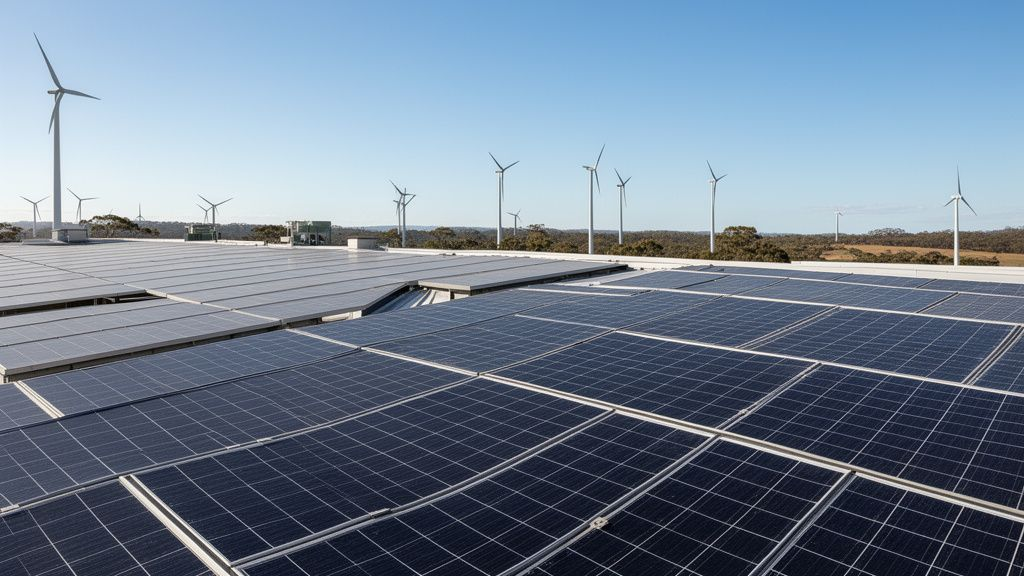
TL;DR: While Australia added a record-breaking 9.1 gigawatts of grid capacity in the 2025/26 financial year, more than half of this was represented by big battery projects. New wind and solar generation capacity fell well short of the levels required to meet the federal government's 82 percent renewable target by 2030, hampered by late-stage project design changes, financing delays, and a lack of firm commercial contracts.
Battery Boom vs. Generation Shortfall
The Australian Energy Market Operator's (AEMO) latest Connections Scorecard highlights a stark contrast in the country's energy transition. In the 2025/26 financial year, a record 9.1 gigawatts (GW) of new generation and storage capacity reached full output on the national grid—more than double the capacity added in the previous year.
However, the composition of these additions reveals a major imbalance:
- Battery Storage: Accounted for more than half of the new capacity, coming in at just over 5 gigawatts.
- Wind and Solar Generation: Accounted for less than 4 gigawatts of the additions.
While big batteries and solar-battery hybrids are expanding rapidly, the low volume of new wind and solar generation is insufficient to meet the federal target of 82 percent renewable energy by 2030. Without a massive acceleration in actual electricity generation, Australia will struggle to safely close its aging coal-fired power stations on schedule.
Project Pipeline and Connection Delays
There is substantial interest in developing new renewable projects, as reflected in a growing connections pipeline, which expanded by 42 percent from 53 GW to 75.4 GW over the year. Wind energy, which has historically struggled with rising development costs, planning issues, grid transmission limits, and social licence challenges, showed signs of recovery. AEMO received a record-breaking 12 wind project applications during the year, totaling 5.2 GW of capacity.
However, actual registration and application approvals fell compared to the previous year, dropping to 7.4 GW and 14.2 GW respectively, with battery storage continuing to dominate these figures.


Margarida Pimentel, AEMO's General Manager of Onboarding and Connections, explained that modern project delays are rarely caused by the structural connection process itself. Instead, developers are stalling their own progress through late-stage project modifications. These include mid-process design changes, equipment and supplier substitutions (which require AEMO to perform technical re-assessments), project ownership transfers, extended financing discussions, and delays in achieving commercial readiness.
Commercial Obstacles and Coal Dependencies
Beyond technical approvals, energy market analysts emphasize that the single largest barrier to building new generation is the difficulty developers face in securing firm electricity purchase contracts. Very few retail utilities or corporate buyers are currently entering the market to purchase large-scale renewable power.
While underwriting frameworks like the federal Capacity Investment Scheme and various state-level initiatives provide safety nets, they are not designed to finance projects fully without an accompanying utility or corporate buyer. Established electricity utilities have little financial incentive to sign these contracts. If a lack of new wind and solar generation prevents the safe closure of coal plants, these utilities' legacy coal-fired generators will likely receive government payments to remain open longer to ensure grid reliability. While rising energy demand from data centres represents a potential source of future commercial demand, this segment remains highly speculative.
Key Takeaways
- Storage Dominance: More than 5 GW of the record 9.1 GW added to the grid in 2025/26 was battery storage, leaving generation behind.
- Target in Jeopardy: Less than 4 GW of new wind and solar was added, a rate far too slow to meet the federal 82% renewable target by 2030.
- Process Delays: Margarida Pimentel of AEMO notes that late-stage project changes, equipment swaps, and financing delays are the primary causes of connection delays.
- Contractual Standstill: A lack of corporate power purchase agreements is stalling projects, as legacy utilities benefit financially from keeping coal plants online longer.