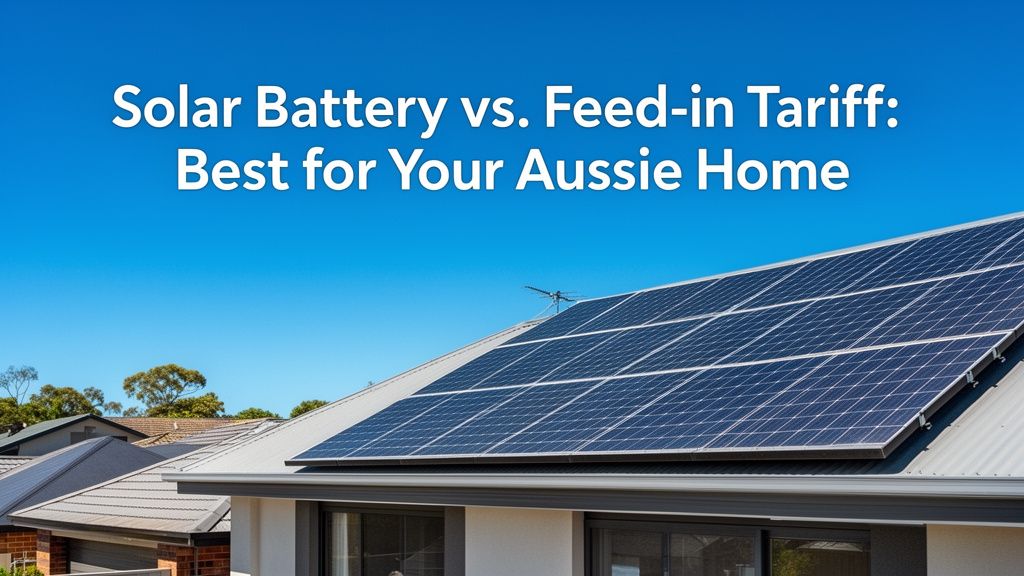
What's Best: Solar Feed-in Tariffs or Battery Charging for Your Home?
TL;DR: For most Australian homes with solar, charging a battery offers better financial returns than exporting excess power for a Feed-in Tariff (FiT). This is because current FiT rates are typically much lower than the price you pay for grid electricity, making self-consumption via a battery more valuable. Your household's energy use patterns, particularly during peak times, largely determine the best strategy.
How do solar Feed-in Tariffs work in Australia today?
Solar Feed-in Tariffs (FiTs) provide a credit on your electricity bill for any excess solar power your system exports back to the grid. When your solar panels generate more electricity than your home uses at that moment, the surplus automatically flows into the local grid. Your electricity retailer then pays you a set rate per kilowatt-hour (kWh) for that exported energy. These rates vary significantly by state and retailer, and they have changed a lot over the years.
In many states, minimum FiT rates exist, like the Independent Pricing and Regulatory Tribunal (IPART) setting a benchmark for NSW retailers. For instance, the IPART benchmark for 2023-24 was 6.9-8.4c/kWh, though many retailers offer slightly more or less. Victorian FiT rates are generally low, often around 3-5c/kWh for a flat rate, with some retailers offering a "time-varying" FiT that pays more during peak export times, such as late afternoon. Queensland and South Australia also see various rates, usually sitting in the 5-12c/kWh range, depending on the retailer and specific plan. These rates are a far cry from the generous FiTs of 40-60c/kWh that were common in the early days of solar, which largely subsidised rapid solar adoption. Today, FiTs simply represent a wholesale price for electricity.
When do solar batteries provide more value for Australian homeowners?
Solar batteries provide significant value by allowing you to store surplus solar generation and use it later, rather than exporting it for a low FiT. This strategy becomes particularly beneficial for homes with high electricity consumption in the evenings or those on time-of-use (ToU) electricity tariffs. Under a ToU tariff, electricity prices peak during specific hours, typically 2pm-8pm, where you might pay 35-50c/kWh or more for grid power. Off-peak rates, often through the night, can drop to 15-20c/kWh. By storing solar power generated during the day and discharging it during peak evening hours, a battery directly offsets expensive grid imports.
Consider a Perth home paying 40c/kWh during evening peak. If their solar panels produce 5kWh of excess power at midday, they could export it for, say, 7c/kWh (earning 35 cents). Alternatively, they could store that 5kWh in a battery and use it during the evening peak, avoiding a $2.00 grid import charge. The battery provides a much larger saving. Beyond financial returns, batteries offer energy independence, reducing reliance on the grid, and provide blackout protection for essential circuits if the system is set up for it. Battery costs range from $10,000 to $18,000 installed for common sizes like 10-13.5kWh, with a typical lifespan of 10-15 years.
How do you decide between exporting surplus and storing it?
Deciding between exporting excess solar power for a FiT and storing it in a battery comes down to a simple comparison: the value of the FiT versus the cost you avoid by not buying electricity from the grid. For most Australian households today, the cost of grid electricity, especially during peak periods, significantly outweighs the income from FiTs. For example, if you pay 30c/kWh for grid electricity and receive 8c/kWh for exported solar, every kilowatt-hour you store and use yourself saves you 30c, while exporting only earns you 8c. Storing and using that power yourself is clearly more financially advantageous.
An ideal scenario for a battery involves a household with high evening energy demand (e.g., air conditioning, cooking, electric vehicle charging after work) and a retailer offering a ToU tariff. In this case, the battery acts as a hedge against expensive peak power, turning otherwise low-value export into high-value self-consumption. For homes with very low electricity consumption, or those where most energy use happens during daylight hours when solar is generating, a battery's payback period might extend. However, even these homes often find value in a battery by offsetting the minimal evening usage at peak rates or securing backup power. It's crucial to analyse your specific energy usage patterns and your retailer's current FiT and import rates to calculate the most effective strategy for your home.
Key Takeaways
- Current Feed-in Tariffs in Australia are generally low, often 5-10c/kWh, making direct export less financially attractive.
- Solar batteries maximise savings by allowing you to self-consume your solar power, avoiding expensive grid electricity purchases, especially during peak times.
- Homes on Time-of-Use tariffs or with high evening energy use benefit most from a solar battery.
- To make the best decision, compare your electricity import rate (particularly peak rates) against your retailer's Feed-in Tariff.
- A battery offers added benefits like energy independence and blackout protection, beyond just financial returns.
Read More
For a comprehensive overview, check out our master guide: Read the Full Guide Here.