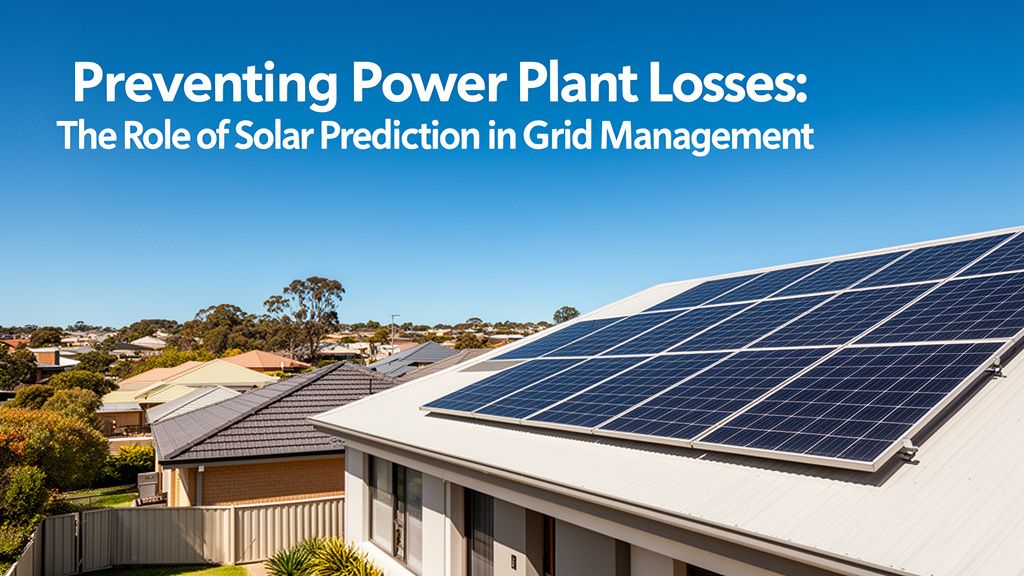
Preventing Power Plant Losses: The Role of Solar Prediction in Grid Management
Australia, the sunburnt country, is rapidly becoming the solar-powered country. With more rooftop solar per capita than almost anywhere else in the world, and massive utility-scale solar farms sprouting across the landscape, our embrace of renewable energy is a source of national pride. This solar revolution, however, brings with it a unique set of challenges for the National Electricity Market (NEM) and the Australian Energy Market Operator (AEMO). The sun doesn't shine constantly, and clouds can sweep in unexpectedly, leading to fluctuations in solar output. Managing these fluctuations effectively is crucial to preventing what we call "power plant losses" – not just physical damage, but significant inefficiencies and wasted potential. This is where cutting-edge solar prediction technology steps in, acting as the grid's crystal ball to maintain stability and lower costs.
The Sunny Challenge: Australia's Solar Boom Meets Grid Stability
Our continent's love affair with solar is undeniable. Millions of Australian homes boast rooftop panels, generating clean electricity and saving homeowners on their power bills, sometimes by hundreds of dollars annually. Large-scale solar projects contribute gigawatts to the grid, pushing down wholesale electricity prices during sunny periods. Yet, this very success highlights a key challenge: intermittency. Unlike coal or gas power stations that can generate electricity on demand, solar output is beholden to the weather. A sudden bank of clouds passing over a major solar farm or numerous residential rooftops can cause a rapid drop in generation, known as a "ramp event." Conversely, clouds clearing can cause a sudden surge. These unpredictable shifts create significant headaches for grid operators who must continuously balance supply and demand to maintain system stability and prevent blackouts.
What Exactly Are "Power Plant Losses"?
When we talk about "power plant losses" in this context, we're not primarily referring to equipment malfunction or physical damage (though those can certainly occur). Instead, it encompasses a broader range of economic and operational inefficiencies driven by the unpredictable nature of renewable energy:
- Curtailment of Renewable Energy: This is perhaps the most frustrating "loss." When there's too much solar generation and not enough demand, or insufficient transmission capacity, AEMO may be forced to "curtail" or switch off renewable generators to prevent grid overload. This means clean, cheap energy is literally wasted, a direct loss of potential.
- Inefficient Operation of Traditional Generators: To compensate for sudden drops in solar, gas or coal-fired power stations might need to quickly ramp up or down. Operating these plants outside their optimal efficiency range consumes more fuel, increases emissions, and shortens their operational lifespan – a significant economic and environmental loss.
- Activation of Costly Reserve Capacity: When generation drops unexpectedly, AEMO must tap into expensive "reserve" power from quick-start gas peaker plants or demand response programs. These services come at a premium, adding millions of dollars annually to system operating costs, ultimately borne by consumers.
- Increased Ancillary Services Costs: Maintaining grid frequency and voltage stability (known as ancillary services) becomes more complex and expensive with high renewable penetration and unpredictability.
Enter the Forecasters: How Solar Prediction Works
Solar prediction is the sophisticated technological answer to these challenges. It involves using a combination of advanced techniques to forecast solar output with increasing accuracy, from minutes ahead to days in advance.


- Weather Models and Satellite Imagery: At its core, solar prediction relies on highly detailed meteorological forecasts. This includes cloud cover, air temperature, humidity, and wind speed. Geostationary satellites provide continuous, real-time images of cloud movements across vast areas, allowing for immediate updates on expected irradiance.
- Historical Data and Machine Learning: Vast datasets of past solar generation, coupled with historical weather patterns, are fed into complex machine learning (ML) algorithms. These algorithms learn the intricate relationships between weather variables and actual solar output, enabling them to make increasingly precise predictions.
- Site-Specific Data: For large-scale solar farms, on-site sensors provide real-time data on irradiance, temperature, and actual power output, further refining the models for specific locations.
- Multi-Horizon Forecasting: Predictions are generated for various timescales: ultra-short-term (minutes to an hour for immediate operational adjustments), short-term (hours to a day for unit commitment and dispatch), and medium-term (days ahead for maintenance scheduling and market bidding).
The Grid's Crystal Ball: Benefits of Solar Prediction
The benefits of accurate solar prediction are transformative for Australia's energy grid, helping to mitigate those "power plant losses" and pave the way for a cleaner, more reliable future:
- Optimising Traditional Generators: With better forecasts, AEMO can more accurately schedule the ramping up or down of conventional power plants. This allows them to operate closer to their most efficient points, saving fuel, reducing emissions, and avoiding costly stress on equipment. Imagine saving millions in fuel costs across the NEM annually due to more precise scheduling.
- Minimising Renewable Curtailment: By knowing when solar generation is likely to surge or drop, grid operators can better manage transmission flows and coordinate with demand response programs, reducing the instances where clean solar energy has to be switched off. This ensures we maximise the use of our renewable assets, delivering more green power to homes and businesses.
- Enhancing Grid Resilience and Stability: Accurate predictions reduce the risk of sudden supply-demand imbalances that can lead to grid instability or even blackouts. By having a clearer picture of future supply, AEMO can pre-emptively deploy resources, ensuring a more stable and reliable electricity supply for all Australians.
- Saving Dollars for Everyone: Reduced reliance on expensive reserve power, more efficient operation of traditional plants, and less curtailment of cheap renewable energy all contribute to lower wholesale electricity prices. These savings ultimately flow through to consumers, helping to keep our energy bills manageable. It's estimated that improved forecasting can save the Australian energy market tens of millions of dollars each year by avoiding unnecessary services and inefficiencies.
- Facilitating Greater Renewable Integration: Ultimately, robust solar prediction is a key enabler for integrating even higher levels of renewable energy into the grid. It provides the confidence and tools necessary for AEMO to manage an increasingly complex and dynamic energy system, accelerating Australia's transition to a sustainable energy future.
Looking Ahead: The Future is Bright and Predictable
As Australia continues its world-leading adoption of solar power, the sophistication of solar prediction technologies will only grow. Investments in better satellite imagery, more powerful AI models, and real-time data integration are crucial. With every improvement in forecasting accuracy, we move closer to a grid that seamlessly integrates vast amounts of renewable energy, minimises waste, and delivers reliable, affordable, and clean power to every Australian. The future of our energy system isn't just sunny; it's increasingly predictable, preventing costly "losses" and lighting the way forward.
Read More
For a comprehensive overview, check out our master guide: Read the Full Guide Here.