How Electrification at Home Boosts Australia's National Security
TL;DR: Electrifying your home with solar and battery storage directly contributes to Australia's national security by reducing reliance on volatile fossil fuel imports and strengthening the resilience of our national energy grid. This shift empowers individual households to become part of a more secure and independent energy future, while also offering significant personal economic benefits.
Why Are Geopolitical Tensions Driving Australia Towards Energy Independence?
Geopolitical tensions and the inherent volatility of global fossil fuel markets are unequivocally pushing Australia towards greater energy independence. Australia, despite being a significant exporter of coal and gas, still relies on international markets for its liquid fuel needs and is exposed to global price fluctuations that impact domestic energy costs. Events like conflicts in key shipping lanes or disruptions in major oil-producing regions can quickly escalate prices and threaten supply chains, making a nation less secure. Investing in renewable energy and electrifying our homes reduces this external dependency, protecting our economy and critical services from international shocks.
Global Energy Volatility and Australia's Exposure
The price of petrol at the bowser or your quarterly electricity bill can often be a direct reflection of global instability. When international oil prices spike due to geopolitical events, Australian households and businesses feel the pinch directly, impacting everything from transport costs to manufacturing expenses. This financial vulnerability underscores a significant national security risk, as a reliant energy system can be leveraged or disrupted by external forces. By shifting to domestically generated clean energy, Australia mitigates its exposure to these unpredictable global markets, ensuring more stable and predictable energy costs for its citizens.
Reducing Reliance on Foreign Energy Sources
True energy independence means minimising a nation's reliance on external sources for its power needs, particularly those with unstable geopolitical landscapes. For Australia, this primarily involves transitioning away from fossil fuels, which are often subject to international pricing, and embracing abundant local renewable resources like solar and wind. Every rooftop solar system installed and every electric vehicle purchased reduces the collective demand for imported fuels, keeping more Australian dollars within the economy and strengthening our domestic energy supply chain. This distributed energy model makes our entire nation less susceptible to foreign pressures and economic blackmail.
How Does Residential Solar Directly Contribute to Australia's National Security?
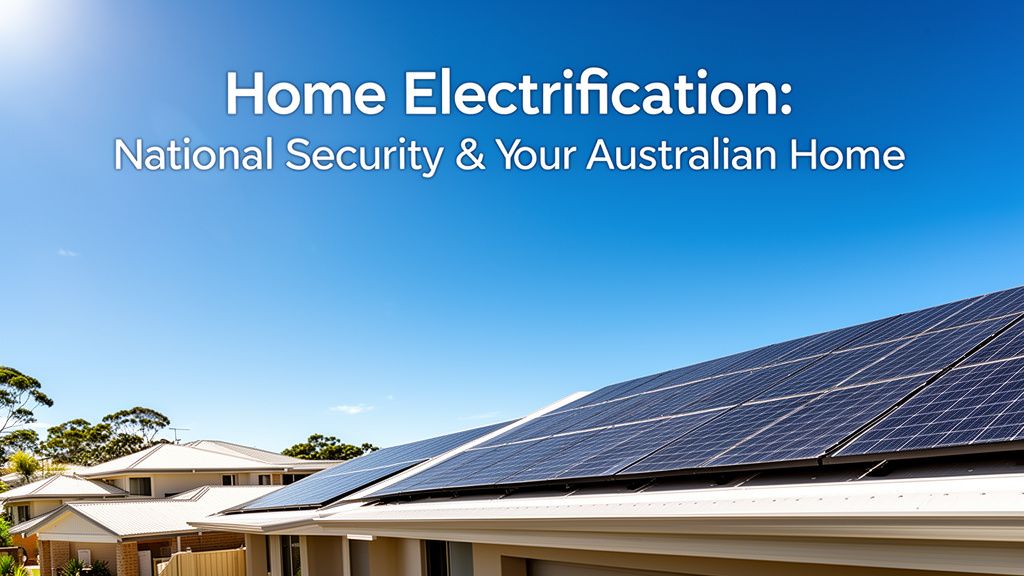
Installing residential solar directly enhances national security by decentralising energy production and significantly reducing reliance on large, vulnerable infrastructure. Instead of solely depending on a few large power plants and a centralised grid that can be targeted or disrupted, millions of individual homes with solar panels create a resilient, distributed network. This 'power to the people' approach means that even if a major part of the traditional grid faces issues, localised solar generation can continue to provide power, ensuring essential services and community resilience are maintained.
Decentralising the Grid and Enhancing Resilience
A centralised energy grid, while efficient in many ways, presents a single point of failure risk; a major outage at a large power station or a significant transmission line fault can plunge vast areas into darkness. Residential solar, especially when coupled with battery storage, fundamentally changes this dynamic by creating thousands of smaller, independent power generators. This decentralised model provides crucial redundancy, meaning that local communities can maintain power even during broader grid failures. It makes our energy infrastructure inherently more robust and less susceptible to natural disasters, cyber-attacks, or other threats that could compromise a centralised system.
Reducing Energy Imports and Protecting the Economy
Beyond grid resilience, residential solar directly contributes to national security by reducing our nation's overall energy import requirements. While Australia exports fossil fuels, we still import significant amounts of refined petroleum products. Every kilowatt-hour generated by a rooftop solar system offsets demand that might otherwise be met by energy sources dependent on global supply chains. This shift lessens our economic exposure to fluctuating international commodity prices, strengthens the Australian dollar, and ensures that more of our national wealth remains within the country, fostering local jobs and economic stability.
What are the Economic and Practical Benefits of Electrifying Your Home?
Electrifying your home with solar and batteries offers significant economic and practical benefits, making it a compelling choice for Australian households well beyond the national security implications. Homeowners can expect substantial reductions in their ongoing energy bills, increased property value, and a reduced carbon footprint, all while gaining greater independence from grid outages and fluctuating energy prices. For many, the financial savings over the lifetime of a solar system are a primary motivator, often seeing payback periods of 3-7 years on an initial investment.
Lowering Your Household Energy Bills
One of the most immediate and tangible benefits of home electrification, particularly with solar power, is the dramatic reduction in household energy bills. A typical 6.6kW solar system, which might cost between $5,000 and $8,000 after government incentives (like the STCs), can generate enough electricity to offset a significant portion, if not all, of an average Australian household's electricity consumption. This translates to potential savings of $1,500 to $2,500 per year, depending on your location and consumption patterns. Pairing this with a home battery, costing an additional $8,000-$15,000, allows you to store excess solar energy for use at night, further maximising savings and minimising reliance on expensive grid power.
Future-Proofing Your Home Against Energy Price Shocks
Electrifying your home provides a powerful hedge against future energy price increases, a critical practical benefit in Australia's volatile energy market. Once your solar system is installed, the "fuel" (sunlight) is free, making your household less susceptible to the upward creep of electricity tariffs or unexpected price hikes driven by external market forces. With a battery, you can even engage in 'peak shifting', drawing power from your battery during expensive peak demand times and recharging it with cheaper off-peak or self-generated solar power. This level of energy autonomy provides peace of mind and predictable energy costs for decades to come, protecting your family's budget.
Key Takeaways
- Electrifying your home directly enhances Australia's national security by strengthening energy independence and grid resilience.
- Residential solar reduces national reliance on volatile global fossil fuel markets, protecting the economy from international shocks.
- Decentralised energy generation from rooftop solar makes the national grid more robust against disruptions and outages.
- Home electrification offers significant financial benefits, including lower energy bills and protection against future price increases.
- Government incentives, like STCs, make solar and battery adoption more affordable for Australian homeowners.
Read More
For a comprehensive overview, check out our master guide: Read the Full Guide Here.