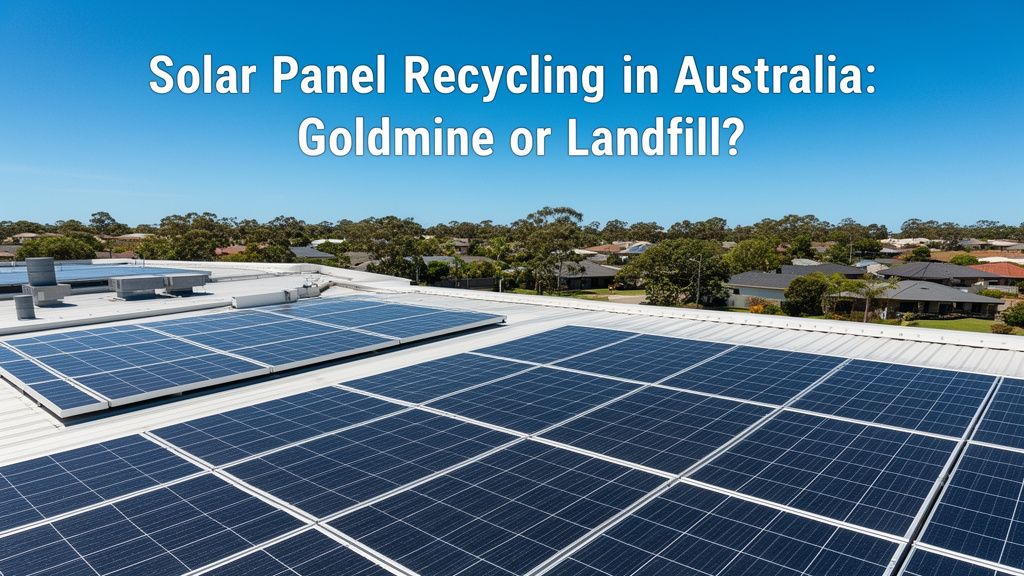
TL;DR: While old solar panels contain valuable materials, the current economic reality in Australia often makes them a landfill burden rather than a goldmine for individual homeowners. However, evolving recycling infrastructure and increasing industry awareness are slowly shifting the landscape, aiming for more sustainable end-of-life solutions.
Australia Faces a Growing Challenge with End-of-Life Solar Panels
Australia is accumulating a significant amount of end-of-life solar panels, with current recycling rates lagging behind installation booms, leading to a looming waste management issue. With millions of solar panels installed across the country over the last decade, many are now approaching or have exceeded their typical 15-25 year lifespan. This creates a massive stream of electronic waste that, if not managed properly, will overwhelm landfills and waste valuable resources. The challenge lies in developing cost-effective and accessible recycling pathways for this complex waste stream.
How Many Panels Are Approaching End-of-Life?
The early 2010s saw a massive boom in solar installations across Australian rooftops, driven by generous government incentives and falling panel prices. Many of these systems, particularly those installed between 2010 and 2015, are now hitting the 10-15 year mark, meaning the first significant wave of panel replacements is imminent. Experts predict that by 2030, Australia could face a cumulative total of over one million tonnes of solar panel waste, highlighting the urgency of establishing robust recycling solutions before the problem escalates. The sheer volume makes it a national concern.
Why Isn't Recycling Widespread Yet?
The primary hurdles to widespread solar panel recycling in Australia include high processing costs, a lack of dedicated large-scale facilities, and inconsistent collection infrastructure. Unlike general e-waste, solar panels require specialised processes to separate their composite materials, which is currently more expensive than sending them to landfill. Furthermore, without a mandatory national producer responsibility scheme, the onus and cost often fall on the homeowner or installer, creating disincentives for proper disposal. This economic imbalance needs to be addressed through policy and innovation.
Do Old Solar Panels Contain Valuable Materials Worth Recovering?
Old solar panels contain a variety of materials, including valuable metals like silver and copper, as well as silicon, glass, and aluminium, though their recovery value for individual homeowners is often minimal due to processing costs. These components, if efficiently separated and processed, can be reintroduced into manufacturing supply chains, reducing the need for virgin materials and mitigating environmental impact. However, the complex layered structure of a typical PV panel makes this separation technically challenging and expensive on a commercial scale.
The Anatomy of a PV Panel
A standard crystalline silicon solar panel is a sophisticated sandwich of materials. It typically comprises over 60-70% glass, followed by an aluminium frame (around 10%), silicon solar cells (about 3-5%), and smaller amounts of copper wiring, silver contacts, and ethylene-vinyl acetate (EVA) encapsulant. The glass and aluminium are relatively easy to recycle, but the silicon cells, with their tiny amounts of silver and copper, are encased in layers of plastic (EVA) that are difficult to separate without specialised thermal or chemical processes.
Economic Realities of Material Recovery
While silver, copper, and even silicon have market value, the cost to extract them from a disassembled solar panel often outweighs their recovered worth. Current recycling methods can range from simple shredding and material separation to more advanced thermal or chemical processes that aim to recover higher purity materials. For Australian homeowners, the typical cost to recycle a single panel can range from $20 to $50, primarily covering collection, transport, and initial processing. This cost is a significant disincentive when landfilling might be cheaper, even with potential fees.
Landfilling Old Solar Panels Poses Significant Environmental Risks
Disposing of solar panels in landfills contributes to environmental pollution through the potential leaching of heavy metals and precious materials into soil and groundwater, occupying valuable landfill space. While modern solar panels are generally considered safe during operation, their end-of-life disposal can release trace amounts of hazardous substances like lead and cadmium (found in older panels or thin-film technologies) if the panels degrade or are damaged within a landfill environment. This is a critical concern for long-term ecological health and resource management.


Leaching Risks and Toxic Components
The primary environmental concern with landfilling solar panels is the potential for hazardous substances to leach into the surrounding environment. While most modern crystalline silicon panels have very low levels of toxic materials, older panels or specific thin-film technologies (like cadmium telluride) contain more significant amounts of heavy metals. Over decades, as panels are exposed to weathering and decomposition in landfills, these materials can potentially contaminate soil and groundwater, posing risks to ecosystems and human health. This reinforces the need for proper disposal.
Resource Depletion and Landfill Strain
Beyond potential contamination, landfilling solar panels represents a significant loss of valuable resources that could otherwise be recycled and reused. The raw materials used in solar panel manufacturing, such as silicon, silver, and copper, are finite. Sending these materials to landfill means they are permanently removed from the circular economy, increasing the demand for new mining operations. Furthermore, the sheer volume and bulk of solar panels consume substantial landfill space, accelerating the need for new waste disposal sites and contributing to broader waste management challenges.
What Practical Options Exist for Recycling Solar Panels in Australia?
For Australian homeowners, options for recycling old solar panels are still emerging but include specialised e-waste recyclers, state government initiatives, and future producer responsibility schemes, though costs often fall to the owner. While a comprehensive national framework is still under development, several innovative solutions are starting to appear, offering pathways for more responsible end-of-life management of solar technology. Staying informed about local council initiatives and specialised services is crucial for navigating these options.
Current Recycling Services and Costs
Currently, several companies in Australia specialise in solar panel recycling, often operating as part of broader e-waste collection networks. Organisations like PV Cycle Australia offer collection and processing services, though typically for commercial volumes or at designated drop-off points. Some larger e-waste recyclers may accept panels, but it's essential to confirm their capabilities. For individual homeowners, the cost to recycle a single panel can vary widely, but expect to pay between $20 and $50 per panel, sometimes more depending on location and quantity, to cover transport and processing.
Future Directions: Producer Responsibility and Government Initiatives
The future of solar panel recycling in Australia is likely to be shaped by extended producer responsibility (EPR) schemes, similar to those for other electronics. Victoria has already led the way with its e-waste landfill ban and supporting recycling initiatives, which has encouraged more robust recycling infrastructure. A national EPR scheme would mandate manufacturers and importers to be responsible for the end-of-life management of their products, internalising recycling costs and driving innovation in design for recyclability. This would significantly reduce the burden on consumers and ensure a more sustainable solar industry.
Key Takeaways
- Old solar panels contain valuable materials like glass, aluminium, silicon, copper, and silver, but their recovery by homeowners is currently not economically viable without significant processing.
- Australia faces a growing solar e-waste challenge, with millions of panels approaching end-of-life and a current lack of widespread, cost-effective recycling infrastructure.
- Landfilling solar panels poses environmental risks due to potential leaching of trace heavy metals and the loss of finite resources.
- Current recycling options for homeowners exist through specialised e-waste recyclers, often incurring costs of $20-$50 per panel.
- Future solutions include mandatory extended producer responsibility schemes and expanded government initiatives to drive down recycling costs and improve accessibility.
Read More
For a comprehensive overview, check out our master guide: Read the Full Guide Here.