How to Assess Your Business's Solar Potential: Key Considerations
In the dynamic Australian business landscape, navigating rising energy costs and pursuing sustainability goals has become paramount. For many companies, solar power presents a compelling solution, offering significant savings, a reduced carbon footprint, and enhanced energy independence. But before jumping into a solar installation, it’s crucial to thoroughly assess your business's unique solar potential. This isn't a one-size-fits-all decision; a careful evaluation will ensure you make a smart, informed investment.
Understanding Your Energy Consumption
The first and most critical step is to deeply understand your business's energy consumption patterns. This means diving into at least 12 to 24 months of electricity bills. Don't just look at the total cost; examine the kilowatt-hour (kWh) usage across different times of the day, week, and year.
- Peak Demand: When does your business use the most electricity? Does this align with peak daylight hours when solar panels are most productive? For many Australian businesses, significant energy demand during the day makes solar an excellent fit.
- Baseload Usage: What is your minimum energy consumption even during off-peak hours?
- Seasonal Variations: Does your energy usage fluctuate significantly with seasons due to heating, cooling, or specific operational cycles?
- Detailed Analysis: Many energy retailers offer online portals providing granular data. Utilise this to map out your daily load profiles. The closer your consumption aligns with solar generation, the higher your self-consumption rate will be, maximising your savings and reducing reliance on low feed-in tariffs for exported power.
Site Assessment: Roof and Space Suitability
Once you understand your energy needs, the next step is to evaluate your physical premises. This involves a comprehensive look at the available space for solar panels.
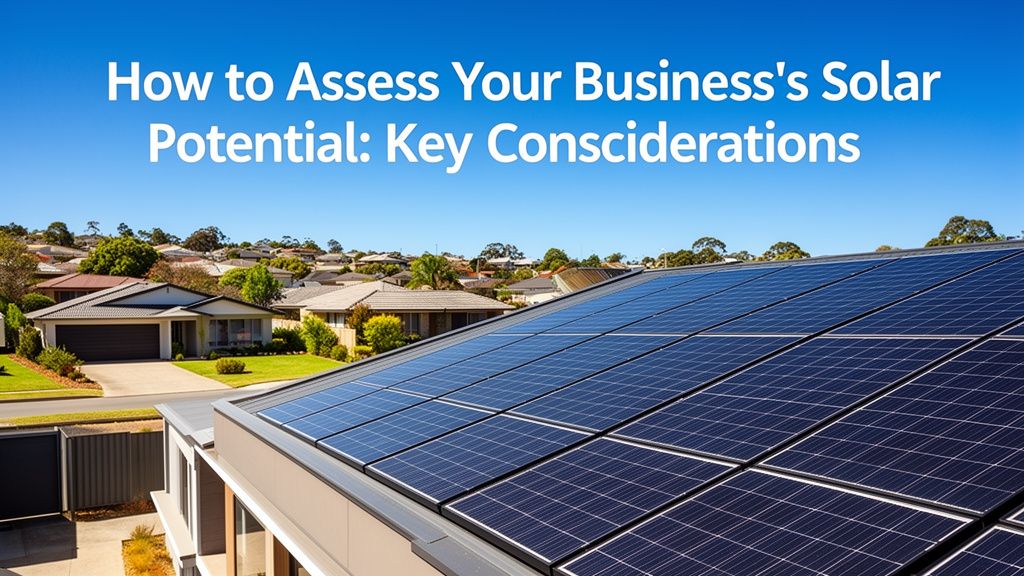
- Roof Space: Is there sufficient, unobstructed roof area? Ideal orientations in Australia are north-facing, but east and west-facing panels can also be highly effective, providing morning and afternoon generation respectively. Consider the pitch of the roof; optimal angles vary by location.
- Shading: This is a critical factor. Even partial shading from trees, adjacent buildings, chimneys, or rooftop equipment (like air conditioning units) can significantly reduce a solar system's overall output. A professional solar assessment will include a detailed shade analysis.
- Roof Condition and Integrity: Is your roof structurally sound enough to support the weight of a solar array for the next 25+ years? Does it need repairs or replacement in the near future? It's much more cost-effective to address these issues before solar installation.
- Ground Mount Options: If your roof is unsuitable due to size, condition, or shading, do you have available land on your property for a ground-mounted system? This can offer more flexibility in orientation and tilt but requires more physical space.
Financial Viability and Return on Investment (ROI)
The bottom line for any business investment is financial return. Solar power is no exception. Calculating the ROI requires looking at upfront costs, potential savings, and available incentives.


- Upfront Costs: The cost of a commercial solar system can vary widely, from around $10,000 for a small business system to hundreds of thousands for larger industrial arrays. Per kilowatt (kW) costs typically range from $1,500 to $3,500, depending on system size, panel quality, inverter technology, and installation complexity.
- Electricity Bill Savings: This is the primary driver of ROI. By generating your own electricity, you reduce the amount you purchase from the grid at retail rates, which are significantly higher than feed-in tariffs.
- Feed-in Tariffs (FiTs): While less impactful than self-consumption, any excess solar power your business exports to the grid will earn you a FiT. These rates in Australia are generally quite low (e.g., 5-10 cents per kWh), so maximising self-consumption is key.
- Government Incentives:
- Small-scale Technology Certificates (STCs): For systems under 100kW, STCs provide an upfront discount on the installation cost. The value depends on the system size and location.
- Large-scale Generation Certificates (LGCs): Larger systems (over 100kW) generate LGCs, which can be sold on a market, providing an ongoing revenue stream.
- Depreciation and Tax Benefits: Solar assets are typically eligible for depreciation deductions, further reducing the net cost.
- State-specific Rebates: While less common for commercial solar, it’s worth checking if your state or territory offers any additional incentives.
- Payback Period: For Australian businesses, a typical payback period for a well-designed solar system is between 3 to 7 years, after which you enjoy essentially free electricity generation for decades.
- Financing Options: Explore various financing models beyond outright purchase, such as commercial loans, Power Purchase Agreements (PPAs) where a third party owns and maintains the system and you buy the power, or equipment leases.
Future-Proofing and Business Objectives
Consider how solar aligns with your broader business strategy and future plans.
- Sustainability and ESG Goals: Solar demonstrably reduces your carbon footprint, helping meet Environmental, Social, and Governance (ESG) targets and enhancing your brand's reputation as a sustainable enterprise. This can be a significant draw for customers, investors, and employees.
- Energy Security and Price Volatility: Owning your power generation reduces your exposure to fluctuating grid electricity prices and potential network outages, offering greater energy security.
- Business Expansion: Do you anticipate increased energy needs in the future? Ensure your solar system is designed with scalability in mind or that there's space for future expansion.
- Integration with Emerging Technologies: Consider the potential for integrating battery storage in the future to further enhance self-consumption and provide backup power, or how solar can support EV charging infrastructure if that's on your horizon.
The Importance of Professional Assessment
Ultimately, assessing your business’s solar potential is a complex task best handled by experts. Engage reputable, Clean Energy Council (CEC) accredited solar providers who specialise in commercial installations. They will conduct a thorough site visit, perform detailed energy usage analysis, accurately assess shading and structural integrity, and provide a comprehensive proposal.
This proposal should include system sizing, estimated generation, financial projections (including ROI and payback period), and details on warranties and ongoing maintenance. A professional will also guide you through understanding local council regulations and grid connection requirements, ensuring a smooth process.
Conclusion
Investing in commercial solar can be a transformative decision for your Australian business, delivering substantial financial savings and contributing to a sustainable future. However, a successful solar project starts with a meticulous assessment of your energy consumption, site suitability, financial viability, and strategic objectives. By taking the time to thoroughly evaluate these key considerations and engaging with trusted solar professionals, you can confidently unlock your business's solar potential and power a brighter, more sustainable operation.
Read More
For a comprehensive overview, check out our master guide: Read the Full Guide Here.