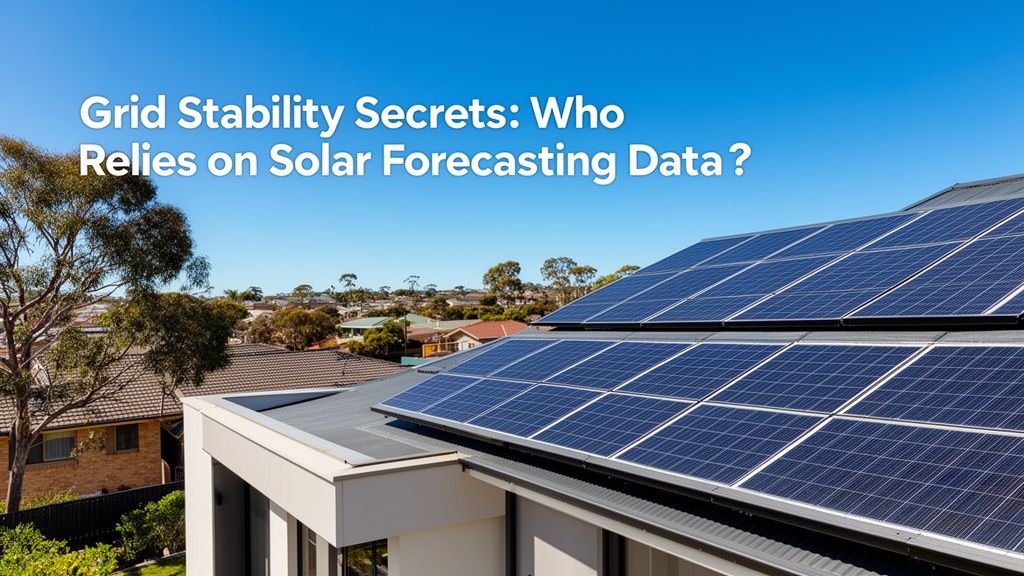
Australia, the sunburnt country, is absolutely teeming with solar power. From the countless rooftop panels glinting on suburban homes to the sprawling utility-scale solar farms baking under our glorious sun, we've embraced solar like few others. It's a fair dinkum Aussie success story, delivering clean energy, slashing power bills, and pushing us towards a greener future. But here's a secret that's not so secret among energy boffins: managing all that sunshine on our electricity grid is a complex dance. The sun, as reliable as it usually is, doesn't always shine exactly when and where we need it to, and it certainly doesn't shine at night! This inherent intermittency of solar power presents a significant challenge for keeping our grid stable and the lights on.
Enter solar forecasting data, the unsung hero working behind the scenes. This isn't just about knowing if it'll be sunny tomorrow for your washing. It's about sophisticated, real-time predictions of solar output across the nation, down to individual power plants and even aggregated rooftop solar generation. This crucial data is the key to unlocking the full potential of renewable energy without compromising the reliability we all expect. But who, exactly, relies on this intricate data to keep our power flowing smoothly? Let's peel back the layers and uncover the key players.
The Sunny Side and the Grid Challenge
Australia boasts one of the highest penetrations of rooftop solar in the world, with over 3.7 million systems installed. Add to that our growing number of large-scale solar farms, and it's clear solar is a massive part of our energy mix. This is fantastic for emissions reduction and energy independence. However, unlike traditional coal or gas-fired power stations that can be ramped up or down predictably, solar output fluctuates. Clouds roll in, storms hit, and obviously, the sun sets. These sudden changes in generation can create imbalances between electricity supply and demand, leading to voltage fluctuations, grid congestion, or, in the worst-case scenario, blackouts.
To maintain grid stability, supply and demand must always be perfectly matched. Even a slight mismatch can have ripple effects across the network. That's where accurate solar forecasting steps in, providing the crystal ball needed to anticipate these fluctuations and allow operators to prepare.
What is Solar Forecasting Data?
Solar forecasting isn't just a best guess. It’s a high-tech discipline that combines a vast array of information:
- Satellite Imagery: Tracking cloud movements and density.
- Weather Models: Predicting temperature, humidity, wind, and atmospheric conditions.
- Ground Sensors: Real-time irradiance measurements.
- Historical Data: Learning patterns from past solar output.
- Artificial Intelligence and Machine Learning: Processing all this data to generate increasingly accurate predictions, often down to 5-minute intervals for short-term forecasts.
These forecasts can predict solar output for minutes ahead (crucial for sudden cloud events), hours ahead (for market bidding and grid dispatch), and even days or weeks ahead (for maintenance planning and long-term market strategies).
Who Relies on Solar Forecasting Data? The Key Players
The list of stakeholders who depend on solar forecasting data to keep the lights on and the market humming is extensive. Here are the main players:
The Australian Energy Market Operator (AEMO)
AEMO is essentially the air traffic controller of Australia's electricity grid, responsible for keeping it stable and secure. They operate the National Electricity Market (NEM) and manage the power system across eastern and southern Australia. For AEMO, solar forecasting data is absolutely mission-critical. They use it to:
- Balance Supply and Demand: AEMO uses forecasts to predict how much solar power will be available and then directs other generators (like gas or hydro) to ramp up or down to fill any gaps or absorb excess, ensuring a continuous supply.
- Manage System Security: Predicting sudden drops in solar generation (e.g., a massive cloud bank moving over a large solar farm) allows AEMO to proactively deploy 'fast response' generation or activate demand-side management to prevent instability.
- Market Dispatch: Accurate forecasts help AEMO determine which power stations should run at what times, optimising the market and keeping wholesale prices stable, which ultimately impacts our power bills.
Without robust solar forecasting, AEMO's job of maintaining a secure and reliable grid in a renewables-rich environment would be exponentially harder, increasing the risk of blackouts.


Network Service Providers (The 'Poles and Wires' Companies)
These are the companies that own and operate the transmission (high-voltage) and distribution (low-voltage) networks – your local 'poles and wires'. Companies like Ausgrid, SA Power Networks, and Powerlink rely on solar forecasts to manage their physical infrastructure. They use the data to:
- Manage Local Grid Congestion: High solar export from rooftops on a sunny day can cause voltage spikes in local networks. Forecasts help these operators predict where and when this might occur, allowing them to adjust voltage regulators or manage demand to prevent equipment damage or localised power quality issues.
- Plan Maintenance: Knowing future solar availability helps them schedule essential maintenance on lines and substations, minimising disruption while ensuring sufficient power supply.
- Integrate New Renewables: When connecting new large-scale solar farms or even community battery projects, forecasting helps in designing robust connections and understanding their potential impact on the local network.
Large-Scale Solar Farm Operators
Operators of big solar farms, like those in Queensland's Darling Downs or regional Victoria, use detailed forecasts to maximise their output and profitability while meeting their market obligations. They use the data to:
- Optimise Market Bidding: Solar farms bid into the NEM based on their expected generation. Accurate forecasts allow them to submit more precise bids, avoiding penalties for over or under-generation and earning more revenue.
- Schedule Operations and Maintenance: Forecasts help schedule panel cleaning, inverter maintenance, or other operational tasks during periods of lower predicted output, minimising lost generation.
- Manage Hybrid Systems: For solar farms co-located with battery storage, forecasts are crucial for optimising when to charge the battery (during peak solar) and when to discharge it (during high demand or low solar periods) to maximise revenue and grid support.
Energy Retailers and Wholesalers
The companies that sell electricity to homes and businesses also rely heavily on solar forecasts. They use the data to:
- Manage Portfolio Risk: Retailers buy electricity from the wholesale market. Predicting solar generation helps them forecast wholesale prices (high solar generally means lower prices) and make informed purchasing decisions to manage their costs and profitability.
- Optimise Trading Strategies: Traders use short-term forecasts to make real-time buying and selling decisions in the NEM, taking advantage of price fluctuations driven by solar availability.
- Design Products: Understanding future solar trends can even inform the development of new electricity plans or demand response programs for customers.
Battery Storage Operators
As more large-scale battery projects come online across Australia, solar forecasting becomes increasingly vital for their operation. Batteries can charge when solar generation is high and prices are low, then discharge during peak demand or when solar output drops, selling power at higher prices. Accurate forecasts allow battery operators to:
- Maximise Revenue: Optimal charge/discharge cycles based on predicted solar output and market prices.
- Provide Grid Services: Batteries can offer fast frequency response and other grid stability services, all of which are optimised with precise solar forecasts.
The Future is Bright (and Predictable)
As Australia continues its rapid transition to renewable energy, the importance of solar forecasting data will only grow. With more rooftop solar, more large-scale farms, and increasing battery storage, the precision and speed of these forecasts will be absolutely critical. Advances in AI, machine learning, and weather modelling are constantly improving the accuracy of these predictions, further solidifying solar's role as a reliable pillar of our energy future.
So, the next time you flick on a switch and the lights come on, spare a thought for the invisible heroes working with sophisticated solar forecasting data. They're the ones keeping our sunny, solar-powered grid humming along smoothly, ensuring that Australia's embrace of renewable energy is not just green, but also incredibly stable.
Read More
For a comprehensive overview, check out our master guide: Read the Full Guide Here.


