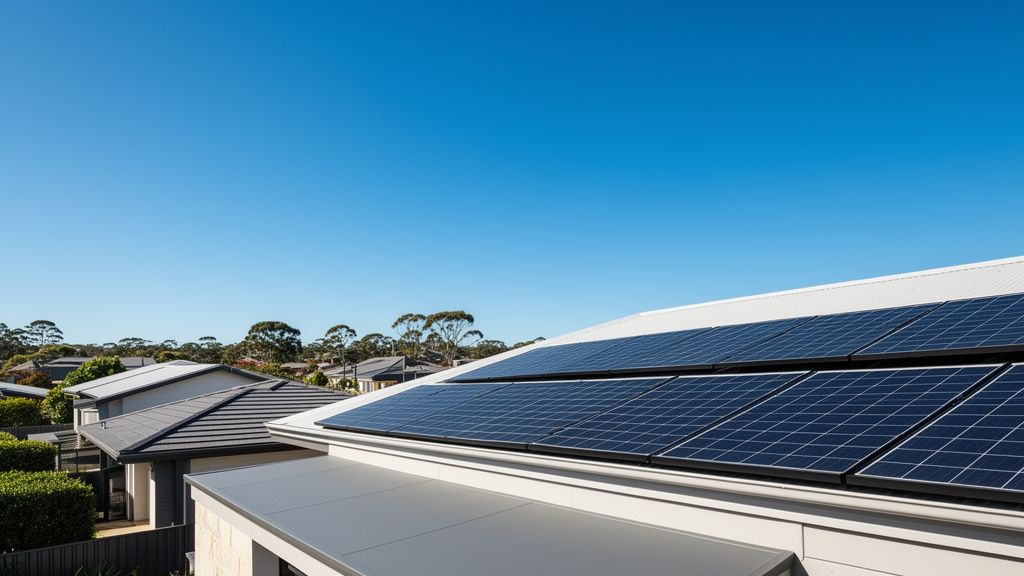
From 3% to Dominant: How Solar's Growth Made Forecasting Critical for Australia
Remember when solar panels were a bit of a novelty? In the early 2000s, less than 3% of Australian homes had solar. It was an expensive, niche technology, often seen as a quirky environmental statement rather than a serious energy solution. Fast forward to today, and the landscape couldn’t be more different. Solar has exploded, becoming a dominant force in our energy mix, gracing the rooftops of millions of homes and businesses across the nation. This incredible journey from fringe player to powerhouse has brought with it an unexpected but crucial challenge: accurate forecasting. Predicting the sun’s output is no longer a niche scientific pursuit; it’s an absolute necessity for keeping the lights on and our energy markets stable.
The Sun Rises: Australia’s Solar Transformation
How did we get here? Australia’s love affair with solar is a tale of convergence – falling costs, clever policy, and a deeply felt desire for energy independence. In the early days, a modest solar system could set you back well over $20,000. Today, a quality 6.6kW system, capable of generating enough electricity for most homes, typically costs between $5,000 and $8,000 after government rebates. This dramatic price drop, coupled with generous feed-in tariffs (FITs) and national incentives, made solar an undeniable financial no-brainer for many.
Suddenly, saving hundreds, even thousands of dollars a year on electricity bills became achievable. Environmental consciousness played its part too, as did the simple appeal of generating your own power. Australians, blessed with abundant sunshine and an independent spirit, embraced rooftop solar with gusto. The result? Over a third of Australian homes now boast solar panels, making us a global leader in per capita solar uptake. This wasn't just incremental growth; it was a revolution.
The Age of Dominance: Solar’s Impact on the Grid
Solar’s transition from 3% to a dominant contributor means it's no longer just supplementing the grid; it's actively reshaping it. During sunny daytime hours, particularly in states like South Australia and Queensland, rooftop solar often generates more electricity than traditional coal or gas-fired power stations. This massive influx of clean energy has profound effects:
- Wholesale Price Impact: Solar frequently drives wholesale electricity prices down, sometimes into negative territory in the middle of the day. While great for consumers indirectly, it creates significant challenges for traditional generators who struggle to compete.
- The "Duck Curve": This visual representation shows net demand for grid power plunging during the day as solar peaks, then rapidly rising in the late afternoon/early evening as the sun sets and people return home, creating a steep ramp-up challenge for conventional power sources.
- Grid Stability: Managing a network with such a large, intermittent energy source requires careful balancing acts to prevent overloads or under-supply, which could lead to blackouts.
Solar is no longer just a "nice to have"; it’s an indispensable, yet inherently variable, part of our core energy infrastructure.
Why Accurate Forecasting Became Non-Negotiable
This new reality has made accurate solar forecasting absolutely critical for multiple stakeholders:


- Grid Stability and Reliability: The Australian Energy Market Operator (AEMO) needs to know, with precision, how much solar power will be generated hour-by-hour, and even minute-by-minute. A sudden cloud bank over a major city can wipe out hundreds of megawatts of generation in an instant. Without accurate forecasts, AEMO can’t effectively dispatch traditional power plants or battery storage to fill the gap, risking grid instability and potential blackouts.
- Market Operations and Pricing: Energy traders and power generators base their entire business models on predicting supply and demand. If they can’t accurately forecast solar output, their bidding strategies become guesswork, leading to volatile prices, market inefficiencies, and potential financial losses.
- Infrastructure Planning: Understanding future solar generation patterns is essential for planning upgrades to our transmission and distribution networks. Where do we need more robust lines? Where should new grid-scale batteries be deployed to soak up excess solar and release it later? Forecasting informs these multi-billion-dollar investment decisions.
- Policy and Regulation: Government bodies and regulators rely on detailed solar forecasts to design effective energy policies, determine future feed-in tariff structures, and integrate new technologies like electric vehicles and virtual power plants (VPPs) into the grid.
- Consumer Optimisation: Even individual homeowners with solar and batteries benefit from forecasting. Smart home systems can use predictions to optimise battery charging, ensuring they have enough power stored for the evening peak or to sell back to the grid when prices are highest.
The Science of Predicting the Sun
Forecasting solar output isn’t as simple as checking the weather app. It involves a complex interplay of science and technology:
- Hyper-local Weather Models: Moving beyond regional forecasts to predict cloud cover, fog, and precipitation at a highly granular level.
- Satellite Imagery: Real-time satellite data tracks cloud movements and atmospheric conditions across vast areas.
- Machine Learning and AI: Advanced algorithms crunch huge datasets – historical weather, actual solar output, grid demand – to identify patterns and predict future generation with increasing accuracy.
- Network of Sensors: Thousands of smaller sensors, sometimes integrated into solar systems themselves, provide ground-truth data.
Despite these advancements, challenges remain. A sudden, localised storm cell or widespread bushfire smoke can throw predictions off. The sheer scale and distributed nature of Australia's rooftop solar make it a unique and formidable forecasting puzzle.
Australia’s Forefront in Solar Management
Australia is at the forefront of managing an energy grid with extremely high levels of intermittent renewable energy. Our experience, successes, and ongoing innovations in forecasting and grid integration are closely watched by countries worldwide. Investments in large-scale batteries, such as the Hornsdale Power Reserve, and the development of virtual power plants are all complementary strategies that rely heavily on accurate solar forecasting to maximise their effectiveness.
Conclusion: A Brighter, More Predictable Future
Solar's journey from a humble 3% to a dominant power source has fundamentally reshaped Australia’s energy landscape. This transformation has been overwhelmingly positive, delivering cheaper, cleaner electricity and empowering millions of Australians. But it has also underscored a vital truth: harnessing the power of the sun effectively requires more than just panels on rooftops. It demands sophisticated, real-time understanding of its output. As solar continues its ascent, accurate forecasting won't just be critical; it will be the very bedrock upon which our stable, affordable, and sustainable energy future is built. The sun may be unpredictable, but our ability to manage its energy need not be.
Read More
For a comprehensive overview, check out our master guide: Read the Full Guide Here.