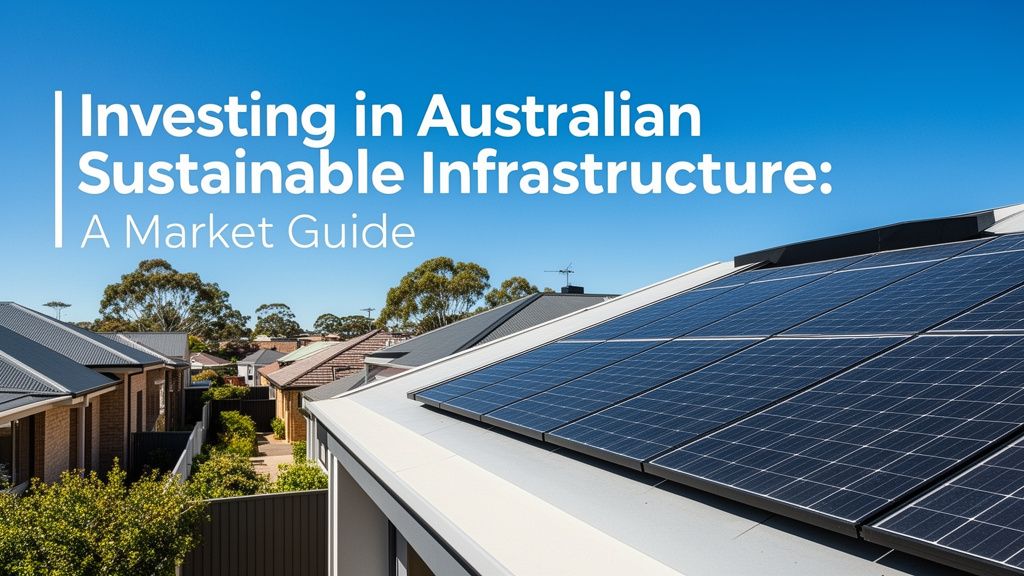
TL;DR: Australia's sustainable infrastructure market offers compelling investment opportunities driven by abundant renewable resources, government support, and increasing demand for clean energy. Investors can find long-term value in projects like large-scale solar farms and battery storage, delivering stable returns while meeting environmental goals.
Why is Australia an Attractive Market for Sustainable Infrastructure Investment?
Australia's unique blend of abundant renewable resources, a stable economy, and strong government support makes it an exceptionally attractive landscape for sustainable infrastructure investment. With some of the highest solar irradiance globally and vast wind resources, the nation is perfectly positioned to transition to a low-carbon economy. This natural advantage, coupled with significant policy initiatives, creates a robust environment for both domestic and international capital seeking green opportunities. The country's commitment to net-zero emissions by 2050 further underpins the long-term viability and growth potential of this sector, drawing in capital for projects that provide essential services while contributing to environmental stewardship.
Abundant Renewable Resources and Export Potential
Australia boasts unparalleled renewable energy potential, particularly in solar and wind, which are driving massive investment into utility-scale projects. Regions like the Pilbara in Western Australia are earmarked for enormous solar and wind developments, not just to power local industries but also to generate green hydrogen for export. This "renewable energy superpower" ambition signifies a monumental shift, creating a pipeline of multi-billion dollar projects. For instance, projects like the Sun Cable's Australia-Asia PowerLink, while ambitious, highlight the scale of opportunity in harnessing solar energy for both domestic use and export to regional markets, positioning Australia as a key player in the global energy transition.
Supportive Policy Frameworks and Incentives
The Australian government, along with various state governments, has implemented a range of supportive policies and incentives designed to accelerate sustainable infrastructure development. These include the Australian Renewable Energy Agency (ARENA) and the Clean Energy Finance Corporation (CEFC), which provide funding, grants, and debt finance for innovative clean energy projects. State-based initiatives, such as Victoria's Renewable Energy Target or Queensland's Energy and Jobs Plan, set ambitious targets and offer regulatory certainty. These frameworks de-risk investments and create a predictable environment for long-term capital deployment, encouraging private sector participation in crucial infrastructure upgrades.
What Investment Opportunities Exist in Australia's Renewable Energy Sector?
Australia's renewable energy sector presents diverse investment opportunities, particularly in large-scale solar, wind, and crucial grid modernisation projects, all vital for a reliable future energy supply. The nation's energy transition is not solely about generation; it equally hinges on how that power is stored, transmitted, and managed. This creates a broad spectrum of ventures for investors, from developing new generation assets to upgrading the fundamental backbone of the electricity network, ensuring system stability and resilience as more renewables come online.
Large-Scale Solar and Battery Storage Projects
Investment in large-scale solar farms continues to boom across Australia, often coupled with substantial battery energy storage systems (BESS). Projects ranging from 100 MW to over 500 MW are common, with total investment costs often exceeding $200 million for a significant solar farm plus a 100 MW/200 MWh battery. For example, a 150 MW solar farm with a 100 MWh battery might attract an investment of around $350 million, promising stable, long-term returns from power purchase agreements (PPAs). These projects are crucial for providing dispatchable power, ensuring grid stability, and reducing reliance on fossil fuels, appealing to investors seeking both financial returns and ESG alignment.
Grid Modernisation and Transmission Networks
Investing in Australia's electricity transmission and distribution networks is critical for facilitating the influx of renewable energy from remote areas to demand centres. Projects like Project EnergyConnect, linking South Australia and New South Wales, and the HumeLink in NSW are multi-billion dollar undertakings designed to enhance grid capacity and resilience. These investments in 'poles and wires' infrastructure are typically long-term, low-risk ventures with regulated returns, making them attractive to institutional investors like superannuation funds. Modernising the grid to handle two-way power flow and integrate smart technologies also opens up opportunities in digital infrastructure and demand-side management solutions.
How Do Sustainable Investments Deliver Tangible Returns for Investors?
Sustainable infrastructure investments in Australia offer tangible returns through long-term stable cash flows, capital appreciation, and alignment with growing ESG mandates, making them a cornerstone for savvy portfolios. These assets often benefit from predictable revenue streams, either through regulated tariffs, government contracts, or long-term power purchase agreements (PPAs) with creditworthy off-takers. This predictability, coupled with the essential nature of infrastructure, tends to de-risk these investments compared to more volatile market segments, providing a reliable income stream over decades.
Stable Returns and De-risked Assets
Many sustainable infrastructure projects, particularly in the renewable energy sector, are underpinned by long-term contracts (e.g., 10-20 year PPAs) which provide consistent revenue streams. For a large-scale solar project, an investor might expect an internal rate of return (IRR) in the range of 7-10% per annum, depending on project specifics and financing structure. These assets are often 'de-risked' once operational, as energy generation is relatively predictable, and operational costs are stable. Compared to speculative ventures, these investments provide stability and inflation-hedged income, which is particularly appealing to pension funds and other long-term institutional investors.


Meeting ESG Mandates and Market Demand
The increasing global emphasis on Environmental, Social, and Governance (ESG) factors is a powerful driver for sustainable infrastructure investment. Investors are not only seeking financial returns but also aiming to meet their own ESG commitments and respond to stakeholder demands for responsible investing. Investing in a new solar farm or a battery storage facility in Australia not only generates electricity but also contributes positively to decarbonisation efforts. This alignment allows investors to access a growing pool of capital dedicated to sustainable finance, often at more favourable terms, as the market increasingly values investments with a demonstrable positive environmental impact.
What Challenges and Risks Should Investors Consider in This Market?
While promising, investors in Australia's sustainable infrastructure market must navigate challenges such as regulatory complexities, social licence issues, and supply chain constraints to ensure successful project delivery. The sheer scale and often remote locations of major projects can present logistical hurdles, while the evolving regulatory landscape requires constant vigilance. Successfully mitigating these risks is paramount for achieving the projected financial and environmental outcomes of sustainable investments.
Navigating Regulatory and Permitting Landscapes
Securing planning approvals and environmental permits for large-scale solar farms, wind projects, and transmission lines in Australia can be a complex and time-consuming process. Varying state and federal regulations, coupled with native title considerations and local council requirements, often lead to project delays and increased development costs. For instance, obtaining all necessary approvals for a 200 MW solar project might take 2-3 years and incur millions in consulting and legal fees. Investors need to factor in these lead times and associated expenses, building robust due diligence processes to understand the specific regulatory environment for each potential investment.
Social Licence and Community Engagement
Gaining and maintaining a 'social licence to operate' is increasingly vital for sustainable infrastructure projects, especially those in regional areas. Opposition from local communities regarding visual amenity, land use, or environmental impact can significantly delay or even halt projects. Effective community engagement, transparent communication, and offering tangible local benefits (e.g., local job creation, community funds) are crucial. Failure to address community concerns can lead to costly legal challenges and reputational damage. Investors must assess a project's community engagement strategy and potential for local pushback as a key risk factor, often requiring early and substantial investment in stakeholder relations.
Key Takeaways
- Australia offers robust opportunities for sustainable infrastructure investment due to strong renewable resources and supportive government policies.
- Key investment areas include large-scale solar farms, battery storage, and vital grid modernisation projects.
- These investments provide stable, long-term returns and help investors meet growing ESG mandates.
- Investors must carefully navigate regulatory complexities, permitting processes, and critical community engagement challenges.
- Due diligence on supply chain resilience and project specific risks is essential for successful investment outcomes.
Read More
For a comprehensive overview, check out our master guide: Read the Full Guide Here.