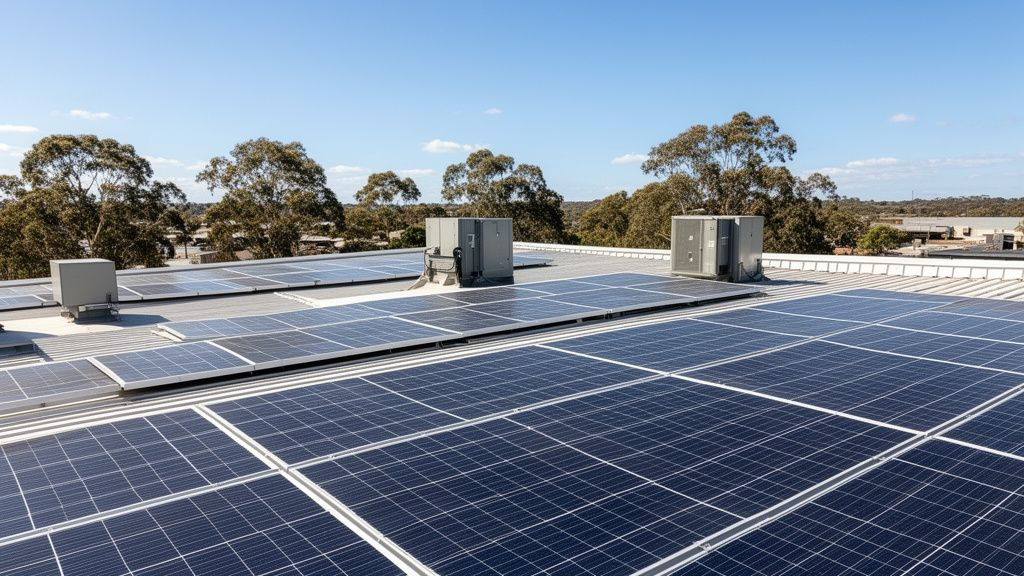
TL;DR: Commercial solar is transforming from a simple localized cost-saving tool into a highly connected, multi-site energy asset. Guided by the landmark Vinnies NSW solar-sharing initiative, businesses and non-profits in 2026 are utilizing advanced software to export and share power across vast property portfolios, maximizing their financial returns and corporate sustainability.
The Financial and Environmental Imperatives for Commercial Solar
In 2026, commercial enterprises face dual pressures: managing volatile electricity expenses and meeting strict carbon-reduction mandates. According to clean energy analysis from Think & Grow Renewable, energy remains one of the largest daily operational costs for businesses. Adopting commercial solar systems provides a predictable, long-term solution. Key benefits include:
- Substantial Bill Reductions: Directly offset daily grid electricity consumption with self-generated clean power.
- Insulation from Volatility: Minimize exposure to unstable wholesale electricity prices through self-generation.
- Enhanced Sustainability Profiles: Meet corporate social responsibility goals and lower carbon footprints to attract eco-conscious clients and investors.
- Long-Term ROI: Leverage competitive government rebates, incentives, and structural cost efficiencies to achieve rapid system payback.
To unlock the maximum value from these commercial installations, organizations are moving beyond standard localized consumption. They are pairing solar panels with battery storage systems and advanced multi-site tracking software to utilize self-generated energy even when a property's local demand is low.
Case Study: Vinnies NSW's 200-Site Solar Power Sharing Initiative
A pioneering example of this evolution is the St Vincent de Paul Society NSW (Vinnies NSW) solar energy-sharing initiative launched in August 2026. The charity, which assists individuals experiencing financial hardship and disadvantage across New South Wales, manages an extensive portfolio of offices, retail op shops, community centers, and warehouses. Due to high and volatile utility costs, electricity has historically been a significant budget item for the organization, directly impacting the funds available for community welfare.
To optimize its assets, Vinnies NSW implemented an energy-sharing model that links rooftop solar installations across its property portfolio. The setup connects solar generation at more than 30 active Vinnies locations with the power demand of more than 200 other sites throughout NSW. Under this structure, physical panels installed on owned properties can offset the electricity bills of leased sites or premises located in dense, urban settings where physical solar installations are not feasible.


According to Kathryn Kerr, Chief Financial Officer at St Vincent de Paul Society NSW, the arrangement successfully reduces overall power bills, freeing up critical operational resources to fund the charity's core community assistance programs. It also contributes directly to the organization's progress toward a net-zero operational footprint.
Technical Underpinnings: How Enosi and Next Business Energy Match Supply and Demand
The Vinnies NSW multi-site initiative is powered by a strategic partnership with commercial electricity retailer Next Business Energy and clean energy software firm Enosi. The program operates under Next Business Energy's "Next Share Direct" energy plan, utilizing Enosi's proprietary "Powertracer" software platform.
In practice, the system operates as follows:
- High-Frequency Matching: Powertracer software monitors solar exports and site electricity demand in half-hour intervals throughout the day.
- Direct Allocation: When an active solar-equipped Vinnies facility generates more power than it can consume, the excess is immediately matched and allocated against the energy consumption of another Vinnies site requiring power at that same moment.
- Premium Export Value: Under the Next Share Direct plan, when these solar exports are successfully matched with internal organizational demand, Vinnies NSW receives more than eight times the standard solar feed-in tariff.
- Transparent Performance Tracking: The Enosi platform includes a unified digital portal, giving the charity detailed data on electricity consumption, solar exports, and individual rooftop system performance across New South Wales.
Adam Vagvolgyi, Executive General Manager of Sales and Marketing at Next Business Energy, highlighted that this commercial program represents a major step forward for multi-site organizations. It provides a viable pathway to extend the financial value of rooftop solar well beyond the physical structures where the panels are installed.
Key Takeaways
- Portfolio-Wide Integration: Businesses with multi-site operations can now utilize solar generation from owned buildings to offset the energy bills of leased premises or dense urban locations.
- The Power of Half-Hour Matching: Software systems like Enosi's Powertracer track energy generation and demand in 30-minute intervals to ensure highly accurate, real-time portfolio balancing.
- Massive Tariff Boost: Under matched commercial sharing plans like Next Share Direct, organizations can secure more than eight times the standard solar feed-in tariff for their exported power.
- Direct Mission Funding: For non-profits and charities like Vinnies NSW, reducing overheads through innovative solar sharing directly increases the funds available for community frontline services.


