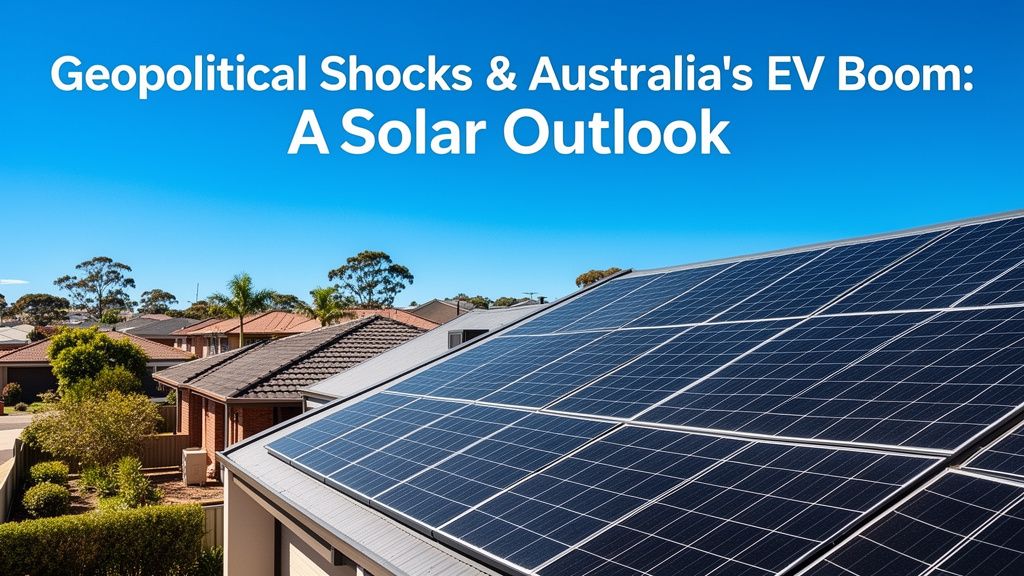
TL;DR: Geopolitical instability and conflicts worldwide have directly driven spikes in global oil prices, making traditional petrol vehicles increasingly costly for Australians. This economic pressure is a major catalyst for the accelerated adoption of electric vehicles (EVs) across the country, prompting a significant shift towards energy independence and a future powered by local, renewable energy sources like solar.
How Do Global Oil Price Spikes Influence Australian EV Adoption?
Global oil price spikes directly fuel a surge in Australian EV adoption by making the running costs of traditional internal combustion engine (ICE) vehicles significantly more expensive and highlighting the clear economic benefits of electric alternatives, especially when charged with solar. When international conflicts or supply chain disruptions send crude oil prices soaring, the pinch is immediately felt at the bowser, with petrol costs often exceeding $2.20 per litre in many major cities. For the average Aussie family, this translates to hundreds of dollars a month in fuel expenses, making the long-term savings of an EV, particularly one recharged at home using cheap or free solar power, incredibly appealing. This direct financial pressure has shifted EVs from a niche environmental choice to a compelling economic imperative for many households and businesses.
The 'Petrol Price Pain' Effect
The recurring cycle of petrol price increases, often tied to distant geopolitical events like conflicts in the Middle East or Russia's invasion of Ukraine, creates a deep-seated frustration among Australian motorists. This 'petrol price pain' directly translates into active research and consideration of EVs. Australians are increasingly viewing an EV, especially one paired with a home solar system, as a tangible shield against this volatility. The ability to "fuel up" for cents per kilometre, or even for free during sunny daylight hours, provides a powerful incentive that far outweighs the initial purchase price concerns for a growing segment of the population.
Economic Savings as a Primary Driver
Beyond just avoiding petrol costs, the economic appeal of EVs is multifaceted. Lower maintenance costs, state government incentives (like stamp duty exemptions or rebates of up to $3,000 for new EVs in some states), and reduced electricity tariffs for off-peak charging further sweeten the deal. For solar homeowners, the synergy is undeniable: using excess rooftop solar generation to power their vehicle effectively offers 'free' travel, drastically cutting their household's transport budget. This direct economic benefit, magnified during periods of high petrol prices, is a principal driver pushing Australia's EV transition forward at an unprecedented pace.
How Do Supply Chain Disruptions Affect EV Availability and Demand?
Supply chain disruptions, exacerbated by geopolitical events, initially presented significant hurdles to EV availability but paradoxically amplified long-term demand by exposing the fragility of global manufacturing and highlighting the urgent need for diversified, resilient energy solutions. The COVID-19 pandemic and subsequent geopolitical tensions led to widespread shortages of critical components, like semiconductors, severely impacting vehicle production across the board, including EVs. This bottleneck meant longer waiting lists for popular EV models, extending lead times to over 12 months in some cases. While frustrating for eager buyers, it simultaneously underscored the broader vulnerabilities of relying on complex, globalised supply chains for essential goods and energy, further solidifying the resolve for local, sustainable alternatives like EVs powered by Australian solar.
Semiconductor Shortages and Production Bottlenecks
The global semiconductor shortage, largely a ripple effect of the pandemic and concentrated manufacturing in a few key regions, brought automotive production lines to a crawl. EVs, being more technologically advanced, typically require a greater number of complex microchips than their ICE counterparts. This created a peculiar situation where demand for EVs was soaring, but manufacturers struggled to meet it, leading to inflated prices for available stock and secondary markets. While this initially slowed the rate of adoption, it also drove innovation in chip manufacturing and diversified sourcing efforts, paving the way for more robust supply chains in the future.
The Push for Localised EV Supply Chains
The disruptions served as a wake-up call, prompting a strategic rethink about national resilience. Governments and manufacturers are now increasingly exploring opportunities for localised production of EV components, from battery materials to entire vehicles. Australia, rich in critical minerals like lithium and cobalt, is uniquely positioned to become a significant player in the global EV battery supply chain. This strategic pivot, driven by the lessons of geopolitical instability, aims to reduce reliance on single-source regions and create more secure, robust pathways for EV manufacturing and deployment within the country, fostering energy independence from the ground up.
Are Geopolitical Events Shaping Australian Government EV Policy?
Geopolitical events are increasingly shaping Australian government EV policy, pushing for greater energy security and reduced reliance on volatile international fossil fuel markets through targeted incentives, infrastructure development, and ambitious emissions targets. The federal and state governments have recognised that a strong domestic EV market, powered by Australia's abundant renewable resources, offers a dual benefit: insulating consumers from global fuel price shocks and accelerating the nation's transition to a net-zero future. Recent policy announcements reflect this shift, with a focus on both encouraging consumer adoption and building the necessary charging infrastructure to support a widespread EV fleet, linking transport directly to renewable energy grids.
Federal and State Incentives
Various state governments have been proactive, offering substantial incentives such as stamp duty exemptions, registration discounts, and direct rebates for new EV purchases, some up to $3,000 to bring down the upfront cost. The federal government recently introduced the National Electric Vehicle Strategy, outlining plans for a national charging network, fleet purchasing targets, and potentially a fuel efficiency standard. These policies are designed not just to green Australia's transport sector but also to strategically position the nation for energy independence in a world where fossil fuel supply lines are increasingly vulnerable to international disputes.
Infrastructure Investment for a Sustainable Future
A key focus of government policy, spurred by the need for resilience, is the investment in charging infrastructure. Recognising that 'range anxiety' is a significant barrier, funding is being directed towards expanding public charging networks, including fast chargers along major highways and in regional centres. Furthermore, there's growing support for smart charging solutions that integrate seamlessly with renewable energy grids and home solar systems. This comprehensive approach ensures that as more Australians adopt EVs, they have reliable, renewable-powered options for charging, directly linking the transport revolution to Australia's solar energy boom.


How Does the Shift to EVs, Powered by Renewables, Impact Australia's Energy Independence?
The shift to Electric Vehicles significantly boosts Australia's energy independence by drastically reducing reliance on imported fossil fuels and capitalising on our abundant renewable energy resources, primarily solar and wind power. Australia currently imports a substantial portion of its liquid fuels, making the nation vulnerable to global supply chain disruptions and price volatility caused by geopolitical shocks. By transitioning to EVs, particularly those charged by our rapidly expanding renewable energy sector, Australia can decouple its transport needs from unpredictable international markets, enhancing national security and economic stability. This fundamental change transforms transport from an energy sinkhole reliant on imports into a domestic energy consumer that can be powered by local, sustainable generation.
Decoupling Transport from Global Oil Markets
Every kilometre driven in an EV charged by Australian electricity – especially from solar panels – is a kilometre not reliant on imported crude oil. This direct substitution progressively reduces Australia's demand for foreign fossil fuels, lessening our exposure to the geopolitical machinations that dictate global oil prices. For a nation with vast solar potential, this represents a strategic advantage, transforming the threat of energy insecurity into an opportunity for self-sufficiency. It shifts economic value from overseas oil producers back into the Australian economy, supporting local jobs in renewable energy and infrastructure development.
Leveraging Renewable Energy for Charging
Australia boasts some of the highest rates of rooftop solar adoption globally, with over three million homes already generating their own electricity. This existing and growing solar capacity is perfectly poised to power the EV revolution. Homeowners with solar can effectively 'fuel' their cars for free during daylight hours, further enhancing the economic benefits of EV ownership and reducing their reliance on the grid and, by extension, traditional energy sources. At a larger scale, the expansion of grid-scale solar and wind farms means that even public charging stations are increasingly powered by clean, domestically produced energy, cementing the link between transport, renewables, and genuine energy independence.
Key Takeaways
- Geopolitical events directly cause fuel price spikes, making EVs a more financially appealing alternative for Australians.
- Investing in an EV, especially when paired with a home solar system, offers significant long-term savings and protection against volatile energy costs.
- Government policies are increasingly supporting EV adoption and charging infrastructure, linking national security to renewable energy growth.
- Australia's transition to EVs, powered by domestic solar and wind, is crucial for achieving genuine energy independence and reducing reliance on imported fuels.
- Consider an EV and evaluate its potential for integration with your existing or planned solar power system to maximise savings and environmental benefits.
Read More
For a comprehensive overview, check out our master guide: Read the Full Guide Here.