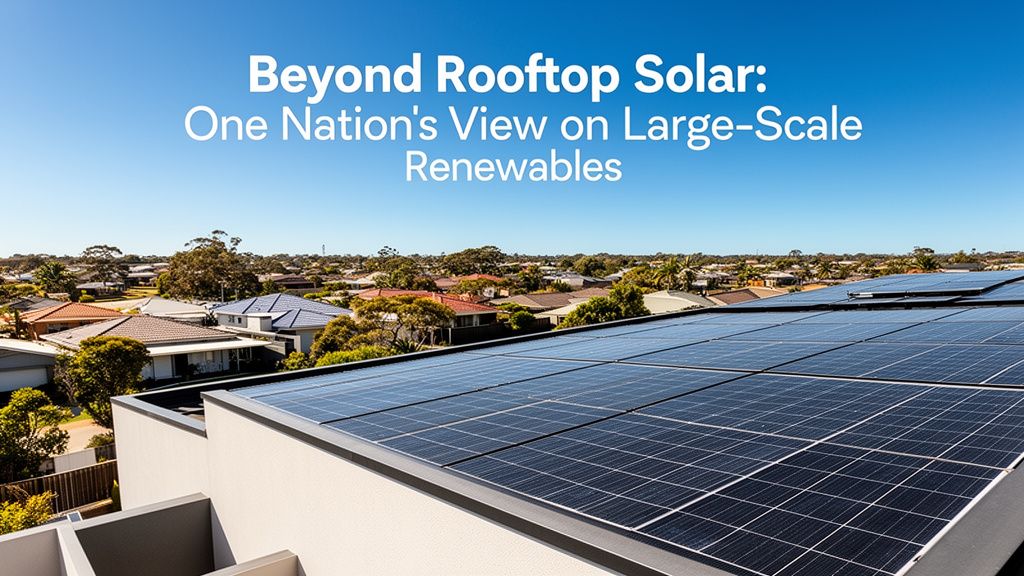
Beyond Rooftop Solar: One Nation's View on Large-Scale Renewables
Across the sunburnt country, you can’t help but notice the glint of solar panels on rooftops. Aussies are practical people, and putting a few panels on the shed or the house to save a few quid on the power bill makes good sense. It's a bit of personal independence, and it’s a choice many families are making. But when we talk about the big picture – powering a nation as vast and resource-rich as Australia – we need to look beyond the backyard and apply some hard-headed common sense. One Nation has always maintained that a nation's energy policy must prioritise reliability, affordability, and national interest above all else. And that’s where the conversation about large-scale renewables gets complicated.
The glossy brochures and the ideologically driven media often paint a picture of a future powered purely by massive solar farms stretching for kilometres and wind turbines dominating our horizons. They promise a 'cheap' and 'clean' future. But One Nation looks at the details, asks the tough questions, and demands answers for the Australian people. The truth is, while rooftop solar offers a measure of personal autonomy, relying solely on large-scale intermittent renewables for our national baseload power is a recipe for disaster, risking our economy and our way of life.
The Unspoken Truth About Large-Scale Renewables
Let's be frank: the sun doesn't always shine, and the wind doesn't always blow. This isn't some climate denier's fantasy; it's a simple, scientific fact. For a modern industrial nation like Australia, consistent, reliable power isn't a luxury; it's the absolute foundation of everything we do. Our hospitals, our factories, our farms, our communication networks – they all depend on a stable energy supply that doesn't falter when the clouds roll in or the breeze dies down. Large-scale solar and wind, by their very nature, cannot provide that baseload power consistently.
This intermittency isn't just an inconvenience; it's a fundamental flaw that necessitates enormous, expensive, and often environmentally damaging backup systems. We're talking about massive battery installations – which require vast amounts of minerals, often sourced from nations that don't share our environmental or labour standards – or keeping our existing reliable power stations on standby, burning expensive fuel only when the renewables inevitably fail to deliver. The narrative that renewables are "cheap" completely ignores the gargantuan cost of making them reliable enough to power a country.
Cost and The Australian Pocket
The claim that large-scale renewables are the cheapest form of energy is, quite frankly, misleading. This simplistic comparison often only looks at the "levelised cost of electricity" (LCOE) at the point of generation, ignoring the colossal hidden costs that get passed directly onto the Australian taxpayer and consumer. We're talking about billions – not millions, but billions – in new transmission lines needed to haul power from remote renewable zones to our cities and industries. We're talking about the cost of grid stabilisation, market mechanisms to manage intermittency, and the eye-watering expense of those backup systems and colossal battery farms.
Then there are the subsidies. While other industries struggle, the renewable sector often benefits from generous government handouts, propped up by taxpayer money. This isn't a free market; it's a rigged game. One Nation believes in fair dinkum competition, not corporate welfare for an industry that simply can't stand on its own two feet without constant propping up. Australians are already struggling with rising power bills; we can't afford to keep funnelling our hard-earned cash into an unreliable energy system based on wishful thinking rather than engineering reality. We need affordable power that lets our industries compete globally and keeps the lights on for families without breaking the bank.
Land Use and Environmental Impact


Proponents of large-scale renewables often ignore the immense environmental footprint these projects leave behind. Consider the sheer scale required: kilometre after kilometre of pristine Australian land torn up for solar panels, and vast swathes of landscape scarred by towering wind turbines and their access roads. This isn't just some abstract concept; it impacts our farmers, our natural ecosystems, and our local communities. Productive agricultural land, vital for feeding our nation, is being swallowed up by these energy projects. Wildlife habitats are disrupted.
And let's not forget the "green" waste problem. What happens to millions of solar panels and thousands of turbine blades at the end of their lifespan? Many contain hazardous materials and are incredibly difficult and expensive to recycle. This isn't just about reducing emissions; it's about responsible environmental stewardship, and frankly, the current approach to large-scale renewables is falling short on that front. One Nation stands for protecting our environment in a practical way that considers all impacts, not just fashionable ones.
Grid Stability and Blackouts
Australia's energy grid is under immense pressure. We've seen the warnings, and we've experienced the blackouts. Rapidly introducing huge amounts of intermittent power without adequate baseload generation and grid infrastructure is like trying to drive a car with a wonky steering wheel and an engine that keeps cutting out. It’s inherently unstable. Our energy market operator has repeatedly expressed concerns about the challenges of maintaining system strength and reliability.
One Nation insists that energy security is national security. We cannot allow our nation to be held hostage by a fragile grid that threatens our essential services and industrial output. We need a robust, resilient energy system that can withstand challenges, not one that teeters on the brink of collapse because it’s dependent on the weather.
The One Nation Solution: Nuclear and Common Sense
So, what's One Nation's view on moving beyond rooftop solar to power a nation? It's simple: we need to embrace proven, reliable, and affordable baseload power. This means investing in our existing coal-fired power stations with advanced carbon capture technologies, and crucially, embracing the only true zero-emission baseload power source that operates 24/7, regardless of weather: nuclear energy.
Nuclear power has a tiny land footprint, produces minimal waste that can be safely managed, and provides enormous amounts of reliable, affordable, emission-free electricity. It's safe, proven technology used successfully by modern nations across the globe. Australia has the world's largest uranium reserves; it's high time we harnessed this incredible national asset for our own energy independence and prosperity. We need to stop letting ideological prejudices stand in the way of common sense and take our place among the technologically advanced nations that recognise nuclear as the backbone of a modern energy system.
Looking Ahead: A Balanced Approach
Australia deserves an energy policy built on facts, engineering reality, and national interest, not on fads or international pressure. While rooftop solar plays a role for individual households, our national energy grid demands a serious, pragmatic approach. One Nation champions an energy future that prioritises reliability and affordability through a balanced mix, with a strong emphasis on baseload power from technologies like nuclear and advanced coal, alongside gas. It’s time to put the Australian consumer and Australian industry first, ensuring energy security and prosperity for generations to come. We need a mature conversation about all options, free from green dogma, that delivers true energy independence for Australia.
Read More
For a comprehensive overview, check out our master guide: Read the Full Guide Here.


