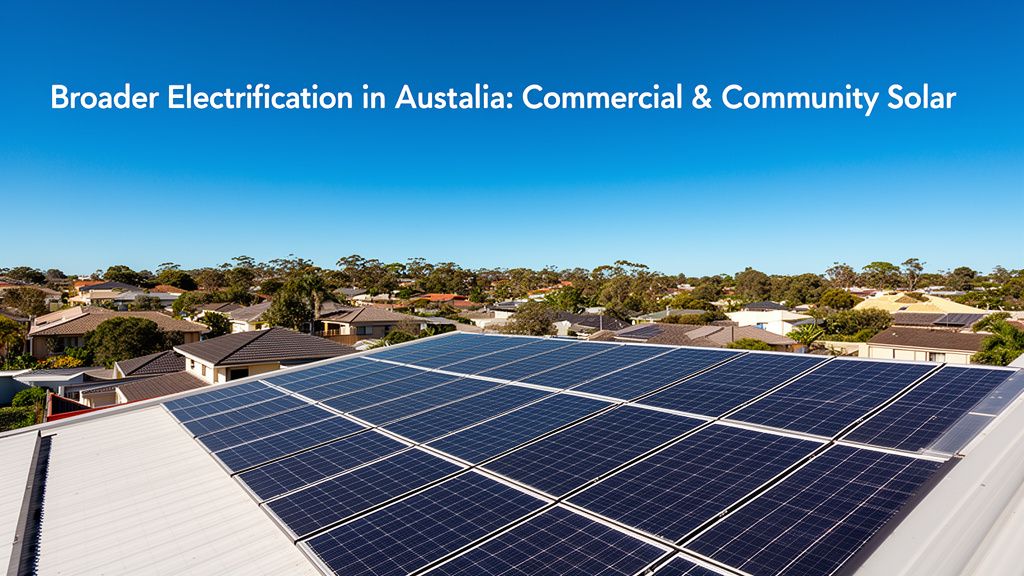
TL;DR: Australia's electrification movement is rapidly expanding past residential solar, with significant growth in commercial, industrial, and community-scale renewable energy projects. This broader shift aims to decarbonise our economy, enhance energy security, and drive economic benefits through substantial investments in large-scale solar, battery storage, and electric vehicle charging infrastructure.
How is Australia's electrification movement expanding beyond individual homes?
Australia's electrification movement is significantly broadening its scope beyond residential rooftop solar, embracing commercial, industrial, and community-level initiatives to drive a more comprehensive energy transition. While millions of Aussie homes proudly sport solar panels, the focus is shifting towards larger-scale deployments that power factories, shopping centres, schools, and even entire neighbourhoods. This expansion is critical for achieving national emissions targets and creating a more robust, decentralised energy grid. Experts highlight that industrial and commercial sectors consume a disproportionately large share of electricity, making their transition to renewables vital. Furthermore, the development of community energy projects fosters local resilience and equity, ensuring the benefits of clean energy are shared widely.
Commercial and Industrial Solar Adoption is Accelerating
Businesses across Australia are increasingly recognising the compelling economic and environmental benefits of installing large-scale solar systems. Unlike smaller residential setups, commercial and industrial (C&I) solar can range from 30kW for small businesses up to multi-megawatt installations for large manufacturers or data centres. For example, a 100kW commercial solar system might cost between $90,000 to $150,000, but can significantly reduce operational costs, often paying for itself within 3-5 years. This trend is driven by rising grid electricity prices, a desire for energy independence, and corporate sustainability goals. Many businesses are also integrating battery storage to maximise self-consumption and participate in demand response programs, further solidifying their energy security.
Community Batteries and Microgrids are Empowering Localities
Beyond individual properties, community-scale energy solutions are gaining traction, with community batteries and microgrids emerging as key components of broader electrification. Community batteries, often shared by hundreds of homes and businesses, store excess solar energy generated locally and discharge it when needed, reducing strain on the grid and improving local power quality. Projects like the South Australian Government's $10 million community battery scheme are enabling suburbs to become more energy self-sufficient. Microgrids, which can operate independently from the main grid, offer enhanced reliability for remote communities or critical infrastructure, ensuring power supply during outages. These initiatives represent a decentralised approach, building resilience from the ground up and fostering local ownership in the energy transition.
What economic and environmental benefits does broader electrification offer Australian businesses and communities?
Broader electrification offers substantial economic benefits for Australian businesses through reduced operational costs and new revenue streams, while simultaneously delivering significant environmental advantages by drastically cutting carbon emissions. For businesses, this translates into greater control over energy expenses and a stronger competitive position, particularly in energy-intensive industries. For communities, it means enhanced energy security, cleaner air, and the creation of new local jobs in the renewable energy sector. The ripple effect extends to public health benefits due to reduced fossil fuel reliance and increased investment in local infrastructure.
Operational Savings and Energy Independence for Businesses
The primary economic driver for businesses embracing electrification is the significant reduction in operational costs. By generating their own power from solar, businesses can drastically cut their electricity bills, often saving tens of thousands or even hundreds of thousands of dollars annually, depending on system size and energy consumption. This insulation from volatile grid electricity prices provides budgeting certainty and a long-term hedge against future price increases. For instance, a medium-sized manufacturing plant could save over $50,000 per year by installing a 200kW solar array, leading to substantial payback periods and increased profitability. Energy independence also means reduced reliance on an often-strained national grid, enhancing business continuity and operational resilience, especially during peak demand periods.
Community Resilience and Emissions Reduction
At a community level, broader electrification through large-scale solar and battery storage strengthens energy resilience. Localised power generation and storage mean communities are less vulnerable to widespread blackouts and can maintain essential services during emergencies. Environmentally, the shift from fossil fuels to renewable electricity generation is paramount for Australia to meet its climate targets. Every kilowatt-hour generated by solar prevents carbon emissions, leading to cleaner air and a healthier environment. Large commercial solar installations alone can offset hundreds of tonnes of CO2 annually. This collective action significantly contributes to Australia's commitment to net-zero emissions, improving public health outcomes and preserving natural ecosystems for future generations.


What challenges and opportunities exist for businesses embracing large-scale solar and electrification?
Businesses embracing large-scale solar and electrification face unique challenges such as grid integration complexities and significant upfront investment, but also unlock immense opportunities for innovation, competitive advantage, and long-term sustainability. Navigating these hurdles requires strategic planning, access to appropriate financing, and an understanding of evolving regulatory landscapes. However, those who successfully transition can achieve substantial cost savings, enhance their brand reputation, and contribute meaningfully to Australia's clean energy future, positioning themselves as leaders in a decarbonising economy.
Navigating Grid Infrastructure and Financing
One of the most significant challenges for large-scale solar projects is grid connection and infrastructure. Australia's grid was designed for centralised power generation, and integrating distributed, intermittent renewables can be complex, often requiring costly network upgrades. Securing approval for export limits and managing grid stability can add time and expense to projects. Furthermore, while the long-term returns are compelling, the upfront capital investment for substantial commercial solar systems or battery storage can be considerable, ranging from hundreds of thousands to millions of dollars. Businesses often need to explore various financing options, including Power Purchase Agreements (PPAs), green loans, or government grants, to make these projects financially viable and manage cash flow effectively.
Policy Support and Emerging Technologies Offer New Avenues
Despite the challenges, a wealth of opportunities exists, particularly with supportive government policies and the continuous innovation in renewable energy technologies. State and federal governments are increasingly offering incentives, grants, and streamlined approval processes for large-scale renewable projects, such as the Australian Renewable Energy Agency (ARENA) funding for innovative energy solutions. Advances in battery technology are reducing costs and increasing efficiency, making storage more accessible for businesses. Furthermore, the integration of smart grid technologies, Artificial Intelligence for energy management, and Vehicle-to-Grid (V2G) capabilities for electric vehicle fleets present new avenues for optimising energy usage, reducing costs, and even generating revenue by providing grid services. Businesses that embrace these emerging technologies can gain a significant competitive edge and future-proof their operations.
Key Takeaways
- Australia's electrification is expanding beyond residential solar to commercial, industrial, and community-scale projects, crucial for national decarbonisation.
- Businesses can achieve significant operational cost reductions and energy independence through large-scale solar, with typical paybacks in 3-5 years.
- Community batteries and microgrids enhance local energy resilience, providing shared benefits and reducing grid strain.
- Broader electrification contributes substantially to Australia's emissions reduction targets and fosters healthier, more sustainable communities.
- While challenges like grid integration and upfront investment exist, policy support, innovative financing, and emerging technologies create immense opportunities for businesses to lead in the clean energy transition.
Read More
For a comprehensive overview, check out our master guide: Read the Full Guide Here.