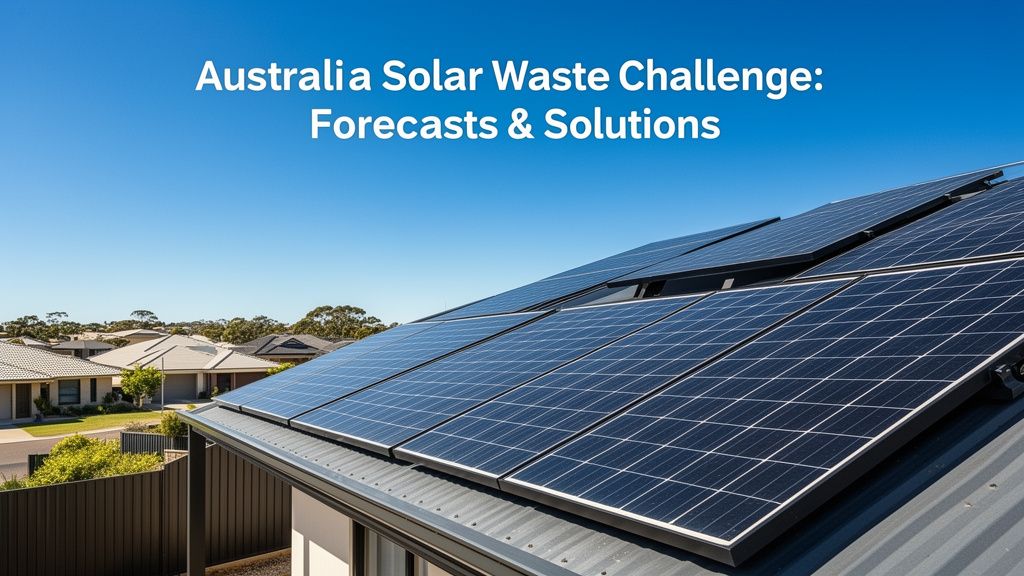
TL;DR: Australia faces a rapidly growing challenge with end-of-life solar panels, projected to reach hundreds of thousands of tonnes by 2050. Despite significant growth in installations, current recycling infrastructure and policy are insufficient to manage this impending waste wave, creating environmental and economic concerns that demand immediate attention and strategic planning.
What are Australia's current solar waste forecasts projecting?
Australia's rapid embrace of solar power, while commendable for emission reduction, is inevitably leading towards a significant waste management challenge, with projections indicating a massive influx of end-of-life solar panels in the coming decades. Research from CSIRO suggests that Australia could accumulate around 100,000 tonnes of PV waste by 2030, escalating dramatically to nearly 1 million tonnes by 2050. These figures represent a staggering volume, dwarfing current waste streams and highlighting the urgent need for a comprehensive national strategy. The bulk of this waste will be silicon-based crystalline panels, the most common type installed across Australian homes and businesses. As the first wave of panels installed in the early 2000s begins to reach its typical 25-30 year lifespan, and with the ongoing boom in new installations, the "solar tsunami" of waste is no longer a distant threat but a rapidly approaching reality.
The exponential growth of solar installations
Australia boasts one of the highest per capita rates of rooftop solar installation globally. Over 3.7 million Australian homes now have solar panels, representing nearly 35% of all dwellings. This impressive growth, fuelled by generous government incentives and falling upfront costs (a typical 6.6kW system might cost $4,000-$8,000 after rebates), has been a key driver in reducing electricity bills and greenhouse gas emissions. However, this success also lays the groundwork for the future waste challenge. Each year, hundreds of thousands of new panels are installed, adding to the cumulative volume that will eventually need processing. Without adequate planning, this incredible clean energy success story could inadvertently create a significant environmental burden down the track.
Tonnage predictions and their implications
The projected tonnage of solar panel waste is not just a statistical curiosity; it carries profound implications. A million tonnes of waste isn't merely a landfill issue; it represents a vast quantity of valuable materials, from high-grade silicon and silver to aluminium and copper, that could be recovered and reused. Sending these panels to landfill means permanently losing these resources and incurring the environmental costs associated with mining new materials. Furthermore, while modern panels are largely benign, older panels and damaged ones can leach hazardous substances into the environment. The sheer volume also strains existing waste management facilities, which are largely unprepared for the specialised handling and processing required for PV modules.
Why are these forecasts often underestimated in public perception?
The sheer longevity of solar panels, typically 25-30 years, often creates a false sense of security, leading many to underestimate the immediate urgency of planning for their disposal. When homeowners invest in solar, their primary focus is understandably on the upfront costs, energy savings, and the environmental benefits of renewable power. The idea of decommissioning panels is a distant concern, pushing the issue out of immediate public view. This "out of sight, out of mind" mentality means that the conversation around solar waste lags significantly behind the enthusiasm for solar adoption itself, leading to a widespread underestimation of the scale and complexity of the problem on the horizon.
The 'out of sight, out of mind' mentality
For many Australians, solar panels are installed on their roof and largely forgotten until they need maintenance or replacement. The typical lifespan of 25-30 years means that panels installed today won't become waste until the 2050s, a timeframe that feels comfortably far off. This long horizon contrasts sharply with the immediate gratification of reduced power bills and lower carbon footprints. Consequently, public awareness campaigns and policy discussions have largely prioritised installation and grid integration, leaving the end-of-life aspect in the shadows. Without a visible, immediate waste problem, it's challenging to galvanise public or political will for preventative measures and investment in future infrastructure.
The disconnect between installation boom and future waste planning
Australia's solar industry has been incredibly effective at driving adoption, with robust supply chains for new panels and skilled installers readily available. However, a similar infrastructure for the reverse process – collecting, sorting, and recycling end-of-life panels – has not developed at the same pace. This creates a significant imbalance. The market is geared for input, not output. As a result, the regulatory frameworks, economic incentives, and physical infrastructure needed to handle the future waste stream are still nascent. This disconnect means that while we are efficiently building a clean energy future, we are simultaneously, and perhaps inadvertently, accumulating a future waste management crisis that is not currently matched by preparedness.
What are the economic and environmental challenges posed by end-of-life panels?
The prospect of hundreds of thousands of tonnes of solar panels heading to landfill presents both a substantial environmental hazard and a missed economic opportunity for valuable resource recovery. Beyond simply occupying space, solar panels contain various materials, some of which are hazardous in high concentrations or can leach into the environment over time if not properly managed. More importantly, disposing of them in landfill means forfeiting the chance to reclaim valuable raw materials that could be reintegrated into new manufacturing processes, thus perpetuating a linear "take-make-dispose" economy instead of fostering a circular one.
The value lost in landfill
Solar panels are complex devices made from a diverse array of materials, including glass (around 70%), aluminium frames (10%), silicon cells (5%), and smaller amounts of copper, silver, and other plastics. Many of these components are highly recyclable and possess significant economic value. For instance, high-purity silicon is a critical component for new panels, and silver, a precious metal, is used in cell contacts. By sending these materials to landfill, Australia is essentially throwing away millions of dollars in potential raw material value, while simultaneously increasing demand for virgin resources and the energy-intensive processes required to extract them. Developing robust recycling capabilities could turn this waste into a resource, creating new industries and jobs in the process.


The cost burden of sustainable disposal
While the environmental benefits of recycling are clear, the economic realities are complex. Currently, the cost of recycling solar panels in Australia is significantly higher than simply sending them to landfill. Recycling can cost anywhere from $25 to $50 per panel, depending on the recycler and the volume, whereas landfill fees might be closer to $5-$10 per panel or even less, if accepted as general waste. This price disparity creates a strong disincentive for sustainable disposal, pushing panels towards cheaper, less environmentally friendly options. Without a clear mechanism to absorb these recycling costs – whether through consumer fees, industry levies, or government subsidies – the economic burden risks falling disproportionately on homeowners or councils, making large-scale sustainable management challenging.
How can Australia prepare for the coming wave of solar waste?
Effectively preparing for Australia's escalating solar waste challenge requires a multi-faceted approach, encompassing improved recycling infrastructure, innovative policy frameworks, and greater consumer awareness. Rather than waiting for the "solar tsunami" to hit, proactive measures are crucial to establish a sustainable end-of-life pathway for panels. This means investing in local processing capabilities, implementing responsible product stewardship schemes, and fostering a circular economy approach where materials are kept in use for as long as possible.
Current recycling infrastructure and gaps
Australia's solar panel recycling infrastructure is currently nascent and fragmented. A few small-scale commercial operations, such as Reclaim PV in South Australia and other initiatives in Victoria, offer limited recycling services, but they are far from being able to handle the projected national volume. Most of these facilities focus on separating the valuable aluminium frames and glass, with the more complex and costly process of recovering silicon and precious metals often outsourced or not performed. The biggest gaps exist in comprehensive collection networks, standardised sorting processes, and advanced material separation technologies capable of processing the full range of panel components efficiently and cost-effectively at scale across the continent. Without significant investment and expansion, existing infrastructure will be quickly overwhelmed.
Policy frameworks for a circular solar economy
To address the economic and logistical challenges, Australia needs robust policy frameworks, such as Extended Producer Responsibility (EPR) schemes. Under an EPR model, manufacturers and importers are made responsible for the entire lifecycle of their products, including their end-of-life management. This incentivises companies to design more recyclable products and to establish or contribute to recycling schemes. Germany's PV Cycle scheme is a prime example. Implementing a similar national scheme in Australia, potentially through an industry levy on new panels (e.g., $10-$20 per panel, added to the initial purchase price), could fund collection and recycling infrastructure, offsetting the cost disparity with landfill. Government support for R&D into better recycling technologies and mandating a "right to repair" or remanufacture panels could also play a vital role in fostering a truly circular solar economy.
Key Takeaways
- Australia faces a projected 1 million tonnes of end-of-life solar panel waste by 2050, largely due to rapid past installations.
- The long lifespan of panels contributes to public underestimation of the impending waste challenge.
- Current disposal methods result in significant loss of valuable materials and potential environmental hazards.
- Implement an Extended Producer Responsibility (EPR) scheme to fund and manage nationwide solar panel recycling.
- Invest in developing and scaling Australian solar panel recycling infrastructure and advanced material recovery technologies.
Read More
For a comprehensive overview, check out our master guide: Read the Full Guide Here.