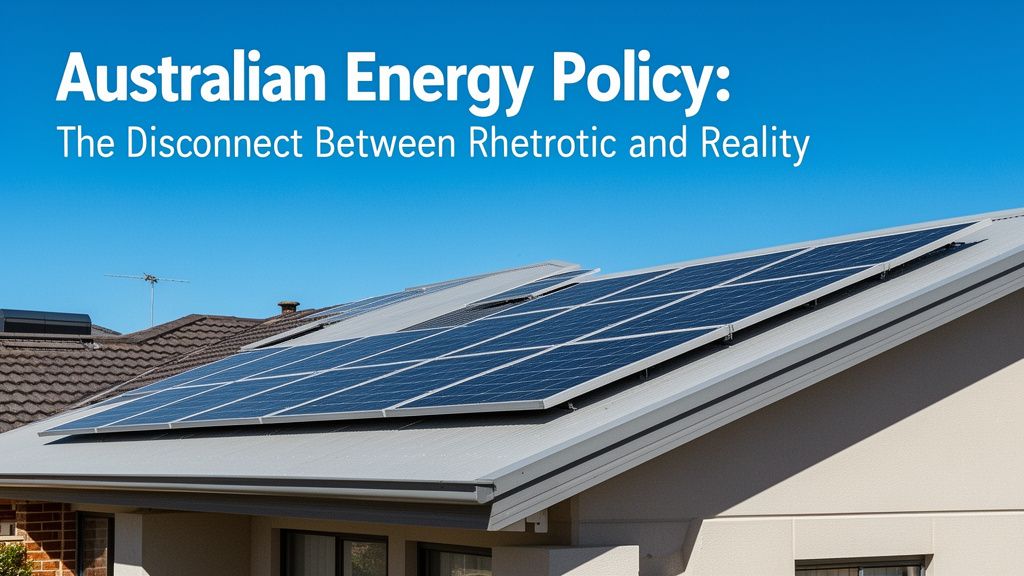
Australia, a sun-drenched continent blessed with vast expanses of land and some of the world's best solar and wind resources, should unequivocally be a global leader in renewable energy. Our homes boast one of the highest rooftop solar uptakes per capita, a testament to the Aussie desire for energy independence and lower power bills. Yet, beneath the glow of solar panels and the spin of political speeches, a stark disconnect exists between our national energy rhetoric and the on-the-ground reality of policy implementation.
The Rhetoric: A Glimpse of Green
Turn on the news, read a government statement, or listen to a parliamentary debate, and you'll often hear a powerful narrative of Australia's energy future. Politicians from across the spectrum frequently espouse commitments to emissions reduction targets, net-zero aspirations, and the burgeoning potential of a "renewable energy superpower." We hear about investments in clean energy technologies, the promise of new green jobs, and the vision of lower energy costs for households and businesses alike. The messaging often highlights Australia's natural advantages, positioning us as a key player in the global transition away from fossil fuels, ready to export green hydrogen and critical minerals to the world. It’s a compelling vision, painted with broad strokes of innovation and sustainability, designed to reassure both domestic voters and international partners that Australia is indeed on the path to a cleaner, more secure energy future.
The Reality: A Carbon Conundrum
Whilst the rhetoric sounds promising, the reality tells a more complex, and often contradictory, story. Despite the grand pronouncements, actual policy and investment decisions frequently lean towards maintaining the status quo or even expanding our reliance on fossil fuels. Billions of Australian dollars continue to be directed towards subsidies for coal and gas projects, whether through direct funding, tax breaks, or infrastructure development that primarily benefits these industries. Just last year, reports indicated that fossil fuel subsidies in Australia amounted to over $AUD11 billion, dwarfing investment in genuine renewable infrastructure.
New gas fields are being approved, and coal mines expanded, sometimes with significant public funding or government-backed guarantees. This sustained support for carbon-intensive industries sends a confusing signal to investors, slowing the momentum of large-scale renewable projects. The energy grid itself, designed for a centralised, fossil-fuel-based system, struggles to accommodate the influx of decentralised renewable generation. Critical transmission infrastructure, vital for connecting remote solar and wind farms to major population centres, faces chronic underinvestment and protracted planning delays. This leaves gigawatts of potential clean energy stranded, unable to reach the homes and businesses that desperately need it. The "energy wars" and the politicisation of climate policy have created an environment of uncertainty, making long-term investment in renewables a high-risk proposition for many. For everyday Australians with rooftop solar, this disconnect manifests in challenges like inconsistent feed-in tariffs, or even curtailment where they're prevented from exporting power back to the grid during peak solar generation.


The Economic and Environmental Costs of Disconnect
The gap between rhetoric and reality isn't merely an academic exercise; it carries significant economic and environmental costs. Economically, Australia is missing out on a colossal opportunity to become a global leader in the green economy. Other nations are rapidly accelerating their investment in renewables, green hydrogen, and battery manufacturing, whilst we remain tethered to the fluctuating fortunes of global fossil fuel markets. Volatile international gas prices have directly impacted Australian electricity bills, despite our vast domestic resources, demonstrating the vulnerability of a fossil-fuel-dependent system. The delay in building essential transmission infrastructure means higher project costs for renewable developers, which ultimately translates to higher energy prices for consumers. We are squandering the chance to create hundreds of thousands of new, future-proof jobs in renewable energy and associated industries, losing ground to countries with more consistent and forward-thinking policies.
Environmentally, the continued support for fossil fuels means higher greenhouse gas emissions, making it increasingly difficult to meet our climate targets and mitigate the impacts of climate change. Australia's reputation on the international stage suffers as we are perceived as lagging in climate action, despite our immense potential.
Bridging the Gap: What Needs to Happen
To truly unlock Australia's renewable energy potential and align our actions with our aspirations, several key shifts are required. Firstly, we need bipartisan, long-term energy policy certainty. This means moving beyond the "energy wars" and establishing a consistent, predictable framework that encourages massive investment in renewables, transmission, and storage.
Secondly, redirecting fossil fuel subsidies into clean energy infrastructure is paramount. Those billions of dollars could accelerate grid upgrades, support large-scale battery storage projects, and fund research and development in cutting-edge renewable technologies.
Thirdly, a rapid and coordinated effort to build out transmission infrastructure is crucial. This will enable our abundant solar and wind resources in regional areas to power our cities and industrial hubs. Streamlining approval processes for renewable projects, whilst maintaining environmental rigour, will also help accelerate the transition. Finally, empowering individual households and businesses with greater support for rooftop solar and home battery storage, coupled with smart grid integration, will ensure that the grassroots renewable revolution continues to thrive.
A Future Aligned with Reality
Australia stands at a critical juncture. We possess all the natural advantages to be a renewable energy powerhouse, delivering affordable, reliable, and clean power to our homes and industries. The disconnect between our ambitious rhetoric and the often-slower, fossil-fuel-leaning reality is holding us back. It’s time for our energy policy to reflect the true potential and aspirations of the Australian people, forging a future where our actions on clean energy genuinely match our words. The benefits, both economic and environmental, are too significant to ignore.
Read More
For a comprehensive overview, check out our master guide: Read the Full Guide Here.


