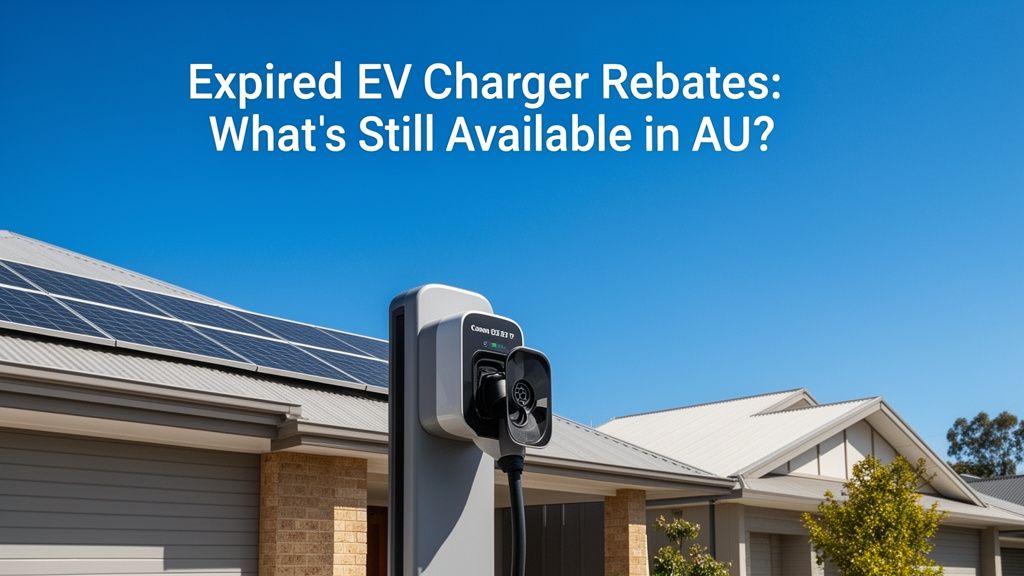
TL;DR: Many popular residential EV charger rebates in Australia, such as those from NSW, Victoria, and Queensland, have now expired. While direct home charger subsidies are largely gone, Australian EV owners can still access significant financial incentives through various state government EV purchase concessions and federal Fringe Benefits Tax exemptions, making EV ownership more affordable.
What EV charger rebates have recently expired across Australia?
Many Australian EV charger rebates, particularly those targeted at residential installations, have concluded their programs over the past year or so. These initiatives, while popular and effective in their time, were often designed as temporary boosts to encourage early EV adoption and supporting infrastructure. For instance, homeowners in states like New South Wales, Victoria, and Queensland might feel they've missed the boat on direct financial assistance for home charging points.
The NSW EV Smart Charging Trial
New South Wales previously ran the EV Smart Charging Trial, which offered up to $2,000 off the cost of purchasing and installing a smart EV charger for eligible participants. This trial aimed to gather data on how smart charging could integrate with the grid and offered a substantial saving for early adopters. However, this specific rebate program closed to new applications in early 2023, meaning the opportunity to claim this direct subsidy has passed for most homeowners. While it helped many get set up, it's no longer an option for those just entering the EV market.
Victorian and Queensland EV Charger Rebates
Similarly, Victoria’s previous EV charger rebate, offered through the Solar Homes Program, provided up to $1,300 towards the cost of an eligible EV charger and installation. This scheme was highly sought after, aligning EV uptake with renewable energy goals. However, the EV charger component of the Victorian Solar Homes Program officially ended on 30 June 2023. Queensland also had its own EV Charger Rebate, which provided up to $1,500 for eligible residential installations. This program also ceased accepting new applications, leaving many who held off on their EV purchase feeling out of luck regarding charger specific subsidies.
What financial incentives are still available for Australian EV owners?
While direct EV charger rebates are now scarce, prospective and current EV owners in Australia still have access to a range of significant financial incentives that can make EV ownership more attractive and affordable. These incentives primarily focus on the purchase of the electric vehicle itself rather than the charging infrastructure, but they contribute substantially to overall savings. These state and federal programs aim to reduce the upfront cost and ongoing expenses associated with EVs, encouraging broader adoption across the country.
State-based EV Purchase Incentives
Several Australian states and territories offer concessions that reduce the cost of buying an electric vehicle. For example, New South Wales provides a stamp duty exemption for new and used EVs up to a dutiable value of $78,000. Victoria offers an exemption on stamp duty for eligible EVs, as does Queensland, Western Australia, South Australia, and the ACT, often with specific vehicle value thresholds. Beyond stamp duty, some states also provide reduced or waived registration fees. The ACT, for instance, offers two years of free registration for new zero-emission vehicles, while Queensland provides a discounted registration fee. These substantial savings can amount to thousands of dollars, making the total cost of ownership more competitive with traditional petrol cars.
Federal Incentives for EVs
At a federal level, the most impactful incentive for many Australians is the Fringe Benefits Tax (FBT) exemption for eligible EVs. If an employer provides an EV to an employee (e.g., through a novated lease or as a company car), and certain criteria are met, the FBT liability can be significantly reduced or eliminated. This makes novated leasing an EV a highly attractive option, potentially saving tens of thousands of dollars over the life of the lease by effectively paying for the car and its running costs from pre-tax income. Additionally, the federal government's Clean Energy Finance Corporation (CEFC) may offer discounted finance for eligible EVs through various lenders, although this isn't a direct rebate, it can lower the cost of borrowing for your EV purchase.


Is investing in an EV charger still worthwhile without a rebate?
Despite the absence of direct residential EV charger rebates, installing a dedicated home EV charger remains an incredibly worthwhile investment for most Australian EV owners. The benefits extend far beyond immediate savings, encompassing convenience, safety, charging speed, and crucially, the ability to maximise the economic benefits of a home solar power system. The initial outlay for a charger, typically between $1,500 and $4,000 fully installed, is quickly offset by the long-term advantages.
Maximising Value with Home Solar
For Australian homeowners with solar panels, a home EV charger is almost a no-brainer. It enables you to charge your electric vehicle directly with free, clean energy generated from your rooftop, rather than exporting it to the grid for a low feed-in tariff (often $0.05 - $0.10/kWh) and then buying power back at peak rates (typically $0.25 - $0.35/kWh). By using your own solar to charge, you effectively pay nothing for your EV's "fuel," drastically reducing your running costs. This synergy not only enhances your solar system's payback period by increasing self-consumption but also maximises your savings and reduces your carbon footprint significantly. A smart charger can even be programmed to only charge when solar is abundant, optimising this benefit.
Convenience and Long-Term Savings
The sheer convenience of waking up every day to a "full tank" cannot be overstated. No more detours to petrol stations or waiting at public charging stations, which can often be busy or more expensive. A home charger provides a reliable, secure, and fast charging solution right where you park your car. While public charging might cost anywhere from $0.30/kWh to $0.60/kWh or more, even if you don't have solar, charging at home during off-peak hours (e.g., $0.15 - $0.20/kWh) is considerably cheaper. Over the lifespan of your EV, these daily savings on fuel costs, combined with reduced maintenance compared to internal combustion engine vehicles, will far outweigh the initial investment in a home charging station.
Key Takeaways
- Most widespread residential EV charger rebates in NSW, Victoria, and Queensland have now expired, meaning direct subsidies for home charger installation are largely unavailable.
- Australian EV buyers can still access significant savings through state government stamp duty exemptions and registration discounts, which reduce the upfront cost of the vehicle.
- The federal Fringe Benefits Tax (FBT) exemption offers substantial savings for EVs acquired through novated leases, making them a very attractive option.
- Installing a home EV charger is still a highly worthwhile investment, providing unparalleled convenience, safety, and faster charging speeds.
- For solar homeowners, a home EV charger allows you to charge your vehicle with free, self-generated electricity, dramatically cutting running costs and improving your solar system's economic returns.
Read More
For a comprehensive overview, check out our master guide: Read the Full Guide Here.


