TL;DR: Australian homeowners with solar panels can sell their surplus electricity back to the grid through a mechanism called a feed-in tariff. This process involves connecting your system, having an approved meter, and signing an energy contract that includes a feed-in rate, turning your home into a net energy exporter.
What Is a Solar Feed-in Tariff and How Does It Work?
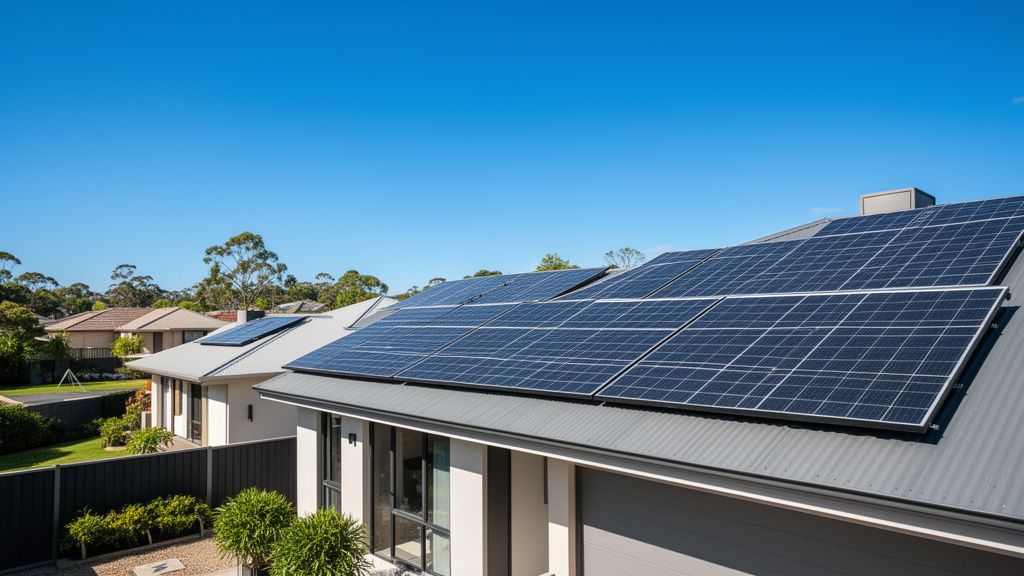
A solar feed-in tariff (FiT) is a credit your electricity retailer pays you for every kilowatt-hour (kWh) of excess solar electricity your system generates and sends back into the main electricity grid. When your solar panels produce more power than your home uses at any given moment, that surplus energy automatically flows back into the grid, helping to power your neighbours' homes or businesses. Your electricity retailer measures this exported energy through a special meter and then applies a credit to your bill based on an agreed-upon FiT rate. These rates can vary significantly between retailers and states, typically ranging from a few cents to around 10 cents per kWh in 2024. The goal is to maximise your self-consumption first, using the free solar power yourself, and then export the rest for a credit.
Net Metering vs. Gross Metering
Most residential solar installations in Australia operate under a net metering system. This means your smart meter records both the electricity you import from the grid and the electricity you export to it. Your electricity bill then reflects the net difference, along with any feed-in tariff credits for your exports. For example, if you import 200 kWh from the grid and export 150 kWh, you pay for the net 50 kWh imported, and your exported 150 kWh earns you a credit based on your FiT rate. Gross metering, where all generated solar power is exported and paid for, is rare for new installations and usually only applies to much older systems. Net metering encourages you to use your solar power first, directly offsetting your higher retail electricity purchase price.
Eligibility Requirements for Feed-in Tariffs
To be eligible for a feed-in tariff in Australia, your solar system needs to meet several conditions. Firstly, it must be installed by an accredited Clean Energy Council (CEC) installer and comply with Australian standards. Your system also needs to be connected to the grid and approved by your local Distribution Network Service Provider (DNSP). This approval confirms your system meets technical requirements and is safe to operate. Finally, you must have a compatible smart meter capable of separately measuring both imported and exported electricity. If you have an older meter, your electricity retailer will arrange for an upgrade, often at a small cost or as part of a new energy plan. Once these technical requirements are met, you can choose an energy retailer that offers a competitive feed-in tariff.
How Do Retailers Pay for Your Exported Solar Energy?
Electricity retailers in Australia manage the billing and payment for your exported solar energy. After your solar system is installed and approved by your local network operator, and a smart meter is in place, you sign up for an electricity plan that includes a feed-in tariff. Each billing cycle, usually quarterly, your retailer calculates your total energy imports and exports. They subtract your feed-in tariff credits from your total charges for grid electricity consumed, and any supply charges or fixed fees. The payment for your exported energy appears as a credit on your bill, reducing the amount you owe. In some cases, if your credits exceed your charges, you might even receive a credit balance on your account. For example, a home in Brisbane exporting 10 kWh daily at a 7c/kWh FiT earns 70 cents per day, or around $63 over a 90-day billing period.
Comparing Feed-in Tariff Offers
Comparing feed-in tariff offers is essential because rates vary significantly across different retailers and regions. Some retailers offer higher FiT rates but might charge higher daily supply charges or per-kWh rates for imported electricity. Others might offer a lower FiT but provide more competitive overall electricity rates or a larger sign-up bonus. You need to consider your household's specific energy consumption patterns – how much you use during the day versus at night, and how much you expect to export. Websites like EnergyMadeEasy.gov.au or state-specific energy comparison sites (e.g., Victorian Energy Compare) allow you to input your details and compare various plans, including their feed-in tariff rates. Always look at the total estimated annual cost or credit, not just the FiT rate in isolation.
The Impact of Time-of-Use Tariffs
Time-of-use (TOU) tariffs introduce another layer of complexity and opportunity for solar homeowners. With TOU tariffs, the price you pay for grid electricity changes throughout the day, often being higher during peak demand periods (e.g., late afternoon/early evening) and lower during off-peak times (e.g., overnight). While most feed-in tariffs in Australia are flat rates, regardless of when you export, some retailers are starting to trial variable FiTs that pay more for exports during peak demand periods. If your home is on a flat-rate FiT, your strategy remains focused on maximising self-consumption to avoid buying expensive peak power. If you have a variable FiT, strategising when to export (or store with a battery) becomes more nuanced, aiming to export during times when the tariff is highest.
Is Selling Excess Solar Energy Still a Smart Move for Australian Homeowners?
Selling excess solar energy remains a smart financial move for Australian homeowners, even with lower feed-in tariffs compared to a decade ago. While FiT rates in 2024 might be around 5-10 cents per kWh, the primary benefit of solar power comes from avoiding the need to buy grid electricity, which typically costs 25-40 cents per kWh. Every kWh you use directly from your solar panels means one less kWh you buy from your retailer at their full retail price. The FiT acts as a bonus, providing a modest credit for the power you can't immediately use. For a typical 6.6kW system in Perth, generating around 25 kWh per day, offsetting even half of your usage saves significantly more than the FiT earned on the other half. Solar also increases your energy independence and reduces your carbon footprint.
Calculating Your Potential Savings and Earnings
Calculating your potential savings and earnings involves understanding your electricity usage and solar production. First, estimate your daily solar generation (e.g., a 6.6kW system might produce 20-30 kWh daily, depending on location and season). Next, estimate your daily electricity consumption. The difference is your potential export or import. If your system produces 25 kWh and you use 15 kWh during daylight hours, you export 10 kWh. At a 7c/kWh FiT, that's 70 cents daily in credits. More importantly, using that 15 kWh yourself avoids buying it at, say, 35c/kWh, saving you $5.25. So, your total daily benefit is $5.25 in avoided costs plus 70 cents in FiT credits, totalling $5.95. This adds up to substantial annual savings, often over $1,000 for an average household.
The Role of Battery Storage in Maximising Self-Consumption
Battery storage systems significantly enhance the value proposition of residential solar by helping homeowners maximise their self-consumption and further reduce reliance on the grid. Instead of exporting surplus solar energy back to the grid for a relatively low feed-in tariff, a battery stores that excess power. You can then use the stored energy later in the evening when your solar panels are no longer producing, avoiding buying expensive grid electricity during peak demand hours. For example, if your FiT is 7c/kWh but your peak electricity price is 38c/kWh, using stored solar from your battery saves you 38c, which is a much higher value than the 7c you would have earned by exporting. Batteries essentially shift your solar consumption, allowing you to get the maximum financial benefit from every kWh your panels generate, though they represent a significant upfront investment.
Key Takeaways
- Australian homeowners earn credits for excess solar power exported to the grid through feed-in tariffs.
- Most systems use net metering, where you get credit for exported power and pay for imported power, with the goal to maximise self-consumption first.
- Eligibility requires a CEC-accredited installer, network approval, and a smart meter.
- Feed-in tariff rates vary by retailer and state; compare offers by considering overall plan costs and your usage patterns.
- Solar remains a smart investment primarily due to avoided electricity purchase costs (25-40c/kWh), with FiT credits (5-10c/kWh) as an added bonus.
- Battery storage can further enhance savings by allowing you to store excess solar for evening use, reducing reliance on the grid during peak pricing.
Read More
For a comprehensive overview, check out our master guide: Read the Full Guide Here.