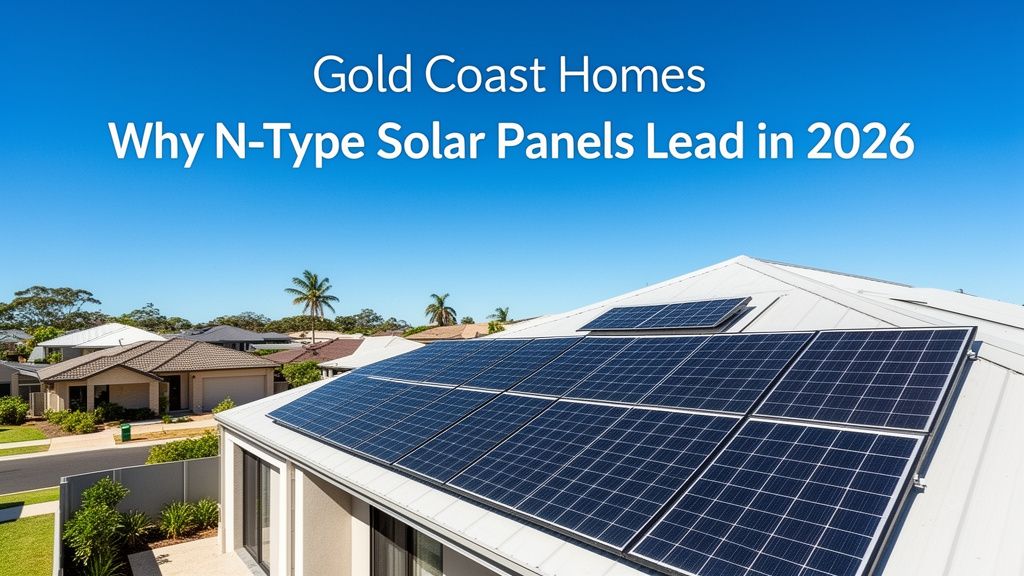
TL;DR: Gold Coast homeowners are increasingly choosing N-Type solar panels in 2026 due to their superior efficiency, better performance in challenging light conditions, and slower degradation rates. This technology offers enhanced energy generation on smaller Gold Coast roof spaces and delivers greater long-term financial savings despite a slightly higher upfront cost, making it ideal for the region's urban environment.
What makes N-Type solar panels superior to traditional P-Type technology?
N-Type solar panels offer significant advancements over older P-Type technology, primarily through a different doping process that enhances their efficiency, durability, and performance. Unlike P-Type cells, which use boron doping, N-Type cells are doped with phosphorus. This change in semiconductor material virtually eliminates light-induced degradation (LID) and drastically reduces potential-induced degradation (PID), common issues in P-Type panels. Consequently, N-Type panels start with a higher efficiency, degrade at a slower rate (often less than 0.4% per year compared to 0.5-0.7% for P-Type), and typically come with longer performance warranties. For Gold Coast homeowners, this means more consistent power output over the system's lifespan and a better return on investment, particularly crucial as Queensland electricity prices continue to fluctuate.
Enhanced Efficiency and Performance
N-Type panels generally boast higher conversion efficiencies, often starting from 22% and beyond, compared to P-Type panels which typically range from 18-21%. This superior efficiency means that for the same physical footprint on a Gold Coast roof, an N-Type system can generate significantly more electricity. This is a critical advantage for many properties in metro Gold Coast areas like Southport, Broadbeach, or Burleigh Heads, where smaller block sizes and multi-story dwellings often mean limited available roof space. Maximising power output from every square metre becomes essential to offset high energy bills and potentially export more to the grid, boosting overall savings.
Superior Durability and Degradation Rates
The phosphorus doping in N-Type cells makes them inherently less susceptible to common degradation mechanisms. This translates to an impressive annual degradation rate, with many manufacturers guaranteeing less than 0.4% per year, often resulting in 87-90% of original output after 30 years. In contrast, P-Type panels typically degrade by 0.5-0.7% annually, leading to about 80% output after 25 years. This slower decline ensures Gold Coast homeowners enjoy higher energy production for a longer period, translating into thousands of extra kilowatt-hours (kWh) over the system's lifetime. The extended performance warranties, often up to 30 years, provide greater peace of mind and reinforce the long-term value proposition.
How do N-Type panels address common Gold Coast solar challenges?
N-Type panels are particularly well-suited for Gold Coast's climate and urban environment due to their superior low-light performance and reduced sensitivity to partial shading. The Gold Coast, known for its stunning coastline, can also experience periods of cloud cover, especially during the wetter months. Additionally, the increasing urban density, particularly around the CBD and coastal strips, means many homes contend with partial shading from neighbouring multi-story buildings, trees, or even other rooftop structures. N-Type technology's ability to maintain higher output under these conditions directly mitigates these local challenges, ensuring consistent energy generation.
Optimising Output in Varied Gold Coast Conditions
Gold Coast homes often face diverse solar conditions throughout the day and year. Mornings and late afternoons, as well as overcast days, typically present lower light intensity. N-Type panels excel in these scenarios due to their advanced cell structure, which captures more photons even in diffuse light. This means Gold Coast homeowners with N-Type systems will see better performance during less-than-ideal sunlight hours, contributing more to their daily energy needs and reducing reliance on the grid. This advantage is crucial for residents who are often out during peak sun hours but need power in the early morning or evening.
Maximising Generation on Limited Roof Space
In densely populated Gold Coast suburbs, available roof space is a premium. Whether it's a townhouse in Mermaid Beach, an older home in Ashmore, or a property near the CBD, roof dimensions can limit the total number of panels. N-Type panels, with their higher power density per square metre, allow homeowners to install a more powerful system within a confined area. For instance, where a P-Type system might achieve 6.6kW, an N-Type system could reach 7.5kW or more with the same panel count, significantly boosting potential energy savings and feed-in tariff eligibility on smaller roofs that are common across the City of Gold Coast.
What is the financial advantage of investing in N-Type solar on the Gold Coast?
While initially a slightly higher investment, N-Type panels offer a faster payback period and significantly greater long-term savings through higher electricity generation and reduced degradation over their lifespan. The Gold Coast's high electricity prices make any additional kilowatt-hour generated more valuable, directly impacting household budgets. The enhanced performance means homeowners can reduce their grid consumption more effectively and potentially export more power, earning valuable feed-in tariff credits from their retailer, making the investment highly attractive over its 25-30 year lifespan.
Understanding the Upfront Cost vs. Long-Term Value
In 2026, an N-Type 6.6kW solar system might cost approximately $6,500 - $8,500 on the Gold Coast, compared to $5,500 - $7,500 for a comparable P-Type system. This slight premium for N-Type is quickly recouped. Given their higher efficiency and slower degradation, N-Type panels generate more electricity from day one and maintain that advantage over decades. Over a 25-year period, an N-Type system could generate 5-10% more total energy than a P-Type system of the same nominal size. This additional generation translates directly into thousands of dollars in extra savings, resulting in a faster return on investment (ROI) and a much lower levelised cost of electricity over the system’s lifetime.
Impact on Gold Coast Household Electricity Bills
The greater output from N-Type panels has a profound impact on Gold Coast household electricity bills. With average Queensland residential electricity prices often above $0.25/kWh, every additional kWh generated by your solar system directly reduces your retail electricity purchases. For a typical 6.6kW system, an N-Type setup could produce an extra 500-1000 kWh annually compared to a P-Type system, depending on conditions. At current rates, this amounts to an extra $125 - $250 in annual savings. Over the 30-year life of the system, these accumulated savings easily justify the initial higher cost, securing long-term financial stability against rising energy costs for Gold Coast residents.


What should Gold Coast homeowners consider before switching to N-Type in 2026?
Gold Coast homeowners considering N-Type solar panels in 2026 should carefully evaluate system sizing to match their energy needs, choose a reputable local installer with proven expertise, and understand the relevant City of Gold Coast regulations. While the benefits of N-Type are clear, a well-planned installation ensures maximum efficiency, compliance, and long-term satisfaction. Consulting with multiple Clean Energy Council (CEC) accredited installers and verifying their Gold Coast experience is a crucial step to ensure a smooth transition to this advanced solar technology.
Navigating City of Gold Coast Solar Regulations
Before any solar installation, Gold Coast homeowners should be aware of the planning requirements set by the City of Gold Coast. Generally, residential solar panel installations are exempt from requiring a planning permit, provided they meet specific criteria, such as being non-reflective and not protruding significantly from the roofline. However, properties within heritage overlays, near protected areas, or with certain covenants might have additional considerations. It is always best practice to consult the City of Gold Coast's planning scheme and relevant building codes, or check directly on their website at https://www.goldcoast.qld.gov.au for the most current information and any specific local requirements for your property.
Choosing the Right Installer for Gold Coast Homes
Selecting a reputable and experienced solar installer is paramount for a successful N-Type system on the Gold Coast. Look for installers who are Clean Energy Council (CEC) accredited and have a strong track record of installing N-Type technology specifically. A good installer will conduct a thorough site assessment, considering factors like roof orientation, shading (especially common in denser Gold Coast areas), and structural integrity. They should provide detailed quotes, clearly outlining panel brands, inverter specifications, warranties, and an accurate estimation of energy production and financial savings tailored to your Gold Coast property. Don't hesitate to ask for local references and inspect past work.
Key Takeaways
- N-Type solar panels offer higher efficiency and significantly slower degradation rates compared to P-Type, providing greater long-term energy output.
- Their superior low-light performance and higher power density are ideal for Gold Coast homes facing partial shading or limited roof space in urban areas.
- While N-Type panels have a slightly higher upfront cost, their enhanced generation leads to a faster payback period and greater financial savings over 25-30 years.
- Gold Coast homeowners should consult the City of Gold Coast website for local planning guidelines and choose a CEC-accredited installer with local expertise.
- Investing in N-Type technology ensures maximum solar generation and bill reduction, future-proofing your Gold Coast home against rising electricity costs.


