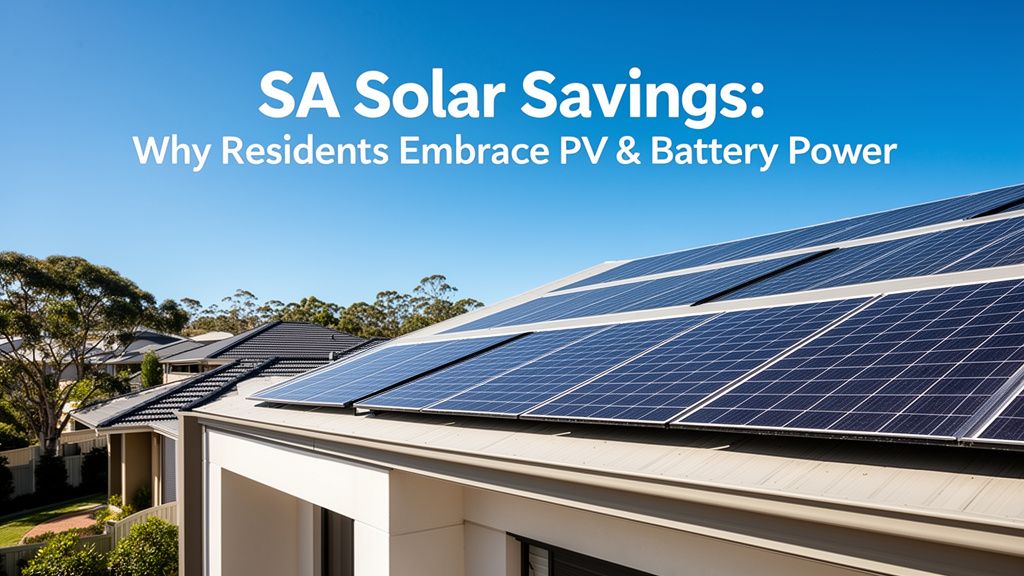
TL;DR: South Australian residents are increasingly adopting solar power to combat the nation's highest electricity prices, leveraging significant savings through reduced grid reliance, generous feed-in tariffs, and supportive government incentives. This shift provides long-term financial stability and contributes to a sustainable energy future for households across the state.
Why Are South Australian Electricity Prices Driving Solar Adoption?
South Australia consistently experiences some of the highest residential electricity prices in Australia, making the prospect of generating one's own power exceptionally appealing for homeowners. For years, factors like network charges, wholesale market volatility, and a reliance on a long, interconnected grid have contributed to bill shock for many SA households. With typical electricity costs often hovering around 40-50 cents per kilowatt-hour (kWh) for grid power, compared to 25-35 cents in some other states, the financial incentive to reduce grid dependency is substantial. Installing solar panels directly addresses this by providing a cheaper, self-generated alternative to expensive retail electricity, turning what was once a significant household expense into a manageable and even profitable energy solution. This direct cost-saving potential is the primary catalyst behind the state's leading solar adoption rates.
Understanding SA's Residential Electricity Tariffs
Residential electricity tariffs in South Australia are often structured with a daily supply charge and a usage charge, which can vary based on time-of-use (TOU) periods. Peak rates, typically during late afternoon and early evening when demand is highest, can be particularly expensive, sometimes exceeding 50 cents/kWh. Off-peak rates during the night are lower but still significant. Solar PV systems directly offset these high daytime usage charges, especially during the sunniest parts of the day, when air conditioning and other appliances are often running. By generating power when it's most expensive to buy, SA households see immediate and noticeable reductions on their quarterly bills.
The Impact of Peak Demand on Household Bills
Peak demand periods, particularly hot summer afternoons when air conditioners are working overtime, place immense strain on the grid and lead to higher wholesale electricity prices, which are passed on to consumers. South Australia's grid experiences these peaks acutely. Solar power directly mitigates the impact of these peaks on individual households by allowing them to self-consume their generated electricity instead of importing it from the grid at elevated peak rates. This not only reduces their personal expenditure but also lessens the overall demand on the grid during critical times, contributing to greater energy security and potentially stabilising prices for all.
How Do SA Residents Achieve Significant Savings with Solar Power?
SA residents achieve significant savings with solar power by strategically maximising self-consumption, capitalising on feed-in tariffs for excess generation, and increasingly integrating battery storage systems. The fundamental principle is to use as much of the free solar energy generated on the roof as possible, thereby avoiding purchasing expensive electricity from the grid. A typical 6.6kW solar system, which might cost an SA homeowner between $5,500 and $8,500 after government rebates, can generate around 25-30 kWh per day. With electricity prices at 40-50c/kWh, this translates to potential daily savings of $10-$15, or over $3,600 to $5,400 annually, depending on usage patterns and export rates. The high cost of grid electricity ensures a relatively quick payback period, often within 3-5 years, making solar a compelling investment.
Maximising Self-Consumption for Immediate Bill Reduction
Maximising self-consumption involves timing the use of high-energy appliances to coincide with peak solar generation hours. This means running washing machines, dishwashers, and pool pumps during the middle of the day rather than in the evening. By consuming their own generated electricity, households avoid paying the retail electricity price, which is significantly higher than any feed-in tariff offered for exported power. Smart home energy management systems and timers further assist in this, allowing homeowners to automate appliance usage to align with solar production, thereby reducing their reliance on the grid and drastically cutting down their electricity bills.
Leveraging Feed-in Tariffs (FiTs) and Battery Storage
While self-consumption is king, any excess solar electricity generated can be exported back to the grid, earning a feed-in tariff (FiT). In SA, FiTs typically range from 5-10 cents per kWh, depending on the retailer. While lower than retail import prices, they still contribute to overall savings. For those looking to further reduce grid reliance and increase their financial return, battery storage systems are becoming increasingly popular. Batteries store excess solar energy generated during the day for use in the evening, when grid power is most expensive, effectively turning their home into a mini power station and extending the benefits of solar well beyond daylight hours. The SA Home Battery Scheme also provides significant incentives, making battery adoption more accessible.
What Government Incentives and Rebates Support Solar in South Australia?
Government incentives and rebates play a crucial role in making solar power more accessible and financially attractive for South Australian residents, significantly reducing the upfront cost of installation. These schemes are designed to accelerate the adoption of renewable energy by providing direct financial assistance. The primary support comes from the federal Small-scale Renewable Energy Scheme (SRES), which offers a point-of-sale discount on solar panel installations. Additionally, South Australia has implemented its own state-specific programs, most notably the Home Battery Scheme, which provides significant subsidies and low-interest loans for the purchase and installation of home battery systems, further enhancing the economic benefits of solar for households across the state. These combined incentives dramatically improve the return on investment for solar power.
The Small-scale Renewable Energy Scheme (SRES)
The federal Small-scale Renewable Energy Scheme (SRES) provides a financial incentive in the form of Small-scale Technology Certificates (STCs) for eligible solar PV systems. These STCs are generated based on the expected future output of your solar system over its lifetime (up to 10 years). The value of these STCs varies, but they are typically assigned to your solar installer, who then provides an upfront discount on the total cost of your system. For example, a 6.6kW system might generate around 90-100 STCs, each worth approximately $35-$40, equating to a discount of $3,150-$4,000 off the total system price, making solar immediately more affordable for SA homeowners.
State-Specific Battery Subsidies and Loans
South Australia leads the nation with its comprehensive Home Battery Scheme, designed to help households reduce their energy bills and contribute to grid stability. This scheme offers significant subsidies, reducing the cost of installing a home battery system. The subsidy amount is tiered, based on the size of the battery and the household's energy concession status, and can be as high as $6,000 for eligible concession holders. Beyond direct subsidies, the scheme also offers low-interest loans, in partnership with the Commonwealth Bank, to help cover the remaining upfront cost of the battery and solar PV system if needed. These state-level incentives make pairing solar with storage a highly viable and financially beneficial option for many South Australian households.
Key Takeaways
- South Australia's high electricity prices make solar power a financially compelling solution for homeowners.
- Maximise your solar savings by aligning high energy appliance use with daytime solar generation.
- Utilise federal STCs and state-specific battery subsidies to significantly reduce upfront installation costs.
- Consider battery storage to further reduce grid reliance and enhance savings, especially during peak evening hours.
- A typical 6.6kW solar system can pay for itself in 3-5 years, offering substantial long-term financial benefits.
Read More
For a comprehensive overview, check out our master guide: Read the Full Guide Here.