Understanding Solar Energy: The Photon Relay Race and Its Challenges
TL;DR: Solar energy conversion is like a photon relay race where sunlight's energy is passed through several stages within a PV system. Challenges arise at each "handover," leading to energy losses and affecting overall system efficiency and your wallet. Understanding these hurdles helps Australians choose better solar solutions for maximum savings.
What is the "Photon Relay Race" Analogy for Solar Energy?
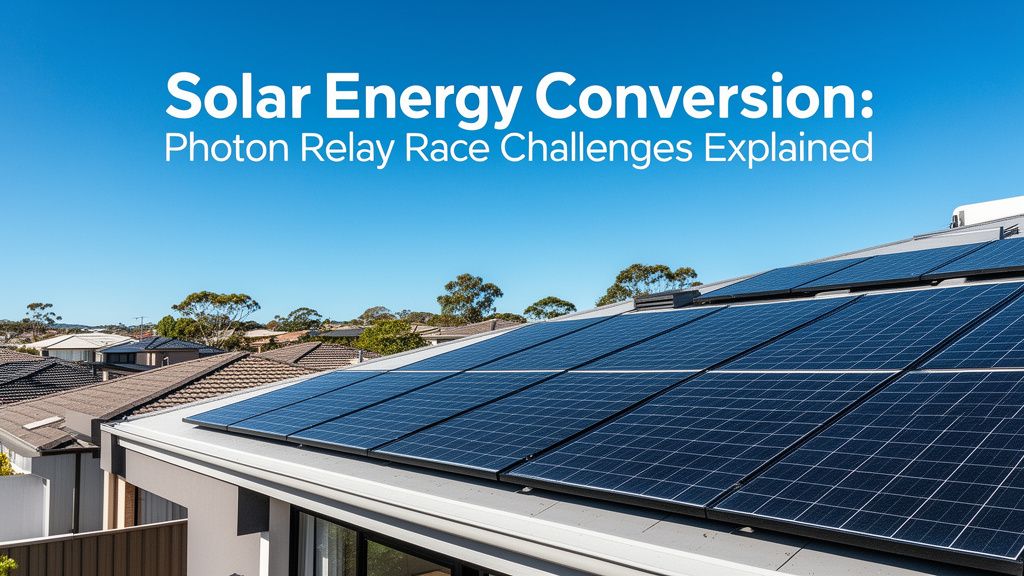
The "Photon Relay Race" is a helpful way to visualise how solar panels convert sunlight into usable electricity, highlighting where challenges can occur. Imagine the sun as the starting gun, firing tiny packets of energy called photons towards Earth. These photons are the "batons" in our race, carrying precious energy. When they hit your rooftop solar panel, the race truly begins, involving a series of energy transfers, much like runners passing a baton in a relay. Each stage of this race is critical, and any fumbles or slow runners can reduce the amount of electricity ultimately generated. From the moment the photon arrives until the power is ready to run your air-con, there are multiple handovers where energy can be lost, impacting the efficiency and cost-effectiveness of your solar investment.
The Starting Gun: Photons from the Sun
The race starts with the sun blasting photons our way. Each photon carries a specific amount of energy, determined by its wavelength – think of them as batons of different colours and weights. For a solar panel to "catch" a baton, the photon's energy needs to be just right. This initial reception is crucial, as not all photons hitting the panel surface are absorbed or possess the ideal energy for conversion. It's the first test of our team's readiness to receive the energy baton effectively.
The First Runner: PV Panels and Electron Excitation
Once a photon hits a photovoltaic (PV) cell, it’s absorbed by a semiconductor material, usually silicon. This absorption is the first runner grabbing the baton. The photon's energy excites an electron within the silicon, knocking it free from its atom. This newly freed electron is now carrying the energy – our baton has been passed to the first runner. The efficiency of this initial handover is paramount; a good panel design ensures that a maximum number of photons successfully transfer their energy to electrons, setting a strong pace for the rest of the race.
What Obstacles Do Photons Face in the Solar Conversion Relay?
Photons face several obstacles in their relay race through a solar panel system, significantly impacting the overall energy conversion efficiency and your eventual power bill. These obstacles manifest as energy losses at various stages, akin to dropped batons, runners tripping, or taking inefficient detours. For Aussie homeowners investing in a 6.6kW system, understanding these challenges means appreciating why some systems perform better in our harsh conditions. Losses can accumulate, turning a potentially powerful 25kWh daily output into a less impressive 18-20kWh, directly affecting your return on investment and how quickly your system pays for itself.
Dropped Batons: Absorption and Thermalisation Losses
One major hurdle is that not all photons are absorbed by the PV material, or they might not have the ideal energy. Some photons simply bounce off the panel's surface, while others pass straight through. This is like a runner missing the baton entirely. Even if a photon is absorbed, if its energy is too high, the excess energy is often lost as heat – known as thermalisation. This is like a runner burning off energy unnecessarily, causing the panel to heat up, which ironically further reduces its efficiency. In Australia’s scorching summers, this thermalisation becomes a bigger issue, slowing down our "runners" and making them less effective as the mercury rises above 30°C, leading to a noticeable dip in daily generation.
Slow Runners: Recombination and Wiring Resistance

After an electron is excited, it needs to move through the circuit to create current. However, sometimes these excited electrons "recombine" with their original atoms before they can be harnessed, effectively dropping the baton before it can be passed on. This is a significant source of loss within the silicon material itself. Furthermore, as the electrons travel through the panel's internal wiring and then through the cabling to the inverter, they encounter electrical resistance. This resistance generates heat and reduces the energy available, much like a slow runner dragging their feet. Poor quality wiring or long cable runs can exacerbate this, adding preventable losses to your system's performance and making your solar dollars work less hard.
How Do We Improve Our Chances of Winning the Solar Energy Race?
Improving your chances of winning the solar energy relay race, meaning maximising your system's output and financial savings, involves smart choices in technology and installation. It’s about ensuring every runner is fast, every baton handover is smooth, and the entire team is performing optimally. For an average 6.6kW residential solar system in Australia, optimising these aspects can mean the difference between saving $1,500 and $2,000 annually, significantly affecting your payback period which typically sits around 3-5 years. Investing in quality components and a reputable installer truly pays dividends, turning potential losses into more dollars in your pocket through higher feed-in tariffs and reduced reliance on grid power, particularly when electricity prices average around 30-40 cents per kWh.
Smarter Runners: Advanced Panel Technologies
The quality of your solar panels – our primary runners – plays a massive role. Modern advancements like PERC (Passivated Emitter Rear Cell) and n-type silicon cells are like equipping our runners with top-tier athletic gear. These technologies are designed to capture more photons and reduce recombination losses, allowing electrons to move more efficiently. For example, PERC cells improve light capture and reduce heat generation, performing better in our sunny, hot climate. N-type cells, less prone to light-induced degradation (LID) and potential-induced degradation (PID), ensure our runners stay strong for the entire 25+ year lifespan of the system, offering consistent output and a fair dinkum return on your initial investment of typically $6,000 - $10,000 for a quality 6.6kW setup.
Expert Coaches: The Role of Inverters and Installation Quality
The inverter is the final, crucial runner in our relay, converting the direct current (DC) electricity from the panels into alternating current (AC) that your home appliances use. High-quality inverters feature Maximum Power Point Tracking (MPPT) which is like an expert coach constantly adjusting strategies to ensure the panels are always operating at their peak efficiency, even under varying light conditions or temperatures. Microinverters and power optimisers take this a step further, providing individual "coaching" to each panel, ensuring that if one panel is shaded (a runner stumbles), it doesn't slow down the entire team. Furthermore, professional installation, with correct panel orientation, tilt, and meticulous wiring, minimises resistance and ensures the entire "track" is clear and ready for a record-breaking performance. Choosing a "shonky" installer might save a few bucks upfront, but it’ll cost you much more in lost generation and potential headaches down the track.
Key Takeaways
- Solar energy conversion involves a multi-stage "photon relay race," where energy losses can occur at each transfer point within your PV system.
- Common challenges include photons not being absorbed, energy lost as heat (thermalisation), and electrons recombining before use, all impacting efficiency.
- Australian conditions like high temperatures exacerbate thermalisation losses, making panel choice critical for sustained performance.
- Modern panel technologies (PERC, n-type) and advanced inverters (MPPT, microinverters) act as "smarter runners" and "expert coaches" to minimise losses.
- Investing in quality components and professional installation is essential to maximise energy generation, accelerate your payback period, and ensure long-term savings on your power bills.
Read More
For a comprehensive overview, check out our master guide: Read the Full Guide Here.