TL;DR: Australian federal and state policies often focus on ambitious renewable energy targets but frequently overlook critical grid infrastructure upgrades and fair market access mechanisms. This disconnect delays project delivery for large-scale solar and reduces the financial appeal of household solar exports.
Do Current Policies Prioritise Supply or Grid Readiness for Renewables?
Current federal and state policies heavily prioritise increasing renewable generation targets without adequately preparing the transmission and distribution grid to handle the new capacity. Australia's National Electricity Market (NEM) was originally designed for a centralised, fossil-fuel heavy system. Integrating intermittent solar and wind generation across vast distances requires significant, coordinated investment in new transmission lines, interconnectors, and grid stability services. The lack of alignment between ambitious generation targets, like NSW's 2030 target for 12 gigawatts of new renewable capacity, and the slow pace of transmission build-outs creates bottlenecks. New solar farms in regions with high generation potential often face lengthy connection queues and network congestion, preventing them from delivering power efficiently or at all. This structural imbalance means projects get approval but cannot connect or operate effectively.
The Disconnect Between Renewable Energy Targets and Network Capacity
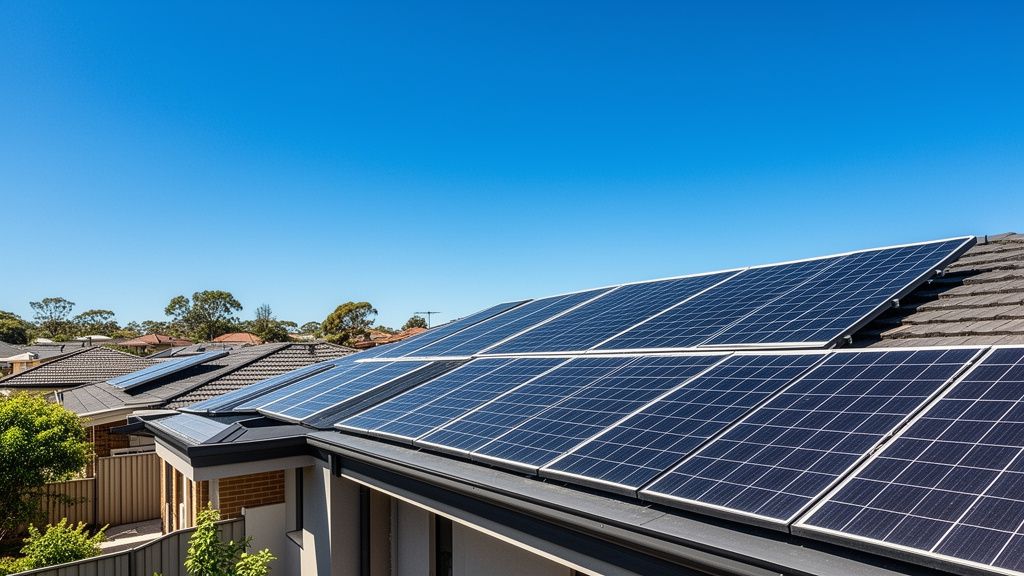
Australia boasts some of the world's highest rooftop solar penetration, with over 3.8 million systems installed by early 2024. While state governments, like Victoria, offer incentives such as the Solar Homes program, the grid infrastructure supporting this decentralised generation often lags. For large-scale projects, the Australian Energy Market Operator (AEMO) regularly identifies "system strength" issues in areas rich in renewables, meaning the grid struggles to maintain stability with high levels of inverter-based generation. This necessitates costly network upgrades or even curtailment of existing clean energy projects, reducing their output and financial viability. Governments announce new renewable zones, but the accompanying transmission lines can take a decade or more to plan and build, creating a significant policy gap.
How Delays in Transmission Upgrades Stall New Solar Farms
Delays in transmission line construction directly impact the commissioning of new solar farms. For example, the proposed HumeLink and VNI West transmission projects, vital for connecting new generation in the Renewable Energy Zones (REZs), face significant planning hurdles and community consultation. A large-scale solar farm in a regional REZ might secure financing and permits, only to sit idle or operate at reduced capacity because the transmission line needed to export its power to major demand centres is years from completion. This adds to project costs, increases investor risk, and slows the overall transition to a cleaner energy mix. Developers report waiting years for grid connection agreements, highlighting how grid infrastructure becomes the ultimate bottleneck.
Why Does Market Access Remain a Challenge for New Large-Scale Solar?
New large-scale solar projects face significant hurdles accessing the National Electricity Market (NEM) due to complex grid connection processes and outdated market rules that do not adequately value their contribution or manage their intermittency. Connecting a new large-scale generator to the NEM involves a detailed and lengthy process with AEMO and network service providers. This includes technical studies, complex modelling, and stringent compliance checks. The existing market framework often struggles to accommodate the fluctuating nature of solar generation, leading to requirements for expensive "firming" capacity, such as batteries or gas peakers, even when the solar resource itself is abundant. These additional costs and regulatory complexities make it harder for new solar to compete and secure long-term power purchase agreements.
Navigating Grid Connection and Congestion Charges
Securing a grid connection for a new large-scale solar project is a multi-year endeavour, fraught with technical and financial challenges. Developers must negotiate connection agreements with network companies, which can include substantial costs for upgrades to local infrastructure. Furthermore, once connected, projects in highly congested areas sometimes incur "congestion charges" or face mandatory curtailment during periods of high generation and low demand. This means a solar farm, even when generating power, might be instructed to reduce its output or receive a lower price for its electricity. This reduces revenue and increases the payback period for investors. For instance, generators in South Australia's Riverland region have experienced significant curtailment due to network limitations.
The Impact of Ancillary Services and Firming Capacity Requirements
The NEM requires various "ancillary services" to maintain grid stability, such as frequency control and voltage support. Traditional thermal generators automatically provided many of these services. Solar farms, being inverter-based, require different solutions, often through batteries or advanced inverters. AEMO increasingly mandates that new intermittent generators demonstrate how they will contribute to system strength or procure these services. This "firming" requirement, while necessary for grid stability, adds substantial capital and operational costs to solar projects. Without clear, consistent policy and market signals for these services, the financial viability of solar farms can be undermined, slowing investment in regions with excellent solar resources but weaker grids.


Are Retailer Policies Inhibiting Small-Scale Solar Exports?
Retailer policies, often influenced by state regulations, increasingly disincentivise small-scale solar exports through low feed-in tariffs and arbitrary export limits, directly impacting household return on investment. Historically, generous feed-in tariffs spurred rooftop solar adoption. However, most Australian retailers cut feed-in tariffs below 5c/kWh in 2024 in many states, effectively devaluing exported solar electricity. Simultaneously, network distributors impose export limits, often capped at 5kW per phase for residential connections, regardless of a household's actual generation capacity or consumption patterns. These two factors mean households with larger solar systems cannot fully utilise their generation potential, forcing them to either self-consume more power or invest in expensive battery storage sooner than planned, reducing the overall economic benefit of going solar.
The Shrinking Value of Solar Exports for Households
The financial benefits of exporting surplus solar power have significantly diminished for Australian households. While importing electricity from the grid costs residential customers anywhere from 25c to 40c per kWh, the payment received for exporting power is often a tenth of that. This substantial difference reduces the financial incentive for households to oversize their solar systems or even export at all. Instead, the focus shifts entirely to self-consumption. This policy direction, driven by both retailer pricing strategies and network concerns about grid stability, means a 10kW system might only provide marginal additional financial benefit over a 6.6kW system if much of its output must be exported at low rates. It makes payback periods longer than they might otherwise be.
Export Limits and Their Effect on Residential Battery Uptake
Export limits, imposed by network service providers, restrict the amount of power a household can send back to the grid at any given time. For instance, many properties can only export 5kW per phase, even if their solar system produces 10kW. If a home is only using 2kW, the remaining 3kW can be exported, but 5kW of potential generation might be wasted. This limitation directly encourages battery storage, as households look for ways to store their otherwise wasted excess generation for later use. While battery storage is a valuable technology, making it almost a necessity due to policy limitations, rather than an optimal economic choice, can inflate the upfront cost of a comprehensive home energy solution. It adds another financial hurdle for many families considering a shift to greater energy independence.
Key Takeaways
- Federal and state policies need better coordination between renewable energy targets and grid infrastructure upgrades to avoid generation bottlenecks.
- New large-scale solar projects require streamlined market access and clearer valuation for grid stability services to ensure financial viability.
- Households face declining financial incentives for solar exports due to low feed-in tariffs and restrictive export limits, increasing battery storage importance.
- Policy frameworks must adapt to support a decentralised, intermittent energy grid, moving beyond a focus solely on generation volume.
Read More
For a comprehensive overview, check out our master guide: Read the Full Guide Here.