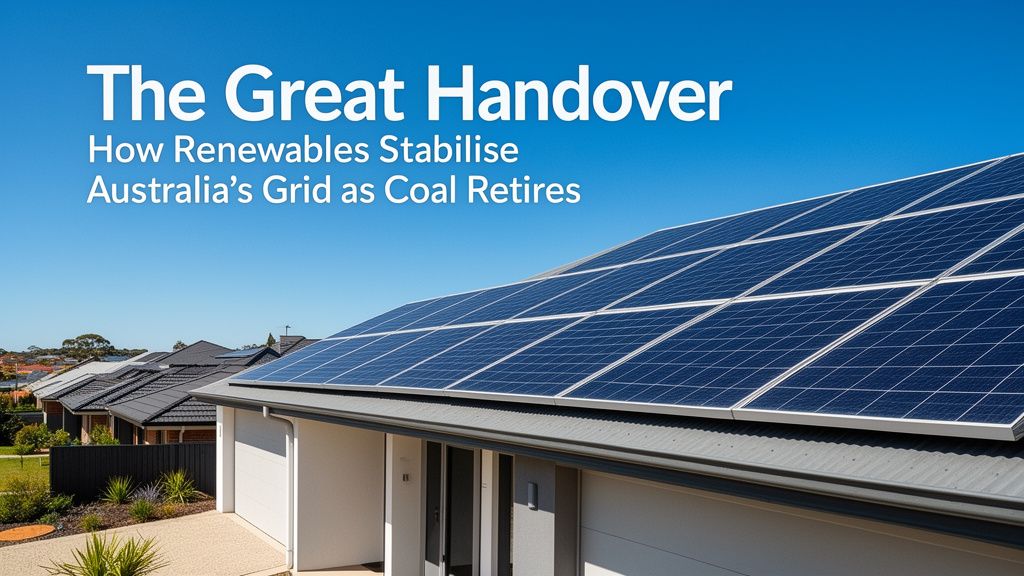
The Great Handover: How Renewables Stabilise Australia's Grid as Coal Retires
Australia is in the midst of a colossal energy transformation. For decades, our electricity grid has relied on the predictable, synchronous hum of coal-fired power stations. They provided not just power, but also the inherent stability that kept the lights on. Now, as these aging behemoths reach their end-of-life and are progressively retired, a new era is dawning. This isn't just about replacing gigawatts; it's about a "Great Handover" where clean, renewable energy steps up to not just power our homes and businesses, but also to stabilise our national grid. And the good news? Renewables are proving they're more than capable of the job.
The Legacy of Coal and Its Stability
Coal-fired power plants, for all their environmental drawbacks, offered a straightforward form of grid stability. Their massive spinning turbines possessed inertia – a physical resistance to changes in speed. This meant that if there was a sudden drop in power supply or a surge in demand, the grid frequency (which needs to stay around 50 Hertz in Australia) wouldn’t fluctuate wildly. These plants also provided “system strength” and voltage support, acting like the steady anchor for the entire electrical network. Their synchronous nature was the backbone of our grid for over a century.
The Renewable Revolution Takes Hold
Australia is a renewable energy superpower. We're blessed with some of the best solar irradiation and wind resources on the planet. Our rooftops are already covered in over 3.7 million solar PV systems, and utility-scale solar farms and wind farms are rapidly expanding across the country. This renewable boom has driven down electricity prices and significantly reduced our carbon footprint. However, wind and solar are "inverter-based" resources – they don’t have those heavy spinning parts that coal plants do. This difference initially raised questions about how they could maintain grid stability without the traditional inertia.
Stabilising the Grid: Inertia and Frequency
This is where advanced technology comes into play. While renewables don’t naturally provide inertia in the same way coal does, modern solutions are stepping in. Synchronous condensers, essentially motors designed to spin freely without generating electricity, are being strategically deployed. They mimic the inertia of traditional generators, helping to stabilise frequency. More importantly, grid-forming inverters (GFM) are a game-changer. Unlike older "grid-following" inverters, GFMs can actively set the voltage and frequency of the grid, acting like a virtual synchronous machine. They can respond to disturbances incredibly quickly – in milliseconds – often faster than conventional power plants can ramp up or down. This rapid response is crucial for maintaining frequency stability.
Beyond Inertia: Voltage and System Strength


Grid-forming inverters in battery energy storage systems (BESS) also excel at providing vital grid services beyond frequency control. They can dynamically provide voltage support, ensuring power quality remains high across the network. Furthermore, they contribute to "system strength," which refers to the grid’s ability to maintain stable voltage waveforms and recover quickly from faults. This is particularly important in remote or weaker parts of the grid where large-scale renewable projects are often built. The Australian Energy Market Operator (AEMO) is actively working to integrate these capabilities, recognising their potential to create a grid that is not just clean, but also more resilient and robust than ever before.
The Power of Storage and Smart Grids
Batteries are the linchpin of this stable, renewable future. From massive utility-scale BESS projects like the Victorian Big Battery (which can power a million homes for 30 minutes) to household battery systems, storage allows us to capture excess solar and wind power and deploy it exactly when and where it's needed. This smooths out the variability of renewables. Virtual Power Plants (VPPs) are also emerging, aggregating thousands of rooftop solar and battery systems into a collective resource that can provide grid services and respond to demand fluctuations. On top of this, smart grid technologies and demand-side management programmes allow us to dynamically manage consumption, further enhancing grid stability and reducing reliance on traditional generation.
The Economic Imperative and a Brighter Future
The transition is not just technically feasible; it’s economically driven. The cost of new solar and wind power is now significantly cheaper than new coal or gas, and battery costs continue to fall rapidly. This means a stable, renewables-dominated grid will not only be cleaner but also more affordable for Aussie households and businesses in the long run. Government agencies like ARENA and the Clean Energy Finance Corporation (CEFC) are investing heavily in these enabling technologies, ensuring Australia remains at the forefront of this global energy transformation.
Conclusion
The Great Handover is well underway. As Australia’s coal fleet progressively retires, it's clear that renewables, coupled with advanced inverter technology, battery storage, and smart grid solutions, are not just replacing lost generation but fundamentally re-imagining grid stability. We are building a future where our energy is not only clean and affordable but also more resilient and responsive than ever before. This is a monumental shift, and Australia is demonstrating to the world that a stable, reliable grid powered predominantly by renewables isn't just a dream – it’s our unfolding reality.
Read More
For a comprehensive overview, check out our master guide: Read the Full Guide Here.