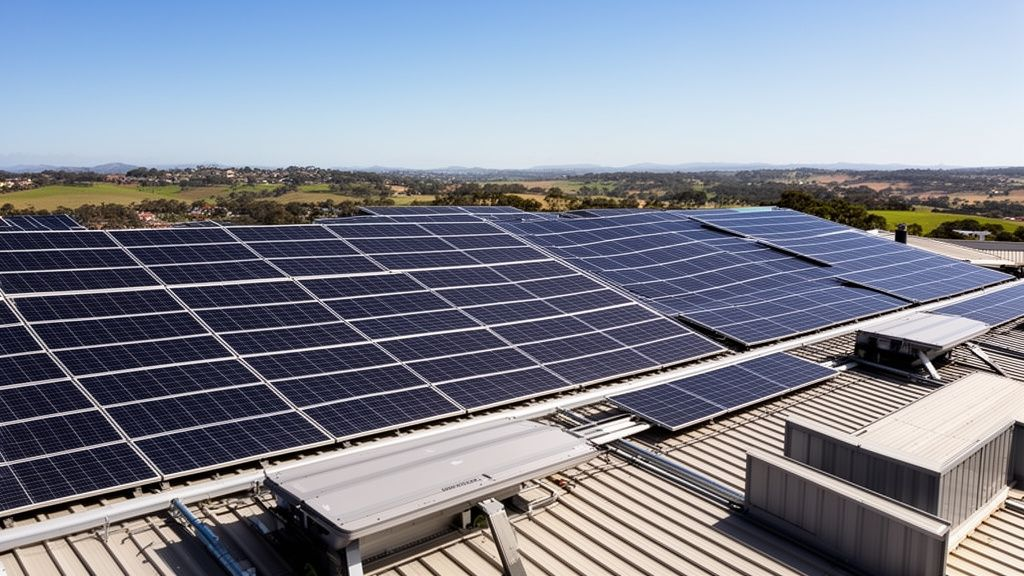
TL;DR: The Independent Planning Commission (IPC) of New South Wales has granted conditional planning approval to the massive Sundown solar and battery project located in the New England Renewable Energy Zone (REZ). Developed by Recurrent Energy, a subsidiary of Canadian Solar, the project will feature a 350-megawatt solar array and a 150 MW, four-hour battery storage system. To address environmental and local farming concerns, the IPC has mandated that the developer pave specific segments of the local Spring Mountain road, construct cattle-proof fencing, and maintain access across the Swan Brook bridge to protect local agricultural operations.
Strategic Approval by the Independent Planning Commission
On August 5, 2026, Rachel Williamson reported that the Sundown solar and battery project, situated at Spring Mountain inside the New England Renewable Energy Zone (REZ) in northern New South Wales, has successfully cleared its final state planning hurdle. The Independent Planning Commission (IPC) of NSW issued its formal approval after a brief two-month evaluation process. This quick determination occurred despite the project receiving 133 objections during its main planning phase.
Due to the long-distance nature of most objections, the IPC cancelled its scheduled public hearing when only one speaker—a local council representative with whom the IPC was already in active dialogue—registered to attend. None of the original 133 objectors attended the commission's sessions. However, the IPC did receive 19 additional submissions, reflecting a nearly equal split of support and opposition from local stakeholders. Ultimately, the commission determined that the project's broad public and environmental benefits outweighed the localized concerns, provided strict mitigation conditions were met.
Solving Local Infrastructure and Road Dust Challenges
The primary focus of the IPC’s conditional approval centres on Spring Mountain road, a dirt thoroughfare that intersects the nearby "Warrawee" agricultural property, splitting the operational farm into two distinct land parcels. The landowner of Warrawee raised critical objections regarding the impact of heavy construction traffic on local roads, noting that farm staff, contractors, and heavy vehicles rely exclusively on Spring Mountain Road and its bridge crossing over Swan Brook as their sole access point in and out of the property. Furthermore, the landowner pointed out that cattle have a constant right of way across the road.
To address these issues and protect farm employees' health from airborne dust and heavy traffic, the IPC has mandated that developer Recurrent Energy must pave and seal the sections of Spring Mountain road that run immediately adjacent to the residential house, a rainwater tank, the cattle yards, and other farm-related buildings. Additionally, Recurrent Energy is required to install secure, cattle-proof fencing along designated stretches of the road to ensure livestock can be moved safely between the split parcels. The developer must also ensure that the Swan Brook bridge crossing remains fully open and accessible to farm traffic throughout the entire construction and installation process.


The New England Renewable Energy Zone and Grid Integration
The Sundown project occupies a highly strategic position at the top of the New England REZ, an area that currently hosts two operational wind farms, alongside several approved and developing wind and solar installations. A major advantage of the Sundown site is its direct proximity to key transmission infrastructure, sitting astride an existing 330 kilovolt (kV) power line. This proximity minimizes the need for extensive new transmission line construction to connect the project to the National Electricity Market.
While local residents expressed high levels of concern regarding the impact of heavy construction trucks on regional roads, the IPC concluded that these temporary transport impacts did not justify a outright refusal of the project. Instead, the commission ruled that the comprehensive road-paving and maintenance conditions imposed on the developer would adequately mitigate these regional impacts. With state-level planning approval secured, Recurrent Energy must now complete the federal Environment Protection and Biodiversity Conservation Act (EPBC) process—where the project was deemed a "controlled action" back in 2022—and finalize its formal grid connection agreement.
Recurrent Energy’s Australian Clean Energy Pipeline
Recurrent Energy, a prominent global developer and subsidiary of Canadian Solar, has established a significant clean energy footprint across Australia. According to the industry tracker Renewmap, the Sundown project is the largest of three Australian solar projects currently on Recurrent Energy's books.
In addition to its solar assets, the company has five standalone battery storage projects currently in development. It is also advancing two major co-located solar and battery projects: the primary Sundown installation and another battery project co-located with the operational Carwarp solar farm. The integration of 150 MW of four-hour storage capacity at the Sundown site will provide critical grid firming capabilities, helping to stabilize the NSW grid by storing daytime solar generation and releasing it during evening peak demand periods.
Key Takeaways
- Project Scale: The Sundown development includes a 350-megawatt solar farm and a 150 MW, four-hour battery storage system in the New England REZ.
- Conditional Approval: The NSW Independent Planning Commission approved the project on the condition that the developer implements extensive dust-suppression and infrastructure measures.
- Road Upgrades: Developer Recurrent Energy must pave parts of Spring Mountain road next to a residential home, rainwater tank, and cattle yards to protect public health and safety.
- Farming Safeguards: The developer is required to build cattle-proof fencing and guarantee uninterrupted access across the Swan Brook bridge for the neighboring "Warrawee" cattle farm.
- Transmission Advantage: The project sits directly astride an existing 330 kV power line, facilitating grid integration once the federal EPBC process is closed out.