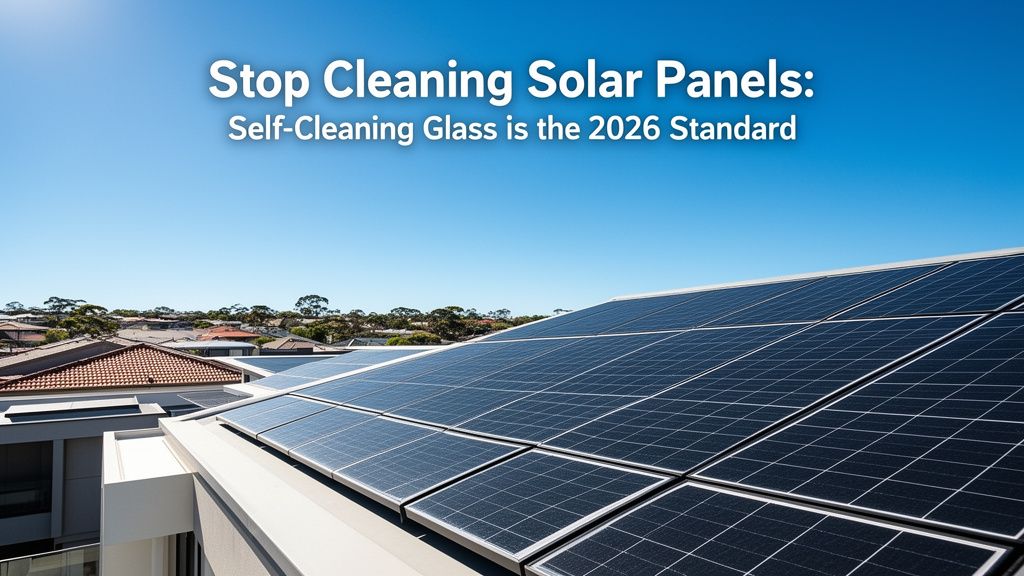
TL;DR: Manual solar panel cleaning is rapidly becoming obsolete for most Australian households due to the widespread adoption of advanced "self-cleaning" glass technology. These innovative coatings leverage natural processes to maintain panel efficiency, eliminating the need for costly and time-consuming routine maintenance by 2026.
Is the "Clean Your Panels Regularly" Advice Still Relevant for Aussie Homes?
For years, the standard advice for Australian solar homeowners has been to regularly clean their panels to maintain optimal performance, but with the rapid adoption of self-cleaning glass, this recommendation is quickly becoming outdated for many. The old wisdom held that dust, grime, bird droppings, and pollen could significantly reduce a solar system's output, potentially by 5-15% or more in particularly dusty or high-traffic areas. While this was undoubtedly true for conventional panels, the landscape of solar technology is evolving, making the traditional chore of panel cleaning an unnecessary burden for the majority of new installations. The prevailing consensus that regular cleaning is a non-negotiable part of solar maintenance simply hasn't caught up with the industry's advancements. It's time to challenge this ingrained habit and recognise that for most modern systems, the panels are perfectly capable of looking after themselves.
The Cost of Manual Cleaning vs. Performance Gains
Historically, homeowners either spent their own valuable time and effort cleaning panels, often risking safety on a slippery roof, or shelled out a fair whack for professional services. A typical professional solar panel clean in Australia can set you back anywhere from $150 to $250, depending on your location, roof access, and system size. If you're doing this every 6-12 months, that adds up to a substantial cost over the 25-year lifespan of a solar system – potentially $3,000 to $6,250 in recurrent expenses. While a 5-10% efficiency gain from cleaning can translate to more kilowatt-hours (kWh) and lower power bills, the diminishing returns often didn't justify the ongoing financial outlay or personal risk, especially when factoring in the cost of water and the inconvenience.
Typical Efficiency Losses Due to Grime
Without cleaning, conventional solar panels accumulate dirt and dust, leading to measurable efficiency losses. In arid or agricultural regions of Australia, where dust is prevalent, losses could easily hit 10-15% within a few months. Even in urban or coastal areas, a build-up of pollutants, salt spray, and bird droppings could reduce output by 5-7%. These losses directly impact your system's return on investment (ROI) by increasing your payback period. While a 5% loss might seem small on paper, over a year for a 6.6kW system, it could mean hundreds of dollars in lost savings. The goal of "self-cleaning" glass is to mitigate these losses passively, ensuring your panels operate closer to their peak performance without intervention.
How Does "Self-Cleaning" Glass Actually Work on Solar Panels?
"Self-cleaning" glass on solar panels employs a sophisticated two-pronged approach to keep surfaces clear: it's both hydrophilic and photocatalytic. This isn't magic; it's clever engineering designed to work with nature's elements – sunlight and rain – to break down organic matter and wash away inorganic dust. The glass is treated with a thin, transparent coating, most commonly titanium dioxide (TiO2), which reacts with UV light. This dual-action mechanism means that panels remain cleaner for longer periods, significantly reducing or eliminating the need for manual intervention and ensuring your solar investment consistently performs optimally without you lifting a finger.
Hydrophilic vs. Photocatalytic Action: What's the Difference?
The "self-cleaning" effect relies on two distinct processes. Firstly, the photocatalytic action: when ultraviolet (UV) light from the sun hits the titanium dioxide coating, it creates a chemical reaction that actively breaks down organic dirt and grime (like bird droppings, soot, or sap) into smaller, less adhesive particles. This process essentially "eats" the dirt, preventing it from sticking firmly to the glass. Secondly, the hydrophilic property comes into play during rain. Unlike regular glass where water beads up and often leaves streaks and dirt behind, the treated surface causes rainwater to spread evenly across the panel in a thin sheet. This sheeting action efficiently washes away the loosened dirt and decomposed organic matter, leaving the panel virtually spotless as it dries without leaving water spots.
The Evolution from Niche to Standard
What started as a niche, premium feature is rapidly becoming standard in higher-quality solar panels due to advancements in manufacturing and cost reductions. Early self-cleaning coatings were expensive and often seen only on architectural glass or high-end commercial solar projects. However, continuous research and development have made these coatings more durable, effective, and economical to produce. As manufacturers strive to differentiate their products and offer greater value, integrating self-cleaning technology has become a logical next step. By 2026, it's expected that a significant majority of new solar panel installations, particularly those from reputable brands in the Australian market, will feature some form of self-cleaning glass, cementing its status as an industry benchmark.
Does the Extra Cost for Self-Cleaning Panels Pay Off in the Long Run?
Yes, for the vast majority of Australian homeowners, the slightly higher upfront investment in solar panels with self-cleaning glass pays off handsomely over the system's lifespan through reduced maintenance costs and consistently higher energy production. While self-cleaning panels might add a small percentage to the overall cost of a new 6.6kW system – perhaps an extra $200 to $500 on a typical $5,000-$8,000 installation – this premium is quickly offset. Consider the avoided costs of professional cleaning over 20-25 years, which, as mentioned, can easily exceed several thousand dollars. Furthermore, panels that maintain better cleanliness naturally operate at higher efficiency, translating into more generated electricity and greater savings on your power bills from day one.
Calculating Your ROI Without Regular Cleaning Costs
Let's do some quick maths, mate. If you save $200 annually on professional panel cleaning and your self-cleaning system costs $300 more upfront, you've recouped that premium in just 18 months. Over 20 years, you're looking at a cool $4,000 saved directly on cleaning expenses alone. This doesn't even account for the additional electricity generated. If consistently cleaner panels mean just a 2% higher annual output compared to uncleaned standard panels, for a 6.6kW system in Sydney producing around 9,000 kWh/year, that's an extra 180 kWh annually. At an average export tariff of $0.08/kWh (or savings on import at $0.30/kWh), that's an additional $14.40 to $54 per year. While these figures might seem smaller individually, compounded over two decades, they significantly boost your overall ROI, turning a minimal upfront cost into substantial long-term gains.


The "Set and Forget" Advantage for Busy Aussies
Beyond the pure financial calculations, there's an undeniable lifestyle benefit to "set and forget" solar panels. For busy Australian families, retirees, or anyone who values their weekends, eliminating the chore of panel cleaning (or the hassle of scheduling and paying for a professional) is a massive win. It means less time worrying about rooftop access, ladders, and water usage, and more time enjoying the benefits of your solar investment without the ongoing maintenance burden. This peace of mind, knowing your system is efficiently working away with minimal input from you, is a significant intangible value that often outweighs the small initial price difference, making self-cleaning panels a no-brainer for modern living.
Who Should Still Consider Occasional Panel Cleaning?
While self-cleaning glass is revolutionary, it's not a magic shield against all forms of grime, meaning a small segment of solar owners might still benefit from occasional cleaning. These are typically households or businesses operating in highly specific, extreme conditions where the natural processes aren't quite enough to handle the sheer volume or type of soiling. It’s crucial to understand these limitations to ensure your system continues to perform optimally, even with advanced coatings. For most, however, the shift is towards monitoring performance rather than routine manual intervention.
Extreme Soiling: When Technology Needs a Hand
In environments with exceptionally heavy and persistent soiling, self-cleaning technology might be overwhelmed. This includes homes directly adjacent to major industrial sites, active construction zones, or very dusty rural properties with extensive agricultural activity like tilling or harvesting nearby. Similarly, panels with a very low tilt angle (less than 10-15 degrees) might struggle more with water runoff, allowing some residue to linger even after rain. While the photocatalytic action will still break down organic matter, an unusual accumulation of non-organic, dense grime might need a helping hand. Even in these rare cases, cleaning frequency would be drastically reduced compared to conventional panels, perhaps once every 2-3 years, rather than every 6-12 months.
Monitoring, Not Manual Labour: A Shift in Maintenance
The move to self-cleaning panels doesn't mean completely ignoring your system; it merely shifts the maintenance paradigm from proactive manual labour to passive performance monitoring. Most modern solar inverters come with apps that allow you to track your system's daily, weekly, and monthly output. If you notice a sudden, unexplained, and persistent drop in power generation that can't be attributed to weather patterns, it might be an indicator that something is indeed stuck on your panels. This data-driven approach allows you to intervene only when necessary, rather than on a fixed schedule. A quick visual inspection from the ground or a targeted clean of a specific issue is often all that's required, rather than a full, laborious panel wash.
Key Takeaways
- Self-cleaning solar glass is rapidly becoming the industry standard for new installations, largely eliminating the need for routine manual cleaning for most Australian homes.
- The technology uses both UV light to break down organic dirt and rainwater to sheet away all loosened debris, maintaining panel efficiency passively.
- The small upfront cost for self-cleaning panels is quickly offset by significant long-term savings from avoiding professional cleaning fees (hundreds to thousands of dollars).
- Most homeowners should stop budgeting for or performing regular panel cleans on new systems with self-cleaning glass.
- Only in extreme dust, industrial pollution, or very low-tilt situations might occasional, targeted cleaning still be beneficial, but monitoring performance data is the smarter approach.