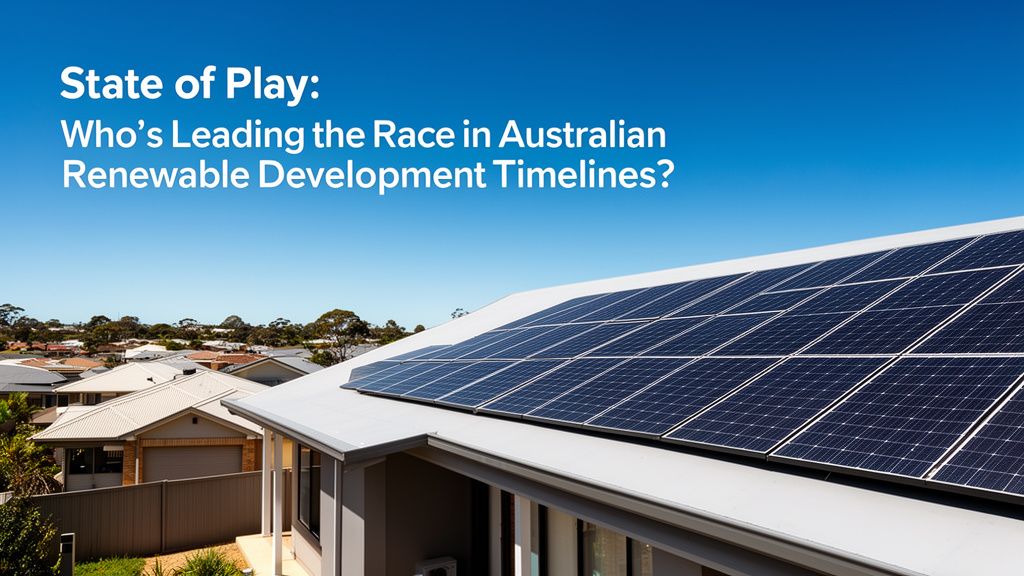
State of Play: Who's Leading the Race in Australian Renewable Development Timelines?
Australia is in the midst of a monumental energy transition. With ambitious national and state-based targets to reach net-zero emissions, the race is on to develop, build, and connect renewable energy projects at an unprecedented pace. It's not just about setting goals; it's about the tangible progress on the ground – the shovels in the dirt, the towers going up, and the megawatts flowing into the grid. So, who's really leading the charge in bringing these crucial projects to fruition, and what challenges are slowing down the timelines?
Australia’s renewable energy landscape is dynamic, with each state and territory pursuing its own unique strategies and grappling with distinct hurdles. While federal policy provides overarching direction, it's at the state level where much of the development activity is concentrated.
The Ambitious Landscape
Australia’s targets are bold. The federal government aims for 82% renewables in the National Electricity Market (NEM) by 2030. States like Queensland and Victoria are pushing for 70-80% renewables by 2035, while South Australia is already frequently running on 100% renewable power and aiming for net 600% by 2030 (generating more renewable energy than it uses). Tasmania has long been 100% renewable thanks to its hydro resources. The scale of investment and infrastructure required to meet these goals is staggering, presenting both immense opportunity and significant development challenges.
New South Wales: The REZ Pioneer
New South Wales has carved out a leadership position through its Renewable Energy Zone (REZ) model. These designated zones, such as the Central-West Orana REZ, are designed to streamline approvals and coordinate grid infrastructure upgrades, attracting significant private investment. The state's Energy Infrastructure Roadmap aims to deliver 12 GW of renewables and 2 GW of storage by 2030. While the REZ model is proving effective in de-risking projects and facilitating grid connections, the actual construction and commissioning within these zones are still ramping up. The challenge lies in translating ambitious plans into fully operational power plants on accelerated timelines, particularly with grid connection queues.
Queensland: Public Investment and the SuperGrid
Queensland is making a strong play with its "Queensland Energy and Jobs Plan," committing $19 billion in public investment to build the "Queensland SuperGrid." This includes significant investment in large-scale solar, wind, and pumped hydro projects like Borumba Dam and Pioneer-Burdekin. With targets of 70% renewables by 2032 and 80% by 2035, the state is leveraging its vast land resources and political will. The timeline for these massive infrastructure projects, especially pumped hydro, extends well beyond 2030, but the commitment to public ownership and strategic planning gives Queensland a distinct advantage in de-risking and fast-tracking essential components of its transition. They are aiming for energy independence, building entire supply chains within the state.
Victoria: Offshore Wind and Firming Power
Victoria is distinguishing itself with an aggressive pursuit of offshore wind, setting ambitious targets of 2 GW by 2032, 4 GW by 2035, and 9 GW by 2040. This is complemented by significant investment in large-scale batteries and transmission upgrades to support its onshore wind and solar farms. While offshore wind projects have longer development cycles, Victoria's early policy certainty is attracting global developers, potentially positioning it as a future leader in this nascent industry for Australia. The rapid deployment of grid-scale batteries is also helping to firm up the state's growing renewable generation.
South Australia: Already Ahead


South Australia frequently hits 100% renewable electricity generation and is often a net exporter. Its focus has shifted from simply adding renewables to ensuring grid stability through sophisticated grid management, large-scale batteries like the Hornsdale Power Reserve, and hydrogen projects. While other states are racing to build their initial renewable capacity, SA is refining its system for maximum renewable penetration and exploring next-generation firming technologies. Their leadership is less about rapid initial deployment and more about pioneering the operational challenges of a highly renewable grid.
Western Australia: Unique Challenges and Opportunities
Western Australia, with its distinct grids (primarily the South West Interconnected System or SWIS), is tackling decarbonisation with an emphasis on integrating renewables into an isolated system. The state is making significant strides in utility-scale solar and wind, particularly for industrial loads, and exploring standalone power systems for remote communities. While not part of the NEM, WA's progress in transitioning from a fossil fuel-heavy economy, especially in mining, presents a unique and important development pathway.
The Silent Leader: Rooftop Solar
Amidst the race for large-scale projects, it’s crucial not to forget Australia’s rooftop solar revolution. With over 3.8 million rooftop solar systems installed, contributing billions of dollars annually, it represents a massive, decentralised power plant. While not typically captured in utility-scale development timelines, rooftop solar continues to outpace forecasts, silently adding gigawatts of capacity and putting downward pressure on wholesale prices. This household-led deployment is a continuous, significant development timeline in itself.
Challenges to Timelines
Despite the varied successes, common hurdles impede faster development timelines:
- Grid Congestion and Connection: The existing grid infrastructure wasn’t designed for a decentralised, intermittent energy supply. Long queues for grid connection and the need for massive transmission upgrades are significant bottlenecks.
- Permitting and Approvals: Complex environmental assessments, native title negotiations, and local planning approvals can add years to a project’s timeline.
- Social Licence: Gaining community acceptance for large-scale projects, especially transmission lines and wind farms, remains a critical challenge.
- Supply Chain and Labour: Global supply chain issues and a shortage of skilled labour can delay construction and inflate costs.
Who’s Leading? It Depends.
There isn't a single clear leader across all metrics.
- NSW is leading in establishing a structural framework (REZs) that should accelerate future projects, once initial grid upgrades are complete.
- Queensland is making huge strides with strategic public investment and ambitious large-scale projects, aiming to create an entire clean energy industry.
- Victoria is showing strong leadership in the emerging offshore wind sector and rapid battery deployment.
- South Australia continues to lead in operational integration and high renewable penetration.
- Rooftop solar remains the quiet, consistent leader in terms of sheer added capacity on an ongoing basis.
The race in Australian renewable development timelines isn't just about who builds the most, but who builds it most effectively, integrates it most stably, and navigates the complex web of challenges most adeptly. The next few years will be critical in seeing how these ambitious plans translate into reality, shaping Australia's energy future for decades to come.
Read More
For a comprehensive overview, check out our master guide: Read the Full Guide Here.