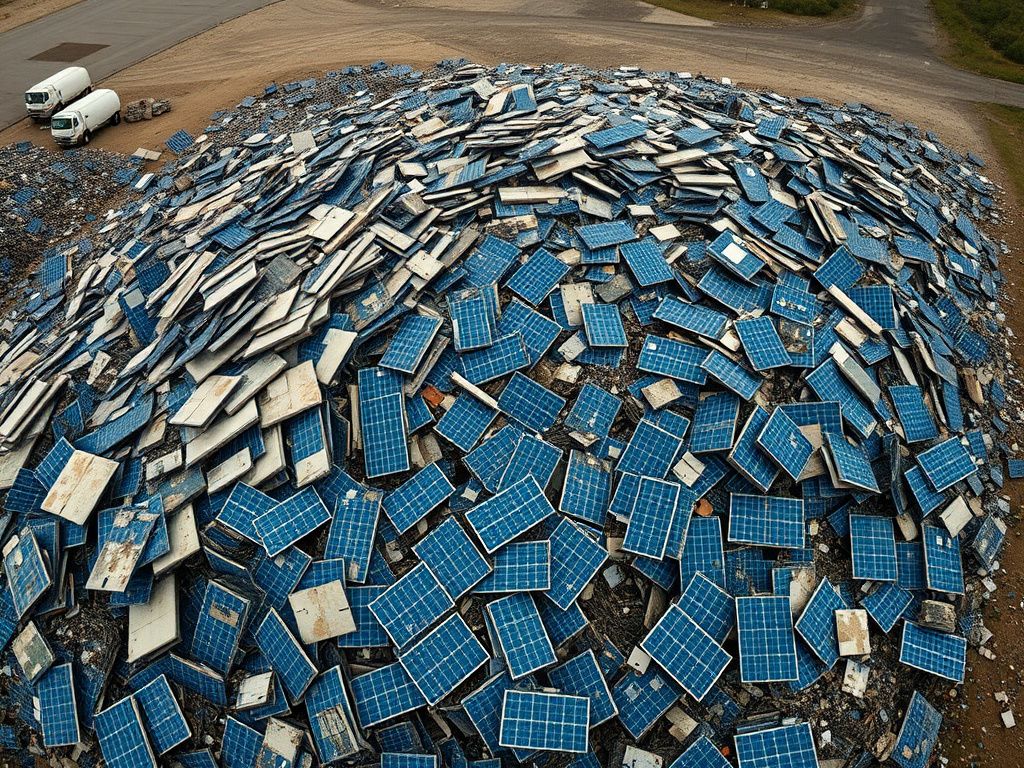
Solar Panel Waste: How Big Is the Problem in Australia?
Australia is one of the most solar-saturated countries on Earth. More than 3.6 million homes have rooftop solar, and the pace of installation shows no sign of slowing. That's brilliant for reducing emissions and cutting electricity bills. But there's a flipside that's only now coming into sharp focus: what do we do with all those panels when they stop working?
The solar panel waste problem isn't a future hypothetical. It's happening right now. And the numbers are bigger than most people realise.
For a complete overview of recycling options, read our Complete 2026 Guide to Solar Panel Recycling in Australia.
The Numbers: How Much Waste Are We Talking About?
Let's start with the raw figures:
- Panels installed in Australia to date: approximately 40–45 million individual panels (across residential, commercial, and utility-scale systems).
- Average panel lifespan: 25–30 years, but many are replaced earlier due to damage, efficiency loss, or upgrades.
- Panels currently reaching end of life: an estimated 1.5–2 million panels per year as of 2026.
- Projected waste by 2030: over 100,000 tonnes per year, according to University of New South Wales research.
- Projected cumulative waste by 2050: up to 1 million tonnes of panels in the waste stream.
To put that in perspective: 100,000 tonnes is roughly equivalent to 5 million individual panels per year. That's a staggering volume — and it's growing.
Why Is the Problem Growing So Fast?
Several factors are accelerating the waste timeline:
1. The Early Adoption Wave
Australia's solar boom kicked off in earnest around 2008–2012, driven by generous state feed-in tariffs and the federal SRES. Those early systems are now 14–18 years old. While many panels are still functional, the inverters and mounting hardware are often failing, prompting full system replacements.
2. Technology Upgrades
Modern panels are significantly more efficient than those installed a decade ago. A 2012-era system might produce 3–4 kW from 16 panels. Today, the same roof space could support 8–10 kW using fewer, higher-wattage panels. The economic case for early replacement is strong, even when old panels still work.
3. Storm and Hail Damage
Australia's extreme weather events — particularly hailstorms — can destroy thousands of panels in a single event. The 2025 hailstorms across parts of Sydney and South-East Queensland damaged tens of thousands of panels, many of which ended up in landfill due to the sudden volume spike.
4. Commercial and Utility-Scale Decommissioning
It's not just rooftops. Australia's first large-scale solar farms, built in the early 2010s, are approaching mid-life. While utility-scale decommissioning is further off, the planning needs to start now — a single large solar farm can contain hundreds of thousands of panels.
Where Does the Waste Go Today?
As of 2026, the breakdown is roughly:
- 20–25% recycled — through specialist facilities or e-waste collection programs.
- 5–10% reused — panels with remaining capacity diverted to second-life applications.
- 60–70% landfilled — the majority, driven by cost and convenience.
- 5–10% illegally dumped or improperly disposed of — a persistent problem, especially in regional areas.
That means roughly three-quarters of decommissioned panels in Australia are not being recycled. For a technology that's supposed to be green, that's a sobering statistic.


The Environmental Cost
Solar panels in landfill aren't just a waste of valuable materials — they pose genuine environmental risks:
- Heavy metal leaching: Older panels contain lead solder. Some thin-film panels contain cadmium. Over decades in landfill, these metals can leach into groundwater and soil.
- Resource loss: Every panel in landfill represents lost aluminium, glass, silicon, silver, and copper that would otherwise re-enter the supply chain. UNSW estimates the total recoverable material value from Australian end-of-life panels could exceed $1 billion by 2033.
- Carbon footprint: Manufacturing new panels from virgin materials has a significantly higher carbon footprint than using recycled inputs. Landfilling panels means more mining, more processing, and more emissions.
How Does Australia Compare?
Globally, Australia is both a leader in solar adoption and a laggard in solar recycling:
- European Union: Mandatory recycling under the WEEE Directive. Collection rates exceed 70% in leading countries like Germany.
- Japan: Strong government-industry partnerships have driven recycling infrastructure development alongside the solar build-out.
- United States: No national mandate, but individual states (Washington, California) have implemented their own schemes.
- Australia: No mandatory national scheme yet (expected 2027). Recycling infrastructure is growing but still insufficient for projected volumes.
The gap between our installation rate and our recycling rate is one of the widest in the developed world.
What's Being Done?
The good news is that momentum is building:
- State landfill bans: Victoria (2019), Western Australia (2024), and South Australia (2025) have banned or restricted solar panels from landfill.
- National pilot program: The new federal recycling pilot is making collection easier and cheaper. Learn more: Australia's New Solar Panel Recycling Pilot Program Explained
- Mandatory product stewardship: A national scheme requiring manufacturers and importers to fund end-of-life recycling is in final consultation, with implementation expected in 2027.
- ARENA investment: Continued funding for recycling technology R&D, helping Australian innovators develop more efficient and cost-effective processes.
- Industry growth: New recycling facilities are opening across the country, with capacity expanding rapidly.
What Can You Do?
As an individual homeowner, you can make a real difference:
- Don't landfill your panels — even if it's the cheapest option today, it's the worst environmental outcome.
- Use the pilot program — free or subsidised drop-off is available in most metro areas.
- Ask your installer — when upgrading, insist on responsible disposal of old panels.
- Spread the word — many Australians still don't know solar panels can be recycled.
The Bottom Line
Australia's solar panel waste problem is real, growing, and underappreciated. But it's not unsolvable. With the right infrastructure, regulation, and public awareness, we can turn a potential environmental liability into a resource recovery opportunity.
The panels on your roof are part of Australia's clean energy future. Making sure they're recycled properly ensures they stay that way.
Read the Complete 2026 Guide for everything you need to know about recycling your solar panels.