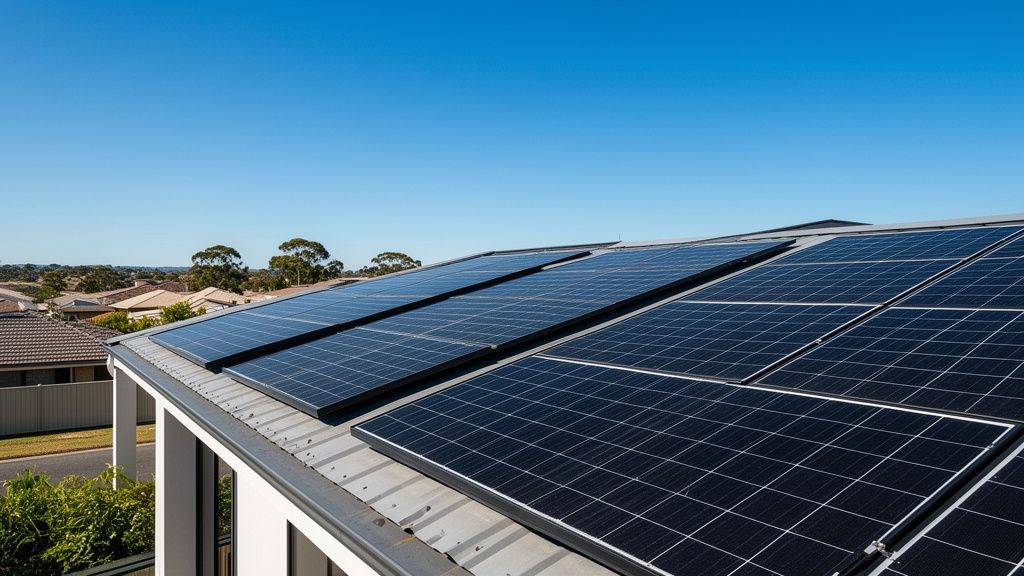
TL;DR: Solar panel degradation reduces your system's output over time. SunPower Maxeon panels typically degrade at a much slower rate (0.25% annually) compared to conventional panels (0.5% or more), leading to significantly higher energy production and better financial returns across their extended lifespan.
What is Solar Panel Degradation and How Does it Impact Your System?
Solar panel degradation describes the gradual loss of power output that all solar panels experience over their operational lifespan. This loss occurs naturally from exposure to environmental factors like UV radiation, temperature fluctuations, and humidity. A panel rated for 400W will produce slightly less power each year. For Australian homeowners, this matters because it directly affects how much electricity your system generates, how much you save on bills, and your overall return on investment. If a system degrades faster than expected, you’ll earn less from feed-in tariffs and buy more power from the grid.
Typical Degradation Rates for Standard Panels
Most conventional silicon solar panels come with a performance warranty that guarantees a certain power output over 25 years. This typically involves a "first-year degradation" of around 2-3%, followed by an annual linear degradation rate of 0.5% to 0.7%. For example, a common warranty might state a panel will still produce 84.8% of its original power after 25 years. This means a 6.6kW system, which might cost between $5,000 and $8,000 installed in a city like Brisbane, will be generating considerably less power towards the end of its warranty period than it did on day one. This reduction directly translates to hundreds, if not thousands, of dollars less in electricity bill savings and feed-in tariff credits over two decades.
How Do SunPower Maxeon Panels Resist Degradation Differently?
SunPower Maxeon panels employ a fundamentally different cell architecture designed to minimise degradation from the outset. Maxeon cells feature a unique solid copper foundation and thick tin-plated connectors. This design helps the cell withstand stresses that cause common issues in conventional panels. These panels are built with a robust contact system that moves electricity through the back of the cell, rather than using fragile metal ribbons on the front. This eliminates many common degradation pathways and supports a far longer operational life.
The Maxeon Cell Advantage
Maxeon cells avoid the fragile front-side contacts found on conventional solar cells, which often lead to microcracks, corrosion, and power loss. Instead, their cells use a solid copper backing and robust tin-plated connectors, making them significantly more resistant to cracking and corrosion. This design also prevents hot spots from forming in shaded areas, which are a major cause of degradation in other panels. SunPower Maxeon 3 panels, for example, typically degrade at an annual rate of just 0.25% after a initial first-year drop of around 2%, meaning they retain 92% of their original output after 25 years. Their extended 40-year warranty, which guarantees 88.2% output retention after four decades, directly reflects this superior durability.
Comparing Long-Term Performance and Warranties
The degradation rate and warranty length directly translate into how much power your solar system delivers over its lifetime. A lower degradation rate means your system produces more electricity for longer, leading to better financial outcomes. While SunPower Maxeon systems often carry a higher upfront cost – a 6.6kW system with Maxeon panels might range from $8,000 to $12,000 in Australia, compared to $5,000 to $8,000 for conventional systems – their superior longevity and lower degradation can offset this initial investment.


Financial Implications of Different Degradation Rates
Consider a 6.6kW system. After 25 years, a conventional panel with a 0.5% annual degradation rate might only produce about 87% of its initial power. A Maxeon panel, with its 0.25% annual degradation, will still be operating at 92% of its original capacity. This 5% difference in output retention translates to hundreds of kilowatt-hours of extra electricity generated each year. Over 25 years, this adds up to thousands of dollars in additional bill savings or feed-in tariff revenue. Many Australian homeowners want a system that performs reliably for decades. The 40-year warranty offered by Maxeon on many of their panels provides peace of mind and guarantees a certain level of performance for almost double the typical warranty period of other panels. This longevity makes Maxeon a strong contender for those prioritising long-term reliability and maximum lifetime energy yield.
Key Takeaways
- SunPower Maxeon panels degrade at a rate of 0.25% annually, half the typical 0.5% rate of conventional solar panels.
- Maxeon's solid copper foundation and unique cell architecture significantly reduce susceptibility to microcracks, hot spots, and corrosion.
- After 25 years, Maxeon panels typically retain 92% of their original output, compared to 80-87% for conventional panels.
- Maxeon offers an industry-leading 40-year warranty, guaranteeing 88.2% output after four decades, which is double the length of many standard warranties.
- Higher upfront costs for Maxeon systems are often offset by greater energy production and extended system life, leading to better long-term financial returns for Australian homes.
Read More
For a comprehensive overview, check out our master guide: Read the Full Guide Here.


