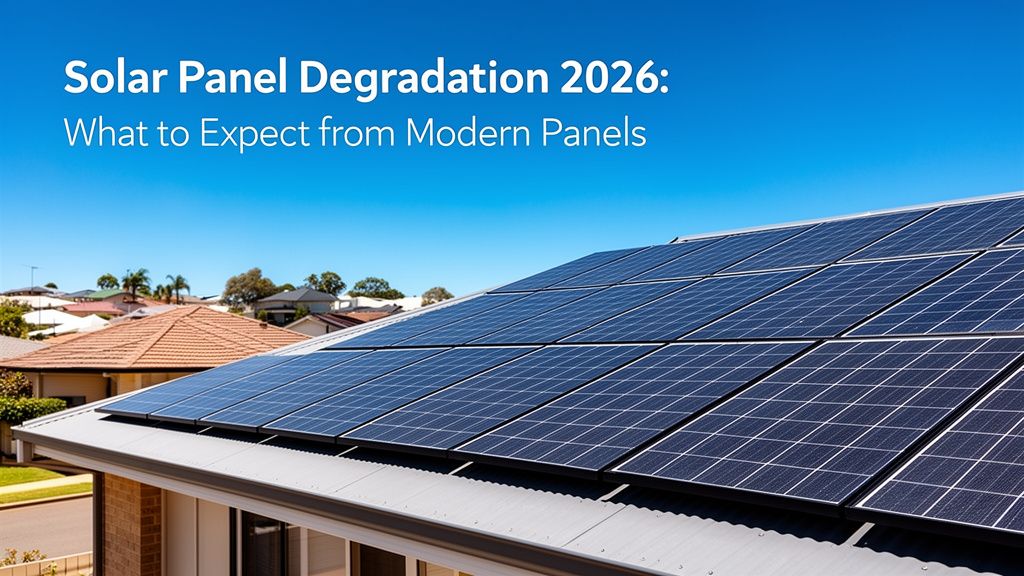
G'day, Aussies! If you're running a solar-powered home or business, or you’re thinking about joining the millions of Australians who have embraced solar, you've likely heard whispers about "solar panel degradation." It’s a natural process, but one that often raises questions about the long-term performance and value of your investment.
As we look towards 2026, the good news is that modern solar technology has made leaps and bounds. The panels available today are far more robust and efficient than those even a decade ago, significantly changing what we can expect from degradation.
Understanding Solar Panel Degradation
Simply put, solar panel degradation is the gradual reduction in a panel's power output over time. It's an unavoidable reality, much like how your car’s engine becomes less efficient with age. This decline is due to a combination of factors, including exposure to UV light, heat, moisture, and various stresses on the panel's materials.
However, it's not a sudden drop-off. It's a slow, predictable process that manufacturers factor into their warranties and system design. For older panels, typical degradation rates might have been around 0.7% to 1% per year. While that might sound small, it added up over a 25-year lifespan.
The Evolution of Solar Panels: A Look Back
A decade ago, the solar landscape was dominated by standard polycrystalline and early monocrystalline panels. These were great for their time, but their susceptibility to issues like Potential Induced Degradation (PID) and Light Induced Degradation (LID) meant their output could diminish more noticeably over time. Early encapsulation materials were also less resistant to the harsh Australian sun.
Fast forward to today, and the engineering behind solar panels is far more sophisticated. Manufacturers have poured significant resources into research and development, leading to panels that are not just more powerful, but also designed for extreme longevity and minimal degradation.
Modern Marvels: How Today's Panels Fight Degradation
The panels you’d install in 2026 (or even today) are a different breed. Thanks to advanced cell technologies and improved manufacturing processes, modern panels are engineered to resist degradation far more effectively.
- PERC (Passivated Emitter Rear Cell) Technology: This was a game-changer, improving efficiency and reducing heat-related losses.
- Half-Cut Cells: By halving the cells, resistance losses are reduced, leading to lower operating temperatures and higher output, which in turn minimises degradation.
- N-Type Cells (e.g., TOPCon, HJT): These are the superstars of today and tomorrow. Unlike older P-type cells, N-type cells are inherently less susceptible to LID and PID. They often boast higher efficiencies and, crucially for our discussion, significantly lower degradation rates. TOPCon (Tunnel Oxide Passivated Contact) and HJT (Heterojunction Technology) are two leading N-type variations known for their superb performance and stability.
- Improved Encapsulation: Modern panels use advanced EVA (Ethylene Vinyl Acetate) or even newer encapsulation materials and superior glass, offering better protection against moisture ingress and UV exposure, especially vital under the intense Australian sun.
- Robust Framing and Junction Boxes: Enhanced structural integrity and better heat dissipation from the junction box also contribute to overall panel longevity.
These innovations mean that while degradation is still a factor, its impact is far less pronounced than it used to be.
What to Expect in 2026: The Numbers
For modern, high-quality solar panels available in 2026, you can expect an annual degradation rate typically ranging from 0.25% to 0.5% per year.
Many top-tier manufacturers now offer linear performance warranties that guarantee at least 87-90% of the original output after 25 years, and some even guarantee 85% after 30 years. Compare that to older panels that might have been closer to 80% after 25 years. This tighter guarantee reflects the confidence manufacturers have in their modern technology.


Australian Conditions: A Unique Challenge
Australia's climate presents particular challenges for solar panels: scorching summers, high UV radiation, and in some regions, cyclonic winds and hail. High-quality modern panels are designed with these factors in mind. Their robust construction, advanced cell architecture, and superior materials help them withstand extreme temperatures and UV exposure without accelerating degradation. Choosing panels specifically rated for harsh conditions, with excellent temperature coefficients and strong mechanical load ratings, is paramount for Aussie homes.
The Power of Warranties
When investing in solar, always pay close attention to the warranties. You'll typically encounter two types:
- Product Warranty: This covers manufacturing defects and material faults, often for 10-25 years.
- Performance Warranty: This is where degradation rates come into play. It guarantees a minimum power output percentage over 20-30 years. For instance, a "25-year linear performance warranty" might guarantee 98% in the first year and then a maximum degradation of 0.5% per year thereafter, ensuring 87% output by year 25.
Always choose panels from reputable manufacturers with a strong presence in Australia, ensuring that if you ever need to make a warranty claim, there’s a local entity to support you.
Real-World Impact on Your Wallet
Let's consider a typical 6.6kW solar system installed on an Australian home, which might generate around 9,000 kWh per year in a location like Sydney.
- With a 0.5% annual degradation rate: After 25 years, your system would still be producing approximately 87.5% of its initial output (9,000 kWh * 0.875 = 7,875 kWh).
- With a 0.25% annual degradation rate (achievable with premium panels): After 25 years, your system would still be humming along at about 93.75% of its initial output (9,000 kWh * 0.9375 = 8,437 kWh).
Considering electricity retail prices currently hover around $0.25 - $0.35 per kWh, that difference of nearly 560 kWh annually could translate to over $150 in additional savings each year after 25 years, simply by choosing panels with a lower degradation rate. Over the system's lifetime, these numbers truly add up, impacting your overall return on investment.
Minimising Degradation: What You Can Do
While modern panels are built to last, you can also play a role in maximising their longevity and performance:
- Choose Quality Components: Start with reputable, high-efficiency panels and a reliable inverter. Don't skimp on quality.
- Professional Installation: A shoddy installation can lead to hot spots, micro-cracks, and other issues that accelerate degradation. Always use a Clean Energy Council (CEC) accredited installer.
- Regular Cleaning: Dust, bird droppings, and grime can reduce output. A quick hose down a couple of times a year (when the panels are cool) can make a difference.
- Routine Maintenance: While solar systems require little maintenance, a professional check-up every few years can identify any potential issues early.
The Bottom Line: Investing in the Future
The outlook for solar panel degradation in 2026 is overwhelmingly positive. Modern panels are a testament to relentless innovation, offering significantly lower degradation rates and longer performance warranties. This means greater peace of mind, more consistent energy savings, and a more robust return on your investment over decades.
For Aussie homeowners and businesses, choosing modern, high-quality solar isn't just about saving a few dollar bucks; it's about investing in a reliable, sustainable future, confident that your system will continue to perform strongly for years to come.
Ready to harness the power of the Australian sun with confidence? Chat with a local solar expert today to explore the latest panel technologies for your home or business.
Read More
For a comprehensive overview, check out our master guide: Read the Full Guide Here.