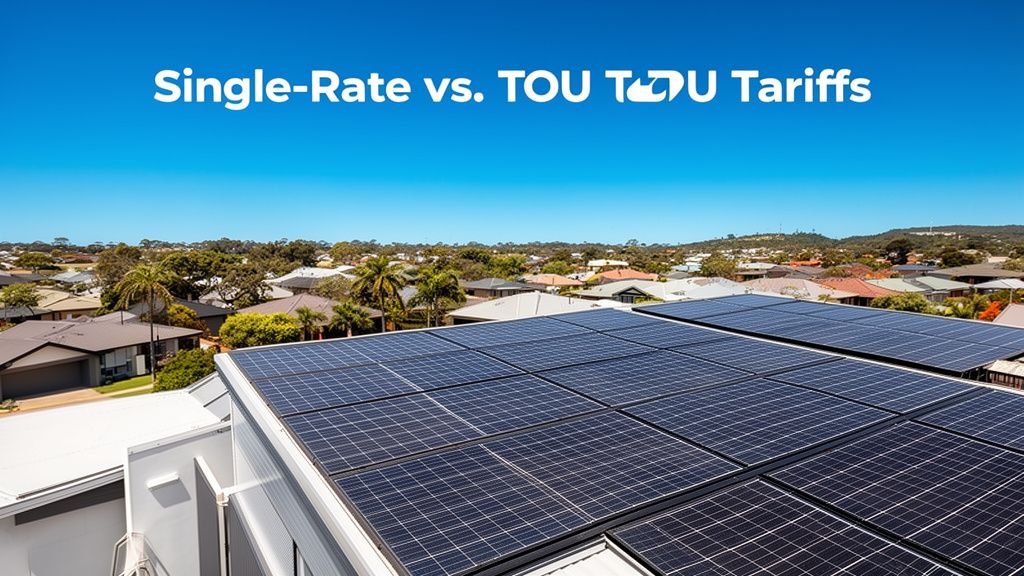
TL;DR: For Australian solar owners, Time-of-Use (TOU) tariffs often offer greater savings, particularly with battery storage, by allowing you to export at higher peak rates and reduce grid consumption during expensive periods. Single-rate tariffs provide predictable billing, which suits households with consistent daytime electricity use who export less. Your household's specific consumption patterns and solar setup determine which tariff saves more.
What Is a Single-Rate Tariff and How Does It Work with Solar?
A single-rate tariff charges you the same price for every kilowatt-hour (kWh) of electricity you consume from the grid, regardless of the time of day or week. This structure simplifies your electricity bill and is straightforward to understand. For instance, your retailer might charge 30 cents per kWh whether you're using power at 10 AM on a Tuesday or 7 PM on a Saturday. Your solar system offsets your usage first, and any excess solar generation feeds back into the grid, earning you a feed-in tariff (FiT).
This tariff type often suits households with predictable, high daytime electricity use that closely matches their solar production. If you work from home, run major appliances like a washing machine or dishwasher during daylight hours, or have electric vehicle charging during the day, a single-rate tariff can simplify your savings. Your solar panels directly reduce the kWh you buy from the grid at a constant rate. Most Australian retailers cut feed-in tariffs below 5c/kWh in 2024, so maximising self-consumption usually provides better value than exporting to the grid.
How Predictable Billing Affects Your Savings
Predictable billing from a single-rate tariff makes budgeting easier for many Australian families. You know exactly what you pay for each unit of electricity you import, removing the need to track peak and off-peak periods. This simplicity means you do not need to adjust your appliance usage times to avoid higher rates. With solar, if your system generates more than you use, you still earn the same FiT rate at any time you export. This makes it easier to calculate your potential savings and payback period without complex analysis of your consumption habits. A typical 6.6kW solar system in Brisbane might reduce a single-rate bill by 60-70% if the household uses most of its power during daylight hours.
How Do Time-of-Use Tariffs Differ and Benefit Solar Owners?
Time-of-Use (TOU) tariffs charge different prices for electricity depending on the time of day and sometimes the day of the week. These tariffs typically divide the day into three periods: peak, shoulder, and off-peak. Peak periods, often in the late afternoon and early evening (e.g., 4 PM to 9 PM), have the highest rates, reflecting high demand on the grid. Shoulder periods sit between peak and off-peak (e.g., 7 AM to 4 PM and 9 PM to 10 PM), with moderate rates. Off-peak periods, usually overnight and sometimes midday weekends, offer the lowest rates.
For solar owners, TOU tariffs present a significant opportunity to maximise savings. Your solar system generates power during the day, which typically falls into shoulder or off-peak periods when import rates are lower. However, during the evening peak, when solar production drops to zero, grid electricity costs significantly more, often exceeding 50 cents per kWh in cities like Melbourne or Adelaide. Strategically, solar owners can self-consume during the day to avoid mid-range shoulder rates and, crucially, export excess solar power to the grid during shoulder periods for a better FiT or store it in a battery to use during expensive peak times.
Maximising Export and Storage with TOU Tariffs
Maximising export and storage with a TOU tariff involves strategic energy management. If your electricity plan offers a decent feed-in tariff during shoulder periods (which sometimes align with higher demand during the day), exporting your excess solar can be valuable. However, the real game-changer with TOU tariffs is battery storage. A home battery allows you to store your daytime solar generation and use that stored energy during the high-cost peak evening period, effectively buying power from your panels at zero cost instead of paying premium grid rates.
For example, a household in Sydney on a TOU tariff might pay 18c/kWh off-peak, 35c/kWh shoulder, and 55c/kWh peak. If they use a 10kWh battery to cover their 5kWh evening peak demand, they save $2.75 ($0.55 x 5kWh) daily compared to buying from the grid. Without a battery, they might still save by shifting their dishwasher or washing machine use to off-peak times overnight or during the day. This flexibility and the potential for significant peak period savings make TOU tariffs attractive for solar households, particularly those with batteries.
Which Tariff Saves You More: Single-Rate or Time-of-Use?
The tariff that saves you more depends entirely on your household's electricity consumption patterns, whether you have battery storage, and your retailer's specific rates and feed-in tariffs. For households without a battery who primarily use electricity during daylight hours when their solar is producing, a single-rate tariff can be simpler and equally effective at reducing bills. These homes minimise grid imports naturally. However, if you consistently use a lot of electricity in the evenings after the sun goes down, a single-rate tariff means you pay the same price for that power as you do during the day, which might be higher than a TOU off-peak rate but lower than a TOU peak rate.

Households with significant evening electricity use, especially those who have installed or plan to install battery storage, almost always benefit more from a TOU tariff. The ability to avoid expensive peak rates by drawing from your battery or shifting consumption to off-peak times provides substantial savings. Furthermore, some TOU plans offer slightly higher feed-in tariffs during shoulder periods, boosting export value. Always compare the specific peak, shoulder, and off-peak rates, alongside the feed-in tariffs, from various retailers in your area before deciding. A detailed analysis of your past electricity bills, showing when you use power, helps you choose the right option.
Factors Influencing Your Best Tariff Choice
Several factors influence your best tariff choice. Your daily consumption profile is key: do you use most power during the day, evening, or overnight? Families with members home all day might suit single-rate, while working families with evening consumption often favour TOU. Battery storage significantly enhances TOU savings by allowing you to self-consume during peak times. Without a battery, you must actively shift your consumption to off-peak periods to gain an advantage.
Your solar system size also plays a role. A larger system might produce more excess power, and if you are on a TOU tariff, you could potentially export this during valuable shoulder periods. Your current retailer's specific rates and feed-in tariffs matter immensely. Some retailers offer minimal differences between single-rate and TOU, while others have large gaps between peak and off-peak. Always review all options from providers like Origin, AGL, or EnergyAustralia in your region. Regularly reviewing your electricity bills and comparing available plans ensures you maximise your solar savings year after year.
Key Takeaways
- Analyse your electricity usage: Understand when your household consumes the most power to match it with the best tariff structure.
- Consider battery storage: If you have or plan to get a battery, a Time-of-Use tariff usually offers greater financial benefits by letting you avoid expensive peak rates.
- Compare retailer offers: Specific peak, shoulder, off-peak rates, and feed-in tariffs vary widely between electricity providers in your area.
- Maximise self-consumption: Regardless of your tariff, using your solar power directly during the day usually provides more value than exporting it for a low feed-in tariff.
- Review regularly: Your household's energy needs and available tariff plans can change, so periodically check if your current tariff remains the most cost-effective.
Read More
For a comprehensive overview, check out our master guide: Read the Full Guide Here.