TL;DR: Australia's renewable energy sector has achieved a wave of positive financial investment decisions (FIDs), led by Ark Energy's $1.3 billion Richmond Valley Solar Farm and Battery Energy Storage System (BESS) in NSW. Backed by government initiatives like Long-Term Energy Service Agreements (LTESAs), these major hybrid projects are combining large-scale solar arrays with long-duration lithium-iron phosphate (LFP) batteries to deliver dispatchable clean power directly to the grid.
The $1.3 Billion Richmond Valley Landmark Project
In July 2026, the first stage of what is set to become the largest solar-battery hybrid energy generator on Australia's primary grid officially locked in its construction funding. Developer Ark Energy, along with its Seoul-based parent company Korea Zinc, secured a historic Financial Investment Decision (FID) for the Richmond Valley Solar Farm and Battery Energy Storage System (BESS).
Located in the Northern Rivers region of New South Wales, approximately 25 kilometers south of Casino, the $1.3 billion project has secured all necessary state and federal development approvals. The complex funding package consists of $586 million in equity financing from Korea Zinc and $716 million in debt financing.
This project represents the first build-to-own development in Ark Energy's portfolio to achieve an FID. It has secured critical commercial backing from the New South Wales government through a Long-Term Energy Service Agreement (LTESA), demonstrating strong policy support for hybrid utility-scale storage.
Richmond Valley: Technical Specifications and Community Value
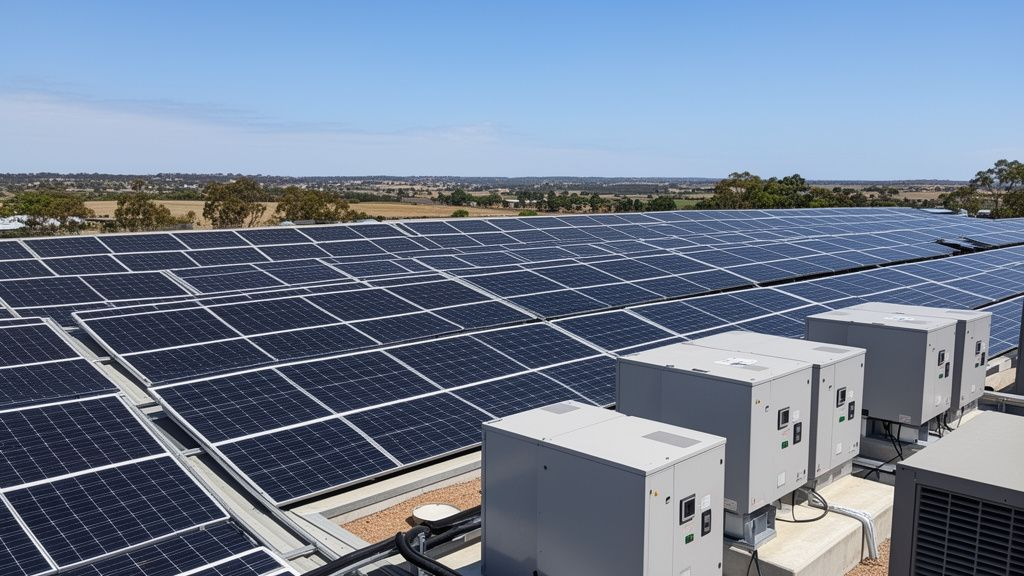
Stage one of the Richmond Valley development is designed to combine a 200 megawatt (MW) AC solar farm with a high-capacity, long-duration Lithium-iron phosphate (LFP) battery storage system. The battery will feature a power capacity of up to 275 MW and a storage capacity of 2,200 MWh, enabling it to supply firmed electricity back to the grid during peak demand periods.
To ensure smooth delivery, Ark Energy has locked in a panel supply agreement with Hanwha Energy and signed an Early Contractor Involvement (ECI) agreement with Elecnor Australia for the balance of plant. Construction is expected to support over 850 direct and indirect local jobs at its peak, bringing approximately $180 million in regional capital expenditure.
In addition to these economic impacts, Ark Energy has committed to an environmental buffer zone featuring a new 30-meter-wide vegetation corridor. It has also established a community benefit fund that will contribute $850 per installed MW of solar generation annually for the entire operational life of the project.


A Wave of Utility-Scale Storage FIDs Across Australia
According to renewable project tracking data from RenewMap, the Richmond Valley announcement is part of a broader wave of major utility-scale storage and hybrid projects securing financial close across Australia. Several other multi-million-dollar projects reached key milestones in July 2026:
- The Waroona Renewable Energy Project (Western Australia): Frontier Energy reached an FID for Stage 1 of this project, which features a 132 MW solar array paired with an 81.5 MW, 6.9-hour (565 MWh) battery storage system.
- The Fraser Coast Project (Queensland): Spanish developer Naturgy finalized a $500 million investment decision for a hybrid project combining 290 MW of solar with a 180 MW, two-hour battery system, situated 50km southwest of Maryborough.
- The Mokoan Battery Retrofit (Victoria): European Energy secured a financing package through Deutsche Bank to add a utility-scale battery directly to its existing 58 MW operational solar farm, helping stabilize the local Victorian grid.
- The Narrogin Wind Farm (Western Australia): Neoen Australia committed to building its 179 MW wind project in the WA Wheatbelt after securing a long-term power purchase agreement with state-owned utility Synergy.
These projects illustrate the accelerating transition toward firmed renewable energy systems, proving that developers are actively pairing generation with long-duration storage to meet grid security requirements.
Key Takeaways
- Richmond Valley Milestone: Ark Energy has secured a financial investment decision for its $1.3 billion hybrid solar-battery project located south of Casino, NSW.
- Massive Storage Capacity: Stage 1 of the Richmond Valley site pairs a 200 MW AC solar farm with a 275 MW / 2,200 MWh long-duration Lithium-iron phosphate (LFP) battery.
- Robust Capital Backing: The project's funding includes $586 million in equity from parent company Korea Zinc and $716 million in debt financing, alongside a NSW government LTESA.
- Broad Regional Benefits: Peak construction at Richmond Valley will support 850 jobs, generate $180 million in local spending, and supply a community benefit fund of $850/MW annually.
- National Pipeline Acceleration: Multiple projects including Frontier's Waroona, Naturgy's Fraser Coast, and European Energy's Mokoan battery upgrade have secured financing, reinforcing Australia's rapid shift to firmed energy systems.