TL;DR: South Australia has firmly established itself as Australia's undisputed solar leader, boasting significantly higher installed solar capacity per capita than the national average. This remarkable achievement is driven by progressive state policies, strong community uptake, and abundant sunshine, leading to lower power bills and a more resilient, renewable-powered grid for its residents.
What makes South Australia the nation's solar leader in kW per capita?
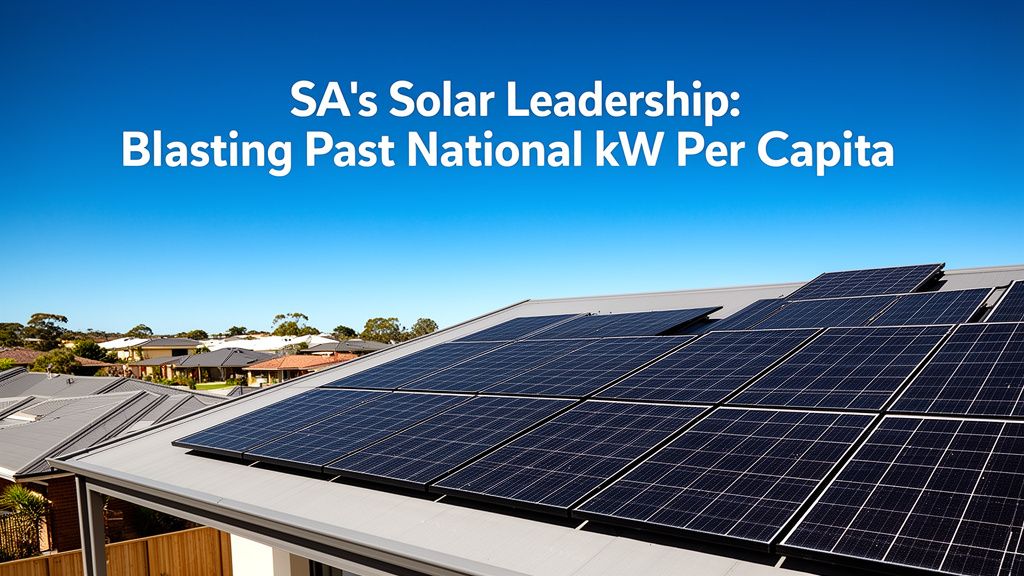
South Australia's leadership in solar energy is unequivocally demonstrated by its outstanding kilowatt per capita figures, significantly outperforming other Australian states and territories. This isn't just about having some solar; it's about a widespread, deep penetration of solar power across households and businesses, making the state a true trailblazer in renewable energy adoption. With over 40% of SA homes now featuring rooftop solar, and an average system size continually increasing, the sheer volume of clean energy being generated per person is a national benchmark. This proactive embrace of solar power by everyday Aussies in SA has cultivated an energy landscape that's not only greener but also more resilient and independent from traditional fossil fuel sources. The commitment from both state government and the community has fostered an environment where solar isn't just an option, it's becoming the default.
The Numbers Don't Lie: SA vs. The Rest
When we crunch the numbers, South Australia's solar supremacy becomes strikingly clear, with the state consistently topping national averages for installed solar capacity per person. As of recent figures, SA typically boasts residential solar penetration rates well over 40%, translating to installed capacity that can be 30-50% higher per capita than the national average. For instance, if the national average sits around 0.8-1.0 kW per person, SA is often soaring past 1.2-1.5 kW per person, depending on the latest data. This isn't a small margin; it's a significant lead that highlights a profound difference in the scale of solar integration. This robust installation rate not only reduces individual household reliance on the grid but collectively transforms the state's energy mix at an accelerated pace.
A Culture of Solar Adoption
Beyond just statistics, South Australia has nurtured a powerful culture of solar adoption, driven by a combination of economic sense and environmental consciousness. Early government incentives certainly played a role, but the sustained momentum comes from word-of-mouth recommendations, visible rooftop installations across neighbourhoods, and a general community understanding of solar's benefits. Many South Australians have personally experienced the savings on their electricity bills, with a typical 6.6kW system potentially saving a household upwards of $1,500-$2,000 annually, depending on consumption and feed-in tariffs. This tangible financial relief, combined with a growing awareness of climate change, has cemented solar as a smart, mainstream choice for homeowners and businesses alike, fostering an unstoppable movement towards energy independence.
How have state policies and incentives supercharged SA's solar uptake?
State policies and well-structured incentives have been absolutely crucial in propelling South Australia to its leading position in per capita solar uptake. The SA government has historically implemented forward-thinking renewable energy targets and support mechanisms that made solar not just attractive, but genuinely accessible and financially rewarding for its citizens. Unlike some other states where policies have wavered, SA has maintained a relatively consistent trajectory of encouraging solar investment, creating a stable environment for both consumers and installers. These proactive measures have effectively reduced the barriers to entry for solar PV systems, from initial installation costs to ongoing financial returns, fostering widespread adoption across various demographics. The result is a robust, decentralised energy generation network that strengthens the entire grid.
Pioneering Renewable Energy Targets
South Australia has consistently set and achieved ambitious renewable energy targets, serving as a powerful catalyst for solar growth. The state was among the first in Australia to commit to significant renewable energy penetration, initially aiming for 50% by 2025 and subsequently upping the ante to 100% net renewable energy generation by 2030. These targets aren't just aspirational; they drive policy decisions, infrastructure investment, and provide a clear signal to the market. This long-term vision has encouraged investment in large-scale solar farms and batteries, but critically, it also fosters a supportive environment for rooftop solar by integrating it into a broader clean energy strategy. The commitment ensures that solar development is seen as a key component of the state's future, not just a temporary trend.
Empowering Households with Rebates and Tariffs
The empowerment of South Australian households to go solar has been significantly boosted by a strategic blend of rebates and feed-in tariffs over the years. While specific rebates fluctuate, the foundational support has often made the initial investment in a solar system much more manageable. For example, a 6.6kW solar system, which might cost an average of $6,000-$9,000 before incentives, becomes significantly more attractive when government rebates (like federal STCs, which still apply) and state-specific programs reduce that upfront cost. Furthermore, historically strong feed-in tariffs provided excellent payback for exported energy, though these have naturally decreased as solar penetration has soared. Even with lower current feed-in tariffs (often around 5-10 cents per kWh), the primary economic driver now is maximising self-consumption, which still leads to substantial savings on retail electricity prices, typically 25-40 cents per kWh. This combination of reduced upfront costs and ongoing savings has made solar an undeniable win for many SA homeowners.

What tangible benefits do SA residents and the grid experience from this solar surge?
The surge in solar adoption across South Australia delivers tangible, widespread benefits for both its residents and the overall electricity grid, extending far beyond individual household savings. For residents, it translates directly into fatter wallets through significantly reduced power bills and greater energy independence. For the grid, this distributed generation of clean energy enhances stability, reduces reliance on expensive, centralised fossil fuel power, and drastically cuts carbon emissions. SA's high solar penetration acts as a massive virtual power plant, mitigating peak demand issues and paving the way for a more sustainable and resilient energy future. It’s a win-win scenario where individual choices collectively create a robust, cleaner energy system for the entire state.
Lowering Power Bills for Aussies
One of the most immediate and appreciated benefits for South Australian residents is the substantial reduction in their power bills. By generating a significant portion, or even all, of their own electricity from rooftop solar, households drastically cut down on the amount they need to purchase from retailers. Considering typical electricity prices in SA can fluctuate widely but often sit in the 30-45 cents per kWh range, avoiding grid purchases leads to massive savings. An average 6.6kW system, producing around 24-28 kWh per day, can offset thousands of dollars in annual electricity costs, leading to payback periods often within 3-5 years. This financial relief is particularly valuable for families and small businesses, freeing up household budgets and contributing to economic stability.
Enhancing Grid Stability and Energy Security
South Australia's high solar penetration significantly bolsters both grid stability and energy security, transforming what was once a vulnerability into a strength. With so much power generated at the point of consumption, the state reduces its reliance on long-distance transmission from large, centralised power stations, decreasing the risk of blackouts during peak demand or system failures. The proliferation of rooftop solar, especially when paired with household batteries, creates a decentralised, resilient energy network. This distributed generation also lessens the need for expensive "peaker" plants that traditionally fired up during high demand, thereby helping to stabilise wholesale electricity prices. Furthermore, this homegrown energy substantially reduces SA's dependence on imported fossil fuels, enhancing the state's energy independence and security against global energy price fluctuations.
Key Takeaways
- South Australia leads Australia in solar capacity per capita, significantly surpassing the national average due to widespread residential and commercial adoption.
- Progressive state policies, ambitious renewable energy targets, and past incentives like feed-in tariffs have been key drivers for SA's solar success.
- SA residents benefit from substantially lower electricity bills, with typical 6.6kW systems offering significant annual savings and quick payback periods.
- The high penetration of solar enhances grid stability, reduces reliance on fossil fuels, and strengthens South Australia's overall energy security.
- SA's solar leadership serves as a model for other Australian states looking to accelerate their transition to a cleaner, more resilient energy future.
Read More
For a comprehensive overview, check out our master guide: Read the Full Guide Here.