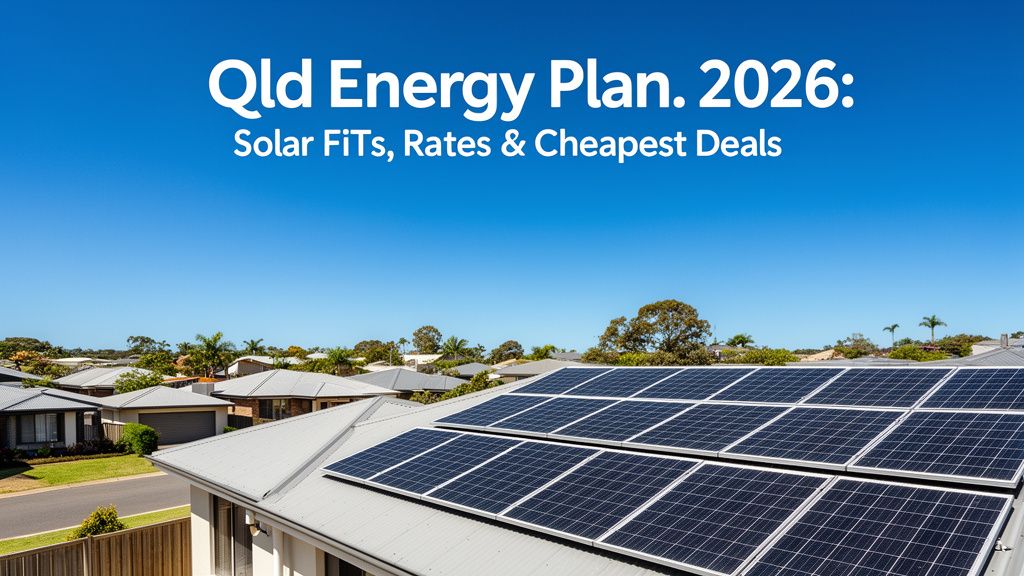
TL;DR: Queensland's electricity market splits into a competitive South East and a regulated Regional network. Regional solar owners receive a fixed 8.66c/kWh feed-in tariff in 2026, while South East residents must compare retailers for the best solar and usage rates. All households receive a $150 federal energy credit from July 2025.
What are the key differences between Queensland's energy networks?
Queensland's energy market divides into the competitive South East (Energex network) and the regulated Regional (Ergon network) areas, creating distinct conditions for consumers. In South East Queensland, electricity prices deregulated in 2016. This means numerous retailers compete for your business, allowing them to set their own usage rates, supply charges, and solar feed-in tariffs. The Australian Energy Regulator (AER) publishes a benchmark reference price annually on 1 July, helping households compare different plans and identify genuine discounts. Residents in areas like Brisbane, the Gold Coast, and the Sunshine Coast can shop around, potentially saving hundreds of dollars a year by switching providers that offer better deals or specific solar incentives.
In contrast, electricity prices in Regional Queensland, which operates on the Ergon network, remain regulated by the Queensland Competition Authority (QCA). This regulation protects customers in areas where it costs retailers more to provide service. Regional households cannot switch retailers to get cheaper usage rates for electricity. The QCA sets "notified prices" to ensure regional residents pay roughly the same as it would cost to supply a customer in the South East. While this limits choice for usage rates, it also brings a degree of stability and a government-mandated solar feed-in tariff, which can sometimes be more generous than competitive rates.
How regulation affects your choices
The presence or absence of competition fundamentally shapes a Queenslander’s ability to influence their energy costs. In the competitive South East, your power to save money comes from actively comparing offers from providers like AGL, Origin Energy, and Alinta Energy. You can look for plans with specific discounts off the reference price, often advertised as percentages like "21% less than reference price." Regional customers, while unable to choose their retailer for usage rates, benefit from the QCA's oversight which ensures fair pricing and a consistent approach to solar credits.
How do Solar Feed-in Tariffs impact Queensland households in 2026?
Solar Feed-in Tariffs (FiTs) provide credits for exported solar power, but rates vary significantly between regions and retailers, directly affecting a solar system's payback period and overall savings. In Regional Queensland, the QCA sets a regulated solar FiT. For the 2025-26 period, this stands at 8.66c/kWh. This fixed rate offers certainty for regional solar owners, providing a clear return for any excess power they send back to the grid. While regional customers cannot compare usage rates, they consistently benefit from this relatively high, government-mandated solar return compared to many competitive market rates.
In South East Queensland, solar FiTs are determined by individual retailers, leading to a much wider range of rates. Historically, competitive market FiTs have been lower than regional regulated rates, often sitting below 5c/kWh from many major retailers in 2024. However, some providers offer premium FiTs or specific plans for customers with solar batteries, such as one plan offering "32% less than reference price" for households with a battery and solar. These higher FiTs are typically tied to specific conditions, like higher daily supply charges or bundled plans, so a thorough comparison is essential. Choosing a retailer with a competitive FiT in the South East can significantly improve the financial performance of a solar installation, helping to offset grid electricity purchases and accelerate the return on investment.
Maximising your solar earnings
Maximising your solar earnings in Queensland depends on your location and the plan you choose. If you are in regional Queensland, your 8.66c/kWh FiT is guaranteed, so your focus should be on maximising self-consumption where possible to reduce grid reliance. In the South East, actively comparing retailer offers becomes crucial. Look beyond the headline FiT; consider the overall plan, including usage charges, supply charges, and any conditional discounts. Some plans might offer a higher FiT for the first few kWh exported daily, or a better rate if you also install a battery. A 6.6kW solar system on a typical Queensland home can offset a significant portion of daytime usage, and a good FiT ensures your excess generation also provides value.
What strategies help Queenslanders find the cheapest electricity rates in 2026?
Finding the cheapest electricity rates in 2026 requires comparing offers, understanding tariff structures, and leveraging government support, especially for South East Queensland residents. In competitive areas, you should regularly review your electricity plan against current market offers. Retailers frequently update their pricing and promotions. The AER's annual reference price provides a useful benchmark; if a plan advertises a discount, it typically applies to this reference price. Look for plans that specifically cater to your household's usage patterns, whether that's high daytime consumption, or if you have solar, plans that offer better feed-in tariffs. Some comparison websites list top plans, for example, identifying a "Battery + Solar" plan as "32% less than reference price" or general plans like "with free FIRST" at "21% less than reference price" in June 2026.
Understanding how you are charged forms another key part of finding savings. Most retailers use a stepped rate structure for usage charges, meaning you pay a certain price for the first block of energy, then a different price for subsequent blocks. For example, average usage charges for a single-rate tariff plan in postcode 4000 are around 33.49c per kWh, with an average supply charge of 165.22c per day. Compare these specific charges, not just the advertised discounts. Gas prices also follow a similar pattern, with average usage charges around 4.40 to 4.66 cents per megajoule and a supply charge of 125.52 cents per day in postcode 4000. For regional Queenslanders who cannot switch for usage rates, focus on understanding the QCA's notified prices and ensuring you are on the correct tariff.
Utilising government energy relief
All Australian households will receive $150 in federal energy bill relief from 1 July 2025. Your energy retailer will credit this directly to your account. If you are in an embedded network (like some apartment buildings or retirement villages), you might need to apply via the Queensland government's website. Queensland also offers further concessions for eligible individuals, including seniors, pensioners, low-income households, and those with medical needs. Contact your energy retailer directly or check the state government's website to see if you qualify for these additional rebates. These government support measures directly reduce your total energy cost, regardless of your retail plan.
Key Takeaways
- South East Queensland residents must compare retailers to find the cheapest electricity rates and best solar feed-in tariffs.
- Regional Queenslanders have regulated electricity prices and a fixed QCA solar FiT of 8.66c/kWh for 2025-26.
- All Queensland households receive a $150 federal energy bill credit from July 2025.
- Understand your energy usage and compare specific usage and supply charges, not just percentage discounts, to find the best value.
- Solar owners in the competitive South East should prioritise plans offering the best overall value, considering both usage rates and FiT.
Read More
For a comprehensive overview, check out our master guide: Read the Full Guide Here.