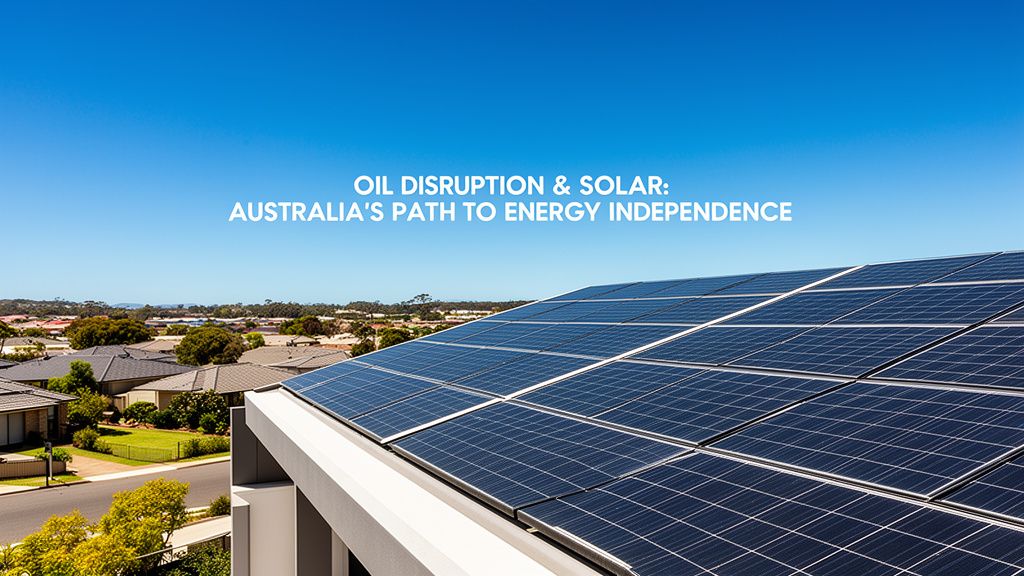
TL;DR: The current global oil supply disruption signals significant economic shifts, impacting fuel prices, supply chains, and inflation across Australia. For households and businesses, this unprecedented volatility accelerates the already compelling case for transitioning to solar energy as a resilient, cost-effective, and independent power source.
Understanding the Impact of Global Oil Shocks on Australian Households
Global oil shocks directly translate into higher costs of living and economic uncertainty for Australian families and businesses, regardless of how far removed we might feel from international conflicts. While Australia is a net energy exporter, our domestic petrol prices are largely dictated by international crude oil benchmarks and the Aussie dollar's strength against the US dollar. When global supply tightens, whether due to geopolitical events, natural disasters, or production cuts, the price at the bowser skyrockets almost immediately, hitting commuters and logistics companies hard. Furthermore, a significant portion of our goods are imported, and disruptions to global shipping, driven by fuel costs, mean everything from groceries to electronics becomes more expensive, fueling broader inflationary pressures. This constant cycle of volatility underscores a fundamental vulnerability in our energy reliance.
How Rising Fuel Costs Pinch Our Wallets
Rising fuel costs are a direct drain on household budgets and a major operational expense for many Australian businesses. Each time the price of unleaded petrol jumps past $2.00 per litre – a common sight during recent disruptions – the weekly grocery budget or small business profit margins take a hit. For the average Australian family with two cars, filling up can easily cost over $150-$200 per week, leaving less discretionary income for other essentials or savings. Businesses, especially those in transport, agriculture, and manufacturing, face significantly increased overheads. These costs are then often passed onto consumers, contributing to a broader inflationary spiral. This isn't just about driving; it affects how products get to shelves and how services are delivered.
The Ripple Effect on Everyday Goods and Services
The impact of oil shocks extends far beyond just petrol prices, creating a pervasive ripple effect across Australia’s economy. Every product we buy, from fresh produce transported interstate to imported electronics, has an energy component embedded in its cost. Higher fuel prices mean more expensive freight, driving up the cost of goods on supermarket shelves. Manufacturers face increased costs for raw materials derived from petroleum, as well as for the energy required to power their factories. Even electricity prices can be indirectly affected, particularly in regions reliant on gas-fired peaker plants whose fuel costs are tied to global energy markets. This broad-based inflation diminishes purchasing power and economic stability for everyone.
Why Oil Volatility Makes the Case for Solar Power Even Stronger
The inherent volatility of the global oil market dramatically strengthens the argument for Australian households and businesses to invest in solar power. Unlike fossil fuels, which are subject to unpredictable global supply chains, geopolitical conflicts, and currency fluctuations, solar energy offers a stable, locally-sourced, and predictable power source. When you generate your own electricity from the abundant Australian sun, you effectively insulate yourself from external energy price shocks. The initial investment in solar provides a long-term hedge against escalating electricity bills, making it a powerful tool for financial stability in an increasingly uncertain world. This shift moves control from global markets to your own rooftop, offering unprecedented energy security.
Achieving Energy Independence with Rooftop Solar
Achieving energy independence through rooftop solar means significantly reducing your reliance on the grid and its susceptibility to external price hikes. By installing a solar PV system, you harness the sun's energy to power your home or business, directly offsetting the electricity you would otherwise purchase from a retailer. This independence becomes particularly valuable during periods of energy market turmoil, such as the current oil supply disruptions that indirectly push up overall energy costs. Australians with solar are less affected by these global shifts, enjoying greater control over their energy consumption and expenditures. This autonomy is a core benefit, providing peace of mind and financial predictability.
Locking in Energy Costs and Hedging Against Inflation
Investing in solar power allows Australian consumers to effectively lock in their future energy costs, providing a robust hedge against inflation and unpredictable price increases. Once your solar system is installed, your primary energy source – the sun – is free. While there's an initial outlay, the operational costs are minimal, meaning your cost per kilowatt-hour generated remains remarkably stable over the system's 20-25 year lifespan. This contrasts sharply with grid electricity prices, which have seen consistent increases, often outpacing inflation. For an average Australian household spending $1,500-$2,500 annually on electricity, solar offers a way to fix a significant portion of that expense, providing long-term financial certainty.
Is Now the Right Time to Invest in Solar for Your Australian Home or Business?
Investing in solar energy is an immediate and strategic move for Australian homes and businesses amidst global oil disruptions, reinforcing long-term financial and environmental benefits. With the continued uncertainty in global energy markets, shifting to a renewable and self-sufficient power source like solar offers unparalleled stability. Australia boasts some of the best solar resources in the world, coupled with attractive government incentives that significantly reduce upfront costs. This unique combination makes the transition not just environmentally responsible, but also an economically astute decision to safeguard against future energy price volatility and secure predictable operating expenses for decades to come.


Current Solar System Costs and Government Incentives
Current solar system costs in Australia remain highly competitive, especially when factoring in generous government incentives. For a typical 6.6kW solar system suitable for many Australian homes, prices generally range from $5,000 to $9,000 after the federal STC (Small-scale Technology Certificate) rebate. Larger systems, such as a 10kW setup for bigger homes or small businesses, might cost between $8,000 and $12,000. These figures represent a significant reduction from a decade ago, making solar more accessible than ever. State-based programs, like interest-free loans in Victoria or Solar Battery rebates in other states, can further reduce the financial burden, accelerating payback periods and boosting ROI.
Calculating Your Potential Savings and Payback Period
Calculating your potential savings and payback period for a solar system in Australia is a straightforward process that highlights the financial advantages. For an average 6.6kW system producing around 25 kWh per day, and assuming an electricity rate of $0.30/kWh, you could save approximately $7.50 per day, or around $2,700 annually. With a system cost of $6,500 after rebates, the payback period could be as short as 2.5 to 3 years. This calculation doesn't even include the value of any feed-in tariffs you might receive for exporting excess power back to the grid, which can further reduce payback times and enhance overall profitability.
What Specific Solar Solutions Can Offer the Best Protection?
Specific solar solutions, particularly those incorporating battery storage and EV charging capabilities, offer Australian homes and businesses the most effective protection against future energy price shocks. While a standard grid-connected solar PV system significantly reduces your electricity bills, adding a battery takes independence to the next level by allowing you to store excess daytime generation for use at night or during peak demand periods. This minimises reliance on the grid during its most expensive hours. Integrating EV charging further future-proofs your energy strategy, enabling you to fuel your transport directly from the sun, creating a comprehensive hedge against both electricity and petrol price volatility.
Pairing Solar with Battery Storage for Ultimate Resilience
Pairing solar with battery storage offers ultimate resilience against power outages and peak price periods, providing enhanced energy security for Australian homes and businesses. A solar battery system stores the excess energy generated during the day, making it available for use when the sun isn't shining or during blackouts. This means less reliance on grid electricity, especially during expensive evening peak tariffs, and continuous power supply even if the grid goes down. While a typical 10-13.5 kWh battery might add $8,000 to $15,000 to the initial solar investment, the long-term savings from reduced grid reliance and the peace of mind during disruptions offer significant value.
Exploring EV Charging Integration for Future-Proofing
Exploring EV charging integration with your solar setup is a powerful move for future-proofing your energy and transport costs in Australia. As electric vehicles become more common, charging them from your own solar array means you’re essentially "fueling" your car for free, bypassing volatile petrol prices entirely. A dedicated EV Charger can be easily integrated into a new or existing solar system, allowing you to maximise self-consumption and drastically reduce your household's overall energy expenditure. This holistic approach not only addresses your home's electricity needs but also liberates you from the fluctuating costs of conventional transport fuels, offering a complete solution to energy independence.
Key Takeaways
- Global oil disruptions directly increase Australian living costs through higher petrol prices and inflated goods due to freight costs.
- Solar energy provides a stable, locally-sourced power alternative, offering a robust hedge against unpredictable global energy market volatility.
- Investing in solar now allows Australian households and businesses to lock in energy costs, significantly reducing long-term exposure to inflation.
- Government incentives and competitive pricing make current solar system investments highly attractive with quick payback periods.
- Pairing solar with battery storage and EV charging offers maximum resilience, ensuring energy independence for both your home and transport needs.
Read More
For a comprehensive overview, check out our master guide: Read the Full Guide Here.


