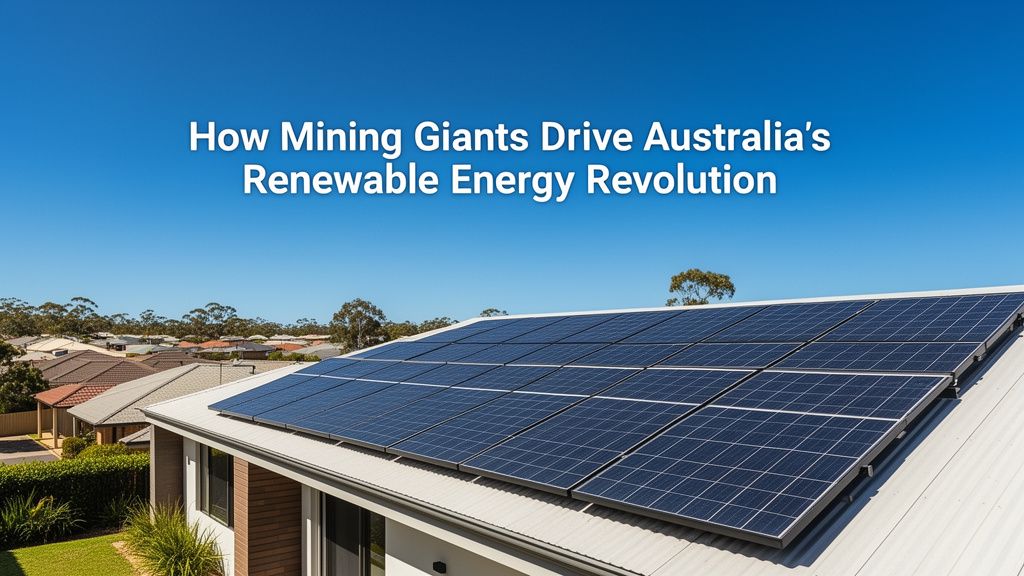
How Australia's Mining Giants Drive the Renewable Energy Transition
TL;DR: Australia's mining companies invest heavily in renewable energy, mainly large-scale solar and battery storage. This strategy significantly reduces their operational costs, helps them achieve environmental targets, and contributes to the nation's energy grid stability, accelerating Australia's shift to renewables.
Why Are Mining Companies Investing Heavily in Renewable Energy? Mining companies invest heavily in renewable energy primarily to cut escalating operational costs and meet growing environmental, social, and governance (ESG) expectations from investors and the public. Historically, remote mine sites relied on expensive, carbon-intensive diesel generators or long-distance grid connections. Fluctuating global fuel prices directly impact their bottom line, making a stable, cheaper energy source highly appealing. Furthermore, as global awareness of climate change increases, companies face pressure to decarbonise their operations. Major shareholders, financial institutions, and even some customers now demand clear pathways to net-zero emissions. Investing in renewable energy allows these companies to demonstrate commitment to sustainability, reduce their carbon footprint, and secure a social licence to operate in a changing world. This move transforms them from heavy energy consumers into significant renewable energy generators, shifting the national energy landscape.
Operational Cost Reductions Running a large mine consumes immense amounts of power. Diesel generation for remote sites can cost upwards of 50 cents per kilowatt-hour (kWh), especially with transport and maintenance overheads. Connecting to the main grid often involves substantial infrastructure investment and ongoing transmission fees, alongside exposure to volatile wholesale electricity prices. Deploying on-site solar and battery storage systems directly replaces a portion of this expensive energy. Once built, the marginal cost of solar power is near zero. While the upfront capital expenditure for a large solar farm is considerable, the long-term operational savings are compelling. For example, a 100 MW solar farm could offset millions of litres of diesel annually, providing predictable energy prices for decades and shielding companies from global energy market fluctuations. These savings directly improve profitability and shareholder returns.
Meeting Emissions Targets Mining companies operate under increasing scrutiny regarding their environmental impact. They report Scope 1 emissions (direct emissions from their operations), Scope 2 emissions (from purchased electricity), and sometimes Scope 3 emissions (from their supply chain). Investing in renewable energy directly tackles Scope 1 emissions by replacing diesel and Scope 2 emissions by using green electricity. Major players like Fortescue Metals Group aim for net-zero Scope 1 and 2 emissions by 2030, a target that demands massive renewable infrastructure. BHP, for instance, has committed to reducing its operational emissions by at least 30% by 2030 from 2020 levels. These commitments are not just public relations exercises; they often tie into executive bonuses and access to capital from 'green' investment funds. Meeting these targets helps maintain investor confidence and future-proof their operations against potential carbon taxes or regulatory changes.
What Large-Scale Renewable Projects Are Miners Building? Miners are building large-scale solar, wind, and battery projects to power their remote operations, improve energy reliability, and contribute excess energy back to the grid. These projects often surpass the scale of typical regional power stations, with capacities ranging from tens to hundreds of megawatts. Due to the vast, often sun-drenched land holdings around their operations in Western Australia's Pilbara or Queensland's coalfields, miners have ideal conditions for utility-scale solar installations. These projects are not just about panels; they integrate sophisticated battery energy storage systems (BESS) to ensure continuous power supply, especially for operations that cannot tolerate intermittency. The sheer size of these installations means they often connect directly into regional transmission networks, adding significant renewable capacity to parts of Australia traditionally underserved by green energy infrastructure.
Mega Solar Farms The Pilbara region of Western Australia, a global mining hub, exemplifies this trend with several mega solar farms. Rio Tinto's 34 MW solar farm at Tom Price and their 45 MW solar plant at Koodaideri help power iron ore operations, reducing their reliance on gas-fired generation. Fortescue Future Industries is planning even larger projects as part of its decarbonisation strategy, aiming for gigawatts of new renewable capacity. These developments involve hundreds of thousands of solar panels spread across vast areas. They require considerable local investment in infrastructure, including new transmission lines and substations, which benefit the broader regional energy landscape. These mega farms often also include facilities to house operations staff, creating further economic activity in remote locations.


Integrated Battery Storage Solutions For mining operations that run 24/7, intermittent power sources like solar require robust backup. This is where large-scale battery energy storage systems (BESS) become critical. Mining companies are deploying batteries with capacities ranging from 50 MWh to over 200 MWh to store excess solar generation and discharge it during peak demand or when the sun is not shining. For example, the BHP-operated Nickel West operation in Western Australia uses a 10 MW / 10 MWh battery to support its solar farm. These batteries provide stability, smooth out power fluctuations, and can even offer grid services like frequency regulation if connected to the wider network. The integration of batteries makes renewable energy a truly reliable option for heavy industry, ensuring consistent power quality for sensitive equipment and continuous production.
How Do Mining Renewables Impact Australia's Energy Grid and Regions? Mining-led renewable projects improve Australia's energy grid stability, particularly in remote and regional areas, and create significant economic opportunities for local communities. By building large, independent power sources, miners reduce the strain on existing, often aged, centralised grid infrastructure. This decentralisation can enhance system resilience, making the grid less vulnerable to failures. In regions with limited grid capacity, these projects add much-needed generation close to demand centres. Beyond electrons, the investment pours into local economies through job creation, procurement of local services, and potential for energy supply to neighbouring communities or other industrial users. This dual benefit of energy security and regional development makes mining's pivot to renewables a powerful force for national progress.
Strengthening Grid Resilience Many of Australia's remote mining operations sit at the end of long transmission lines, making them vulnerable to outages and voltage instability. By generating their own power, often with integrated battery storage, these sites become more self-sufficient, reducing their reliance on the often-fragile fringe of the national grid. When these facilities are large enough to feed excess power back into the regional grid, they effectively act as distributed power stations. This helps stabilise the local network, reduces transmission losses, and improves the overall reliability of electricity supply for everyone in the area, not just the mine. It diversifies the energy mix away from ageing coal-fired plants or expensive gas, contributing to a more modern and robust energy system.
Boosting Regional Economies The development of massive renewable energy projects requires significant investment in labour, materials, and services. This creates jobs during construction, from electricians and engineers to civil workers and project managers. Once operational, ongoing maintenance and management roles emerge, providing long-term employment in regional centres. Local businesses benefit from supplying everything from concrete and fencing to accommodation and catering for workforces. For example, a 100 MW solar project might involve hundreds of construction jobs over 12-18 months. This investment stimulates regional economies, often in areas historically dependent solely on mining itself, helping diversify income streams and build new skillsets in renewable energy. It represents a real transfer of wealth and capability into Australia's heartland.
Key Takeaways
- Mining companies are driving substantial investment into large-scale renewable energy projects across Australia.
- These investments are motivated by significant operational cost savings and commitments to emissions reduction targets.
- Major miners are deploying multi-megawatt solar farms and extensive battery storage systems, often in remote locations.
- These projects enhance Australia's energy grid resilience, particularly in regional areas, by decentralising power generation.
- The shift creates new jobs and economic opportunities, boosting regional development beyond traditional mining activities.
Read More
For a comprehensive overview, check out our master guide: Read the Full Guide Here.