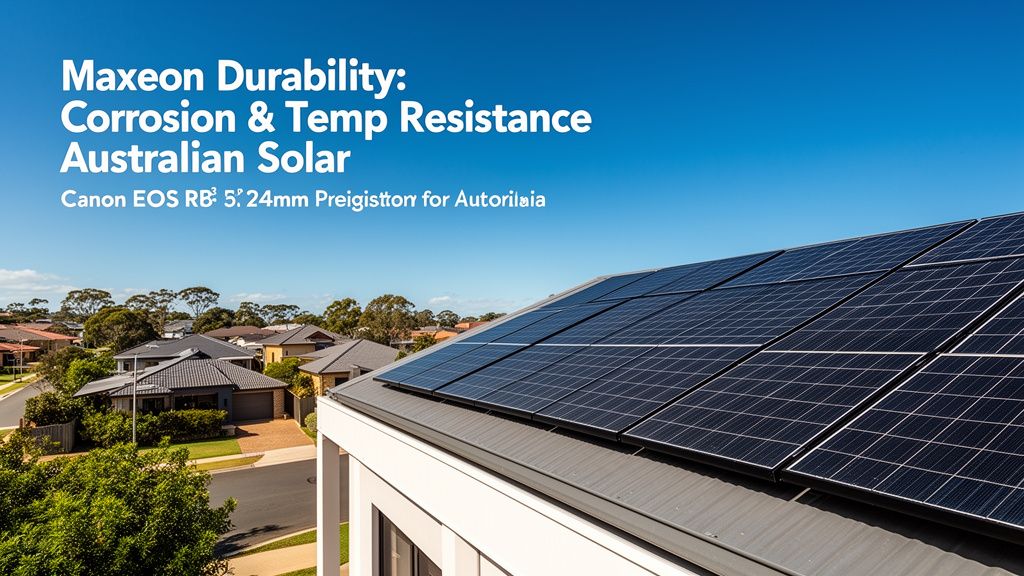
TL;DR: Maxeon solar panels are engineered with a unique solid copper foundation and advanced cell architecture, providing exceptional resistance to the corrosive effects of salt mist and humidity. Their design also handles extreme temperature fluctuations and thermal cycling without compromising performance, ensuring long-term reliability in harsh Australian conditions.
Why Does Salt Mist and Humidity Damage Solar Panels?
Salt mist and high humidity actively degrade standard solar panels over time, especially in coastal or high-moisture regions of Australia. Conventional solar panels often use a metallisation paste printed onto the silicon cells, forming thin grid lines for current collection. These thin silver lines, along with the electrical connections and busbars, are vulnerable to electrochemical corrosion when exposed to moisture and airborne salts. This process, often called potential-induced degradation (PID) or simply corrosion, manifests as rust on metallic components, delamination of the panel layers, and overall power loss. The protective backsheet and encapsulant layers can also degrade, allowing moisture to penetrate deeper and accelerate damage. This effect reduces the panel's power output and shortens its operational life, directly impacting your return on investment.
Understanding the Corrosion Challenge in Australia
Australia's vast coastline and diverse climates present significant corrosion challenges for solar installations. Areas like the Sunshine Coast, Perth, or parts of Tasmania experience consistent salt-laden air, which acts as an electrolyte when combined with humidity. This accelerates the degradation of less robust solar panels. Even inland, high humidity and specific atmospheric pollutants can contribute to panel corrosion. Standard panels with exposed metallic grid lines on the front of their cells become prime targets for this electrochemical reaction. Once corrosion begins, it often progresses, creating hotspots, reducing efficiency, and eventually causing outright failure. This is why robust materials and superior encapsulation are critical for solar panel longevity here.
How Maxeon Panels Resist Corrosion
Maxeon Series panels employ a distinct design that inherently resists corrosion. Instead of delicate front-side metallisation, Maxeon cells feature a solid copper foundation on their back, making them virtually impervious to the corrosion mechanisms seen in conventional panels. This copper backing acts as both the primary electrical conductor and a structural reinforcement, encapsulating the sensitive silicon. The cells also lack the traditional grid lines on the front, removing common points of vulnerability where salt and moisture can initiate corrosion. Furthermore, Maxeon uses a specialised encapsulant and a robust construction that minimises moisture ingress and prevents delamination, even under extreme humidity and salt mist exposure. Maxeon panels meet the IEC 61701 salt mist corrosion test at the highest severity level, proving their resilience.
How Do Extreme Temperature Changes Impact Solar Panel Longevity?
Extreme temperature changes, common across Australia from the scorching deserts to freezing alpine regions, place immense stress on solar panels. Solar panels heat up significantly during the day, often reaching 60-80°C on a hot roof, and then cool down overnight. This daily expansion and contraction, known as thermal cycling, puts mechanical strain on every component: the silicon cells, the solder joints, the encapsulant, and the aluminium frame. Over years, this constant movement can lead to microcracks in the silicon cells, fatigue in the solder bonds, and delamination of the protective layers. Microcracks cause hot spots and reduce power output, while fatigued solder joints can fail completely, leading to entire sections of the panel becoming inactive. Panels must be designed to withstand thousands of these temperature cycles without compromise.
The Impact of Australian Climate Swings
Australia's climate features some of the most dramatic temperature swings globally, challenging solar panel materials. Regions like the Australian Capital Territory can see winter nights drop below zero and summer days exceed 40°C, a 50-degree shift within 24 hours. The outback experiences even larger diurnal temperature variations. These conditions accelerate material fatigue in panels not built for such extremes. Conventional solar cells use thin metallic ribbons to connect cells, which are prone to breaking under repeated thermal expansion and contraction. This stress also affects the sealing materials, potentially creating pathways for moisture when cracks form. Panel manufacturers need to account for these dynamic forces to ensure panels perform consistently for decades without premature failure.
Maxeon's Design for Thermal Stress
Maxeon panels specifically address thermal stress through their unique cell architecture and construction. The solid copper foundation of each Maxeon cell provides superior mechanical strength and dissipates heat more effectively than conventional designs. This robust backing prevents microcracks from forming in the silicon, even under significant temperature fluctuations. Crucially, Maxeon cells employ flexible cell connectors that can expand and contract without stressing the solder joints or the silicon. This design dramatically reduces the risk of interconnection failure, a common issue in standard panels over time. Maxeon panels also have a lower temperature coefficient, meaning they lose less power in high heat compared to many competitors, maintaining higher output during Australia's hot summers.

Does Maxeon's Durability Translate to Better Long-Term Value?
Maxeon's inherent durability, stemming from its corrosion and temperature resistance, directly translates to better long-term value and investment protection for Australian solar owners. A solar system's true cost isn't just its upfront purchase price; it includes the total energy produced over its lifespan and the expenses for any repairs or replacements. Panels that degrade rapidly or fail prematurely erase potential savings and incur additional costs. Maxeon's robust construction ensures more consistent power output for decades, reducing the likelihood of early panel failures and maintaining system performance closer to its original specifications. This reliability means fewer headaches for homeowners and a more predictable financial return on their solar investment.
Reliability in Australian Conditions
Maxeon panels consistently perform in Australia's varied and challenging environmental conditions. Their superior resistance to salt mist makes them a reliable choice for homes along the Queensland, NSW, and Western Australian coasts. Their thermal stability and robust cell structure ensure consistent output and structural integrity, even in the extreme heat and temperature swings experienced across inland Victoria, South Australia, and the Northern Territory. This inherent reliability means the system you install today will likely produce close to its expected output for many years, avoiding the common pitfalls of panels that crack, delaminate, or suffer significant power loss after only a decade or so. Homeowners avoid unexpected repair costs and maximise their energy savings over the system's extended life.
Investment Protection and Warranty
Investing in Maxeon panels provides significant investment protection, supported by an industry-leading warranty. Maxeon offers an incredible 40-year product and power warranty, a clear demonstration of their confidence in panel longevity. This warranty covers the panel's physical integrity and guarantees a minimum power output (typically 88.3% after 40 years for Maxeon 3/5/6). For comparison, many standard panels offer 10-15 year product warranties and 25-year performance warranties, often with higher degradation rates. This extended, comprehensive coverage means that if a Maxeon panel fails prematurely or degrades beyond the guaranteed rate within four decades, the company replaces or repairs it. This significantly de-risks a long-term solar investment, offering peace of mind to Australian homeowners.
Key Takeaways
- Maxeon panels use a solid copper foundation to resist corrosion from salt mist and humidity, crucial for Australian coastal properties.
- Their unique design handles extreme thermal cycling and temperature swings without microcracks or solder joint fatigue, common in standard panels.
- Maxeon's robust construction ensures consistent power output and minimal degradation over decades, offering superior long-term reliability.
- The 40-year product and power warranty provides unmatched investment protection and peace of mind for Australian solar owners.
- Choosing Maxeon panels helps you avoid costly early repairs and maximise your solar energy savings over the system's lifetime.
Read More
For a comprehensive overview, check out our master guide: Read the Full Guide Here.