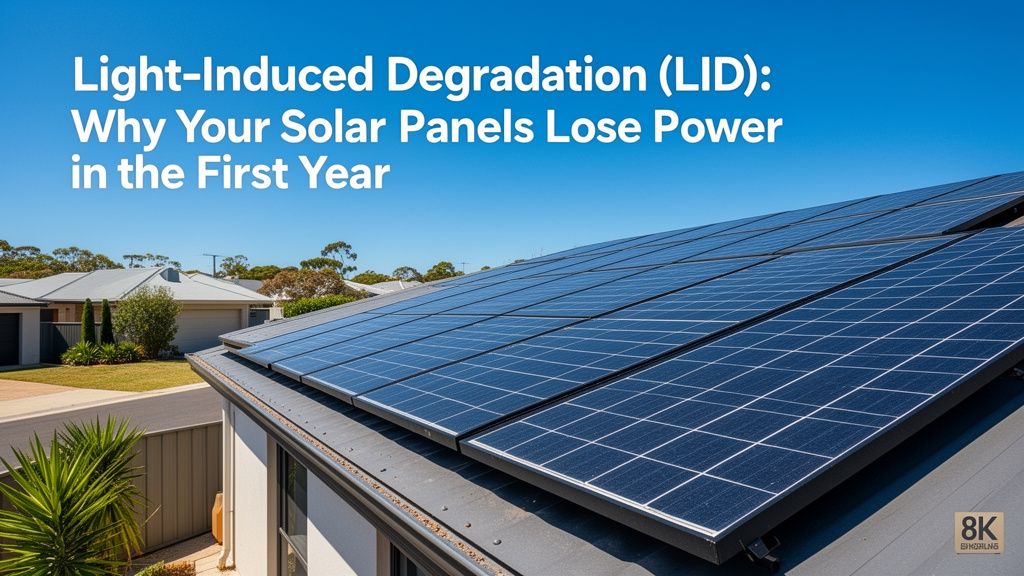
Light-Induced Degradation (LID): Why Your Solar Panels Lose Power in the First Year
G'day, fellow sun-lovers! You've made the smart move, invested in a shiny new solar power system for your Aussie home, and you're already picturing those significantly smaller electricity bills. There's nothing quite like the feeling of harnessing our abundant sunshine to power your life.
But then, a few weeks or months in, you might notice something a bit peculiar. Your monitoring app shows your system's output is slightly less than what you expected, or perhaps even a smidge lower than it was on day one. Before you panic and call your installer, take a deep breath. What you're likely experiencing is a common, well-understood phenomenon in the solar world called Light-Induced Degradation, or LID. And no, it’s usually not a sign of a faulty system, but rather a normal part of your panels settling in.
What Exactly is Light-Induced Degradation (LID)?
In simple terms, LID is an initial, rapid drop in a solar panel's power output that occurs predominantly within its first few days, weeks, or months of exposure to sunlight. Think of it as a "burn-in" period. While the term "degradation" sounds alarming, it's distinct from the slow, continuous power loss that all solar panels experience over their two-plus-decade lifespan. LID is a one-off event, a stabilisation process, after which the panels continue to degrade at the much slower, expected rate.
This phenomenon is primarily observed in solar cells made from p-type silicon, which is the most common type used in residential solar panels across Australia due to its cost-effectiveness and good performance. The good news is, manufacturers are well aware of LID and have designed their panels and warranties with this initial dip in mind.
The Numbers: How Much Power Are We Talking About?
So, how much power are we actually talking about losing? Typically, LID accounts for a power loss of between 1% and 3%. In some cases, particularly with older technologies, it could be slightly higher, reaching up to 5%. While 1-3% might sound small, let's put it into perspective for a common Australian residential system.
Imagine you've installed a 6.6 kW solar system, a popular choice for many Aussie homes. If this system experiences a 2% LID, that means its effective maximum output would drop from 6.6 kW to approximately 6.47 kW. Over a year, if your system typically generates around 9,000 kWh annually, a 2% reduction would equate to 180 kWh less generation.
To put a dollar figure on it, if you’re paying an average of, say, $0.30 per kWh for your electricity in Sydney, that 180 kWh less generation could represent about $54 in reduced savings over the year. While not negligible, it's a manageable figure and, importantly, it's baked into the long-term performance expectations of your system.
Why Does LID Happen? A Peek Inside Your Panels
To understand LID, we need to get a little bit technical, but don't worry, it's pretty straightforward. The vast majority of solar cells are made from crystalline silicon. For p-type silicon cells, they are doped with boron during manufacturing to create the necessary electrical properties. However, when these boron-doped silicon cells are first exposed to sunlight (which bombards them with photons) and a small amount of oxygen, a chemical reaction occurs.
This reaction leads to the formation of boron-oxygen complexes within the silicon crystal lattice. These complexes act as "recombination centres," meaning they effectively trap the electrons that are supposed to be flowing to create electricity. When electrons are trapped instead of flowing, the panel's efficiency – and therefore its power output – is reduced.
This process happens relatively quickly, usually within the first few hundred hours of direct sun exposure. Once these boron-oxygen defects have formed and stabilised, the rate of power loss significantly slows down to the much more gradual long-term degradation rate.
Is LID a Problem? Understanding Your Warranties
The short answer is: no, LID is generally not a problem, provided you've chosen quality panels from a reputable manufacturer. Solar panel manufacturers are acutely aware of LID and factor it into their performance warranties.
Most solar panel warranties guarantee a certain percentage of the initial power output after a specified number of years. For example, a common warranty might state that panels will retain 98% of their nominal power output in the first year, and then degrade by no more than 0.5% per year thereafter, guaranteeing 80-85% of power after 25 years. That initial 1-3% LID is already accounted for in that first-year warranty figure. This means that if your panel is rated at 400W, the manufacturer expects it to be performing at around 392W (98%) by the end of its first year, including any LID effects.
It’s crucial to review the performance warranty of any panels you're considering. A strong warranty from a well-established brand offers peace of mind that your investment is protected, even with the initial LID.
Mitigation & Modern Solutions: Battling LID
The good news is that solar technology is constantly evolving, and manufacturers are finding increasingly effective ways to minimise LID.
One of the most significant advancements has been the development of LID-resistant cell technologies. For instance, PERC (Passivated Emitter Rear Cell) technology, while still p-type, offers some improvements. However, the real game-changers are n-type solar cells, such as TOPCon and HJT (Heterojunction Technology). Unlike p-type cells which use boron doping, n-type cells are phosphorus-doped. Phosphorus doesn't form the same detrimental complexes with oxygen under sunlight, making n-type panels inherently far less susceptible to LID – often showing losses of less than 0.5%. While traditionally more expensive, n-type panels are becoming increasingly competitive in the Australian market.
Beyond cell type, some manufacturers employ proprietary manufacturing processes and treatments to reduce LID, such as specific annealing (heating) steps or passivation layers designed to mitigate defect formation. When researching panels, look for those that explicitly mention "low LID" or "LID-free" properties, often indicative of these advanced technologies.
What Should Australian Homeowners Do?
If you're an Australian homeowner considering solar, or if you've recently installed a system, here’s what you should take away from understanding LID:
- Don't Panic: A slight drop in performance during the first year is normal and expected.
- Choose Reputable Brands: Stick with well-known manufacturers who have a track record of quality and provide comprehensive performance warranties that explicitly address first-year degradation.
- Consider Advanced Technologies: If maximising long-term output and minimising initial degradation are high priorities, investigate panels featuring n-type cell technology (TOPCon, HJT) for superior LID resistance. While these might have a slightly higher upfront cost, their improved long-term performance can offer greater savings.
- Understand Your Warranty: Before purchasing, read and understand the performance warranty carefully. Ensure the first-year degradation figures align with industry standards and your expectations.
- Monitor Your System: Keep an eye on your system's performance via your inverter's monitoring app. While you might see a slight dip initially, any sudden, significant, or ongoing drops beyond the first few months should be investigated by your Clean Energy Council (CEC) accredited installer.
Powering On with Confidence
LID, while a real phenomenon, is far from a deal-breaker for solar power. It's a well-understood characteristic of common solar cell technology, accounted for by manufacturers, and continually being minimised through innovation. Our sunburnt country provides an incredible resource for generating clean energy, and understanding nuances like LID only strengthens your confidence in this fantastic investment.
So, continue to enjoy the benefits of your solar system. With the right information and a quality installation, your panels will be reliably converting our abundant sunshine into clean power for decades to come, helping you save money and contribute to a greener Australia. If you have any concerns or want to explore LID-resistant options further, always consult with a local, trusted solar expert.
Read More
For a comprehensive overview, check out our master guide: Read the Full Guide Here.