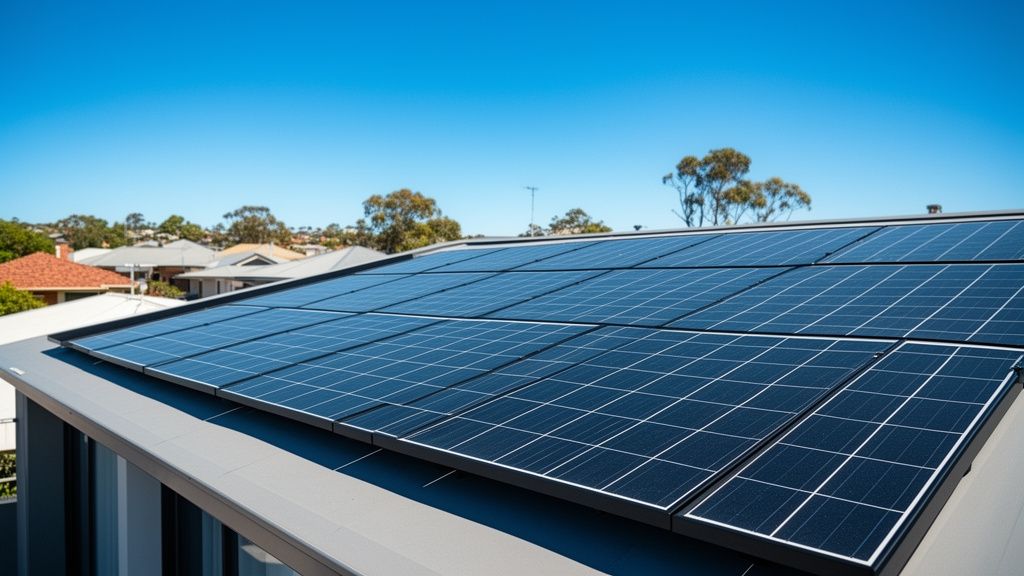
Protecting Your Investment: Solarwatt's Double Glass Solar Panels Explained
TL;DR: Solarwatt's double ultra-hard glass technology encases solar cells between two layers of highly durable glass, protecting them from extreme weather like hail and enhancing longevity far beyond standard panels. This design drastically reduces degradation and physical damage, ensuring stable energy production for decades, particularly in Australia's harsh climate.
What Makes Solarwatt's Double Glass Technology Unique?
Solarwatt's double ultra-hard glass technology sets its solar panels apart from conventional modules. Most solar panels use a glass-foil construction, with a single layer of tempered glass on the front and a polymer backsheet. Solarwatt's approach replaces that backsheet with another layer of hardened glass. This means the sensitive solar cells are sandwiched securely between two sheets of robust, 2mm thick ultra-hard glass. This twin-glass design creates a highly durable, hermetically sealed unit that offers superior protection compared to traditional setups. The materials chosen for this construction resist environmental stressors over many decades. Standard panels face vulnerabilities where the polymer backsheet can delaminate or degrade, allowing moisture ingress and UV damage to the cells over time. Solarwatt's double glass eliminates these points of weakness, creating a significantly more resilient product built for Australian conditions.
How Does Double Glass Construction Prevent Degradation?
The double glass structure actively prevents common forms of solar panel degradation. Standard modules often suffer from PID (Potential Induced Degradation), a performance drop caused by voltage differences between the cells and the panel frame. The all-glass design of Solarwatt panels minimises the electrical conductivity pathways that contribute to PID, effectively eliminating this issue. Furthermore, the glass-on-glass construction significantly reduces the rate of micro-cracks forming in the solar cells. Micro-cracks, often invisible to the naked eye, slowly reduce a panel's efficiency. They can develop from minor impacts, thermal expansion and contraction, or even during handling and installation. By providing a stiffer, more protective casing, the double glass acts as a strong shield, absorbing mechanical stress and preventing these microscopic fractures.
How Does Double Glass Technology Protect Against Australian Conditions?
Australia's climate presents unique challenges for solar panel longevity, from intense UV radiation to violent hail storms. Solarwatt's double ultra-hard glass technology specifically addresses these environmental pressures, offering a level of protection standard panels cannot match. The two layers of toughened glass provide exceptional resistance to mechanical impacts. For instance, testing shows these panels can withstand hail stones up to 40mm in diameter travelling at 30 metres per second, a significantly higher impact resistance than the industry standard. This means fewer damaged panels and lower replacement costs after severe weather events. The glass construction also offers superior protection against UV degradation. Australia's high UV index breaks down the EVA encapsulant and polymer backsheets in traditional panels over time, leading to yellowing, cracking, and reduced performance. Glass does not degrade under UV exposure, preserving the integrity of the panel's internal components for far longer.
Thermal Stress and Moisture Resistance


Australian temperatures can swing wildly, from scorching summer days to frosty winter nights, creating significant thermal stress on solar panels. The all-glass construction of Solarwatt panels handles these temperature variations better than glass-foil modules. Glass expands and contracts less than polymer materials, which reduces the internal stress on the solar cells and connections. This consistent dimensional stability prevents premature wear and tear that can lead to power losses. Additionally, the hermetically sealed glass-on-glass design provides an impenetrable barrier against moisture ingress. Humidity and rain can cause corrosion and short circuits in less protected panels. By completely encasing the cells in glass, Solarwatt ensures no moisture reaches the sensitive electrical components, preserving optimal performance and extending the operational lifespan, even in high-humidity coastal regions.
What Are the Long-Term Benefits for Australian Homeowners?
Choosing Solarwatt's double ultra-hard glass panels translates directly into tangible long-term benefits for Australian homeowners. The enhanced durability and protection lead to a significantly longer effective lifespan for your solar system. While many standard panels offer a 10-12 year product warranty, Solarwatt provides an impressive 30-year product warranty on its glass-on-glass modules, demonstrating confidence in their longevity. This extended warranty means you have peace of mind knowing your investment is protected for three decades. A system that lasts longer maintains higher output for more years, improving your overall return on investment. You avoid the costs and inconvenience of early panel replacements, which can run into thousands of dollars for labour and new hardware, effectively costing you upwards of $150-$200 per panel for removal and installation.
Stable Energy Production and Reduced Lifetime Costs
The superior protection offered by double glass technology ensures stable energy production over the long haul. Panels that resist micro-cracks, PID, and UV degradation maintain their efficiency closer to their initial output for a greater period. This means more consistent savings on your electricity bills over 20, 25, or even 30 years. Solarwatt also offers a 30-year performance warranty, guaranteeing at least 87% of the nominal power output after three decades. This commitment to sustained performance directly translates to a lower lifetime cost of ownership. You pay less for maintenance, experience fewer faults, and generate more clean energy, maximising your financial benefits and contributing to a more sustainable future for your home. Investing in such robust technology upfront typically costs only a little more than standard panels – perhaps an additional $500 to $1,000 for a typical 6.6kW system – but it pays dividends in reliability and longevity.
Key Takeaways
- Solarwatt's double ultra-hard glass panels encase cells between two layers of glass, offering superior protection over traditional glass-foil modules.
- This design significantly resists hail impacts, UV degradation, micro-cracks, and PID, crucial for Australia's harsh climate.
- Panels boast a 30-year product warranty and a 30-year performance warranty, ensuring long-term reliability and stable energy output.
- Homeowners benefit from reduced maintenance costs, consistent energy savings, and a higher return on investment over the system's lifespan.
- The upfront investment in double glass technology provides greater peace of mind and sustained performance for decades.
Read More
For a comprehensive overview, check out our master guide: Read the Full Guide Here.