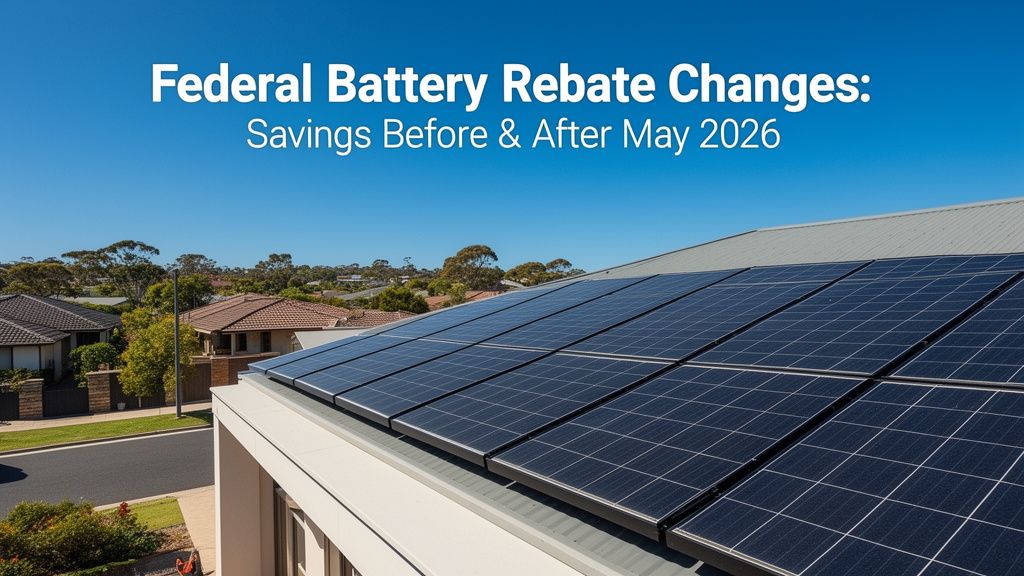
TL;DR: While there isn't a direct federal battery rebate currently, May 2026 marks a potential shift towards federal support, likely through the Household Energy Upgrades Fund (HEUF) which could offer low-interest loans or rebates. Prior to this, savings primarily come from indirect federal solar PV incentives (STCs) and state-based battery rebates, whereas post-2026, direct federal incentives for batteries may significantly reduce upfront costs.
What Federal Battery Rebates Are Currently Available in Australia?
Currently, there is no direct federal rebate specifically for installing a home battery in Australia. The primary federal incentive for residential solar energy systems, including those that would pair with a battery, is the Small-scale Renewable Energy Scheme (SRES), which generates Small-scale Technology Certificates (STCs). While STCs significantly reduce the upfront cost of your solar panels, making a battery system more financially viable overall, they do not directly subsidise the battery itself. This means that if you're looking to install a battery today, any direct financial assistance will typically come from state or territory government programs, not the federal government.
How Small-scale Technology Certificates (STCs) Work for Solar
Small-scale Technology Certificates (STCs) are a federal incentive designed to encourage the uptake of solar PV systems. When you install an eligible solar power system, you are entitled to a certain number of STCs, which are calculated based on the system size and its geographic location. These certificates have a monetary value, typically traded on an open market, and your solar installer will usually apply this value as an upfront discount on your system's price. For example, a 6.6kW solar system might generate around 90-100 STCs, which at a value of $38 per STC, could provide a discount of approximately $3,420 to $3,800. While this reduces the cost of the solar panels that charge your battery, it's crucial to understand that the battery unit itself doesn't generate STCs.
State-Specific Battery Rebates You Might Be Eligible For
While federal support for batteries is indirect, several Australian states and territories offer their own battery rebates or loan schemes. For instance, Victoria's Solar Homes Program offers rebates of up to $1,400 for eligible households to install a Solar Battery, alongside interest-free loans for solar PV. South Australia's Home Battery Scheme provides subsidies based on battery size and household income, potentially reducing costs by thousands of dollars. New South Wales has also explored or implemented various local initiatives. These state-level programs are the current best bet for direct financial assistance specifically targeting battery storage, making them a vital part of your cost-saving strategy before any potential federal scheme rolls out.
What is the Proposed Federal Battery Rebate and When Could it Start?
The Australian federal government has signalled its intention to provide more direct support for household energy storage through the Household Energy Upgrades Fund (HEUF), but specific battery rebate amounts are not yet set in stone. This proposed fund, announced as part of broader climate and energy initiatives, aims to assist households in improving their energy efficiency and transitioning to renewable energy. The May 2026 date is significant as it aligns with the potential expiry of the current STC scheme for solar PV, suggesting a possible pivot or expansion of federal support mechanisms, potentially to include direct battery incentives or low-interest loans for battery installations. Details are still being ironed out, but the direction indicates a shift towards more direct federal involvement in battery uptake.
Understanding the Household Energy Upgrades Fund (HEUF)
The Household Energy Upgrades Fund (HEUF) is a federal government initiative designed to provide financial assistance to households for energy efficiency upgrades and the adoption of renewable energy technologies. While the specifics of its battery support component are yet to be fully defined, it's expected to offer either low-interest loans or direct rebates, or a combination of both, for eligible battery installations. The goal is to reduce upfront costs, making battery storage more accessible to a wider range of Australian homeowners, thereby increasing energy independence and reducing grid reliance. This fund represents the most concrete indication of future federal support that could directly impact battery affordability.

The Timeline for Potential Federal Battery Support
The timeline for the introduction of a direct federal battery rebate or significant support from the HEUF is still somewhat fluid, but May 2026 is a key date to watch. This date is relevant because it is the projected end of the Small-scale Renewable Energy Scheme (SRES), which currently provides STCs for solar panel installations. Many speculate that as the STC scheme winds down, federal funding mechanisms may be redirected or evolved to include more direct support for energy storage solutions like batteries. While some elements of the HEUF, such as low-interest loans for energy-efficient products, are already underway, the specific and substantial support for batteries is still in development, making May 2026 a crucial marker for potential policy changes and new financial incentives.
How Might Your Savings Differ Before and After May 2026?
Your potential savings on a home battery system could look significantly different before and after May 2026, primarily due to the anticipated introduction of direct federal incentives. Before May 2026, any cost savings on a battery come from state rebates (where available), the indirect benefit of STCs reducing your solar PV cost, and the long-term energy bill savings from optimising self-consumption. After May 2026, if a direct federal battery rebate or substantial HEUF loan program is implemented, it could provide a substantial upfront discount, making batteries more affordable for more Australians from day one. This shift could move battery purchases from being predominantly supported by state-specific and indirect federal benefits to a more unified and direct federal approach.
Current Battery Savings Scenarios (Pre-May 2026)
Before May 2026, a typical 10kWh home battery system might cost between $8,000 and $15,000 fully installed, depending on the brand and complexity. If you're in a state like Victoria, you could receive a rebate of up to $1,400, bringing the net cost down to, say, $6,600 - $13,600. Additionally, the federal STC scheme would have already reduced the cost of your accompanying solar panels by several thousands of dollars, making the overall solar-plus-battery package more attractive. Your savings then continue monthly through reduced electricity bills, potentially hundreds of dollars a quarter, depending on your energy consumption patterns and feed-in tariffs. The payback period for a battery under current conditions often ranges from 5 to 10 years, heavily influenced by your electricity usage and available state incentives.
Projected Battery Savings Scenarios (Post-May 2026)
Following May 2026, if a direct federal battery rebate or significant HEUF loan program comes into effect, the upfront cost of a battery could see a substantial reduction. While exact figures are speculative, a federal rebate could potentially offer a flat amount or a percentage of the battery's cost, similar to how STCs work for solar. For example, a $2,000-$4,000 federal rebate on that same $8,000-$15,000 battery system could reduce the net cost to $4,000-$13,000. Combined with existing state rebates (if they continue), the net cost to the homeowner could drop significantly, potentially by thousands more. This would drastically shorten the payback period, making battery storage a more immediate and compelling financial decision for Australian households looking to maximise their solar investment and energy independence.
Key Takeaways
- There is currently no direct federal rebate for home batteries; federal support is indirect via STCs for solar PV systems.
- State-specific battery rebates (e.g., Victoria, South Australia) are the primary source of direct financial assistance for battery installations before May 2026.
- May 2026 is a key date as it aligns with the potential expiry of the federal STC scheme and the proposed Household Energy Upgrades Fund (HEUF) to offer direct battery support.
- Anticipate a shift towards direct federal battery incentives (rebates or low-interest loans) after May 2026, which could significantly reduce the upfront cost of battery systems.
- Homeowners should investigate current state rebates and plan for potential future federal incentives to optimise battery purchase timing and savings.
Read More
For a comprehensive overview, check out our master guide: Read the Full Guide Here.