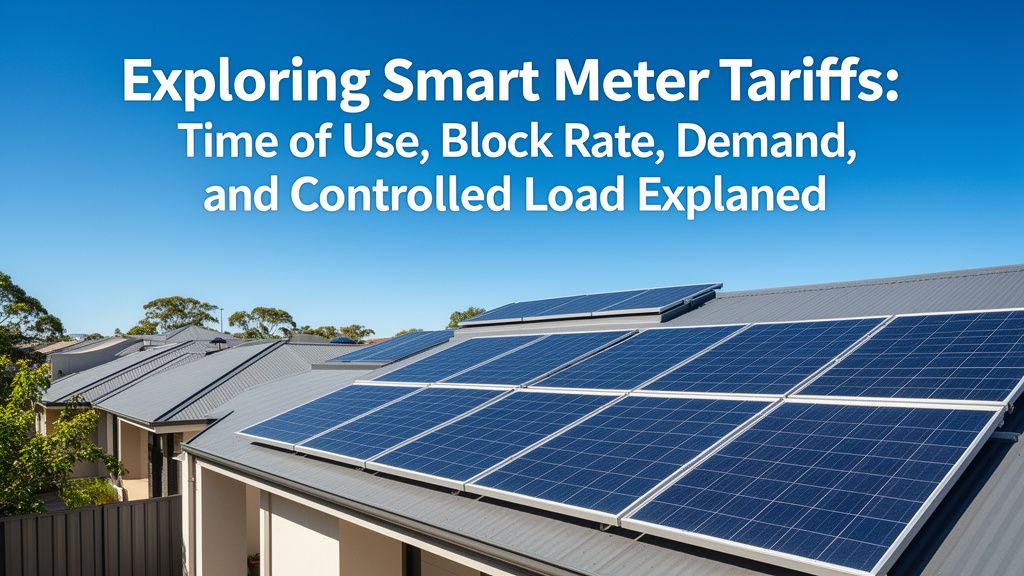
Exploring Smart Meter Tariffs: Time of Use, Block Rate, Demand, and Controlled Load Explained
For Australian homeowners embracing solar power, a smart meter isn't just a fancy digital display; it's your gateway to unlocking significant savings. But to truly maximise your solar investment, you need to understand the electricity tariffs your smart meter can enable. Gone are the days of a simple flat rate. Modern tariffs are designed to encourage more efficient energy use, and for solar owners, this means strategic thinking can turn your rooftop sunshine into serious financial benefits. Let's delve into the different types of tariffs you might encounter and how they interact with your solar system.
Time of Use (TOU) Tariffs
Time of Use (TOU) tariffs are perhaps the most common smart meter tariff structure. They charge different rates for electricity depending on the time of day and often the day of the week. Typically, these are broken down into three periods:
- Peak: The most expensive period, usually late afternoon/early evening (e.g., 4 pm - 8 pm), when demand on the grid is highest. You might pay $0.35 - $0.50 per kWh or even more during these hours.
- Shoulder: Moderately priced periods bridging peak and off-peak (e.g., 7 am - 4 pm and 8 pm - 10 pm). Rates could be around $0.20 - $0.35 per kWh.
- Off-Peak: The cheapest period, usually overnight (e.g., 10 pm - 7 am) and often all weekend, when demand is lowest. Expect rates of $0.10 - $0.20 per kWh.
For solar owners, TOU tariffs are a golden opportunity. The goal is to maximise self-consumption during peak and shoulder periods when grid electricity is most expensive. By running appliances like your dishwasher or washing machine during the day when your solar panels are generating, you avoid costly grid imports. If you have a battery, it becomes incredibly valuable, allowing you to store excess solar generated during the day and discharge it during the evening peak period, further reducing your reliance on expensive grid power. Exporting power during peak times can also fetch higher feed-in tariffs with some retailers, though feed-in tariffs are generally much lower than import rates.
Block Rate Tariffs
Block rate tariffs, sometimes called "inclining block" or "declining block" tariffs, charge different rates based on the total amount of electricity you consume within a billing period.
- Inclining Block: The price per kilowatt-hour increases as your consumption crosses certain thresholds. For example, the first 150 kWh might cost $0.25/kWh, the next 200 kWh at $0.30/kWh, and anything over that at $0.35/kWh.
- Declining Block: Less common for residential users, this is the opposite, where the price per kWh decreases as you consume more.
While less prevalent for new residential connections in Australia compared to TOU, some older plans or specific network areas might still have block rates. For solar owners on an inclining block tariff, your solar system helps keep your grid imports within the cheaper initial blocks, effectively reducing your overall average cost per kWh. The more you generate and self-consume, the less likely you are to hit those higher-priced consumption blocks.
Demand Tariffs
Demand tariffs are a newer and increasingly common structure, particularly for households with larger solar systems or in certain network areas. Unlike consumption-based tariffs (which charge per kWh), demand tariffs charge based on your peak power demand (kW) over a short interval, usually 30 minutes, within a billing period.
Here’s how it works: the network records your highest instantaneous power draw (measured in kilowatts, kW) during a specified window (e.g., 3 pm - 9 pm daily) for that month. You then pay a demand charge based on that highest kW spike. This could be, for example, a charge of $5 - $15 per kW for your highest 30-minute average demand each month.
For solar owners, demand tariffs present a significant challenge and a massive opportunity for battery owners. A large spike in simultaneous appliance use (e.g., air conditioning, oven, and electric vehicle charging all at once) could set a high demand charge for the entire month, even if it only happened once. A battery system becomes incredibly valuable here for "peak shaving." It can automatically discharge during those high-demand moments, preventing you from pulling a large spike from the grid and thereby dramatically reducing your monthly demand charge. Strategic appliance use, like staggering high-power loads, is also crucial.
Controlled Load Tariffs
Controlled load tariffs are distinct from your general supply and are very common across Australia. They apply to specific, dedicated high-energy appliances that are wired separately and can be remotely switched on and off by the electricity network. The most common examples are electric hot water systems and pool pumps.
The advantage is that the electricity for these appliances is significantly cheaper than your general supply, often around $0.10 - $0.20 per kWh. The trade-off is that the network controls when these appliances operate, usually during off-peak periods when there’s surplus grid capacity. For instance, your hot water system might only heat overnight, or your pool pump might run during the middle of the day.
For solar owners, controlled load can still be beneficial. Since these appliances often run outside of peak solar generation hours (e.g., overnight for hot water), they don't directly compete with your solar panels for energy. If you have excess solar generation, you can even use smart relays or timers to manually switch on your hot water system or pool pump during the day to utilise your free solar power, effectively turning your hot water tank into a thermal battery. However, traditional controlled load remains a separate, cheaper tariff.
Maximising Solar Savings with Smart Tariffs
Understanding these tariffs is the first step. The next is to leverage your solar system and habits to minimise costs:
- Maximise Self-Consumption (TOU & Block Rate): Shift appliance use to daylight hours when your solar is generating.
- Invest in a Battery (TOU & Demand): A battery is your best friend. It stores excess solar for evening peak use (TOU) and can brilliantly "peak shave" to avoid high demand charges.
- Monitor Your Usage (All Tariffs): Use your smart meter data (often accessible via your retailer's app) to understand when you're using power and how that aligns with your tariff structure.
- Strategic Load Management (Demand): Avoid running multiple high-power appliances simultaneously, especially during potential peak demand windows.
- Utilise Controlled Load Wisely: Where possible, integrate your solar with controlled load appliances to soak up excess generation.
In the evolving landscape of Australian energy, smart meters and their associated tariffs offer unprecedented control over your electricity bills. By understanding Time of Use, Block Rate, Demand, and Controlled Load structures, you can turn your solar power system into an even more powerful tool for financial and environmental savings. Always check with your electricity retailer to confirm the specific tariffs available in your area and for your setup.
Read More
For a comprehensive overview, check out our master guide: Read the Full Guide Here.