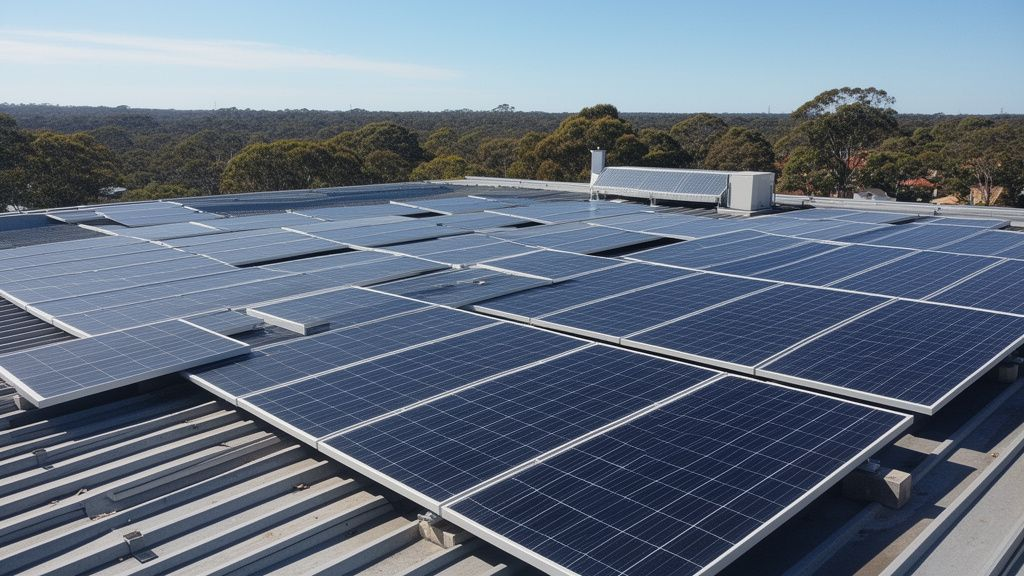
TL;DR: A landmark study from UNSW Sydney and the ARC Centre of Excellence for Weather of the 21st Century has revealed that Australia’s future renewable-powered electricity grid is far more resilient to natural climate variability than previously expected. By modeling 84 years of weather data through to 2050, researchers demonstrated that the interconnected National Electricity Market (NEM) effectively balances out the impacts of major climate drivers like ENSO and the Indian Ocean Dipole.
The Weather-Dependent Grid: A Growing Question
As Australia systematically replaces retired coal-fired power stations with wind farms, solar arrays, and energy storage, the nation's electricity supply becomes fundamentally dependent on the weather. On hot summer afternoons or still winter mornings, wind and solar resources dictate the exact volume of generation flowing into the grid.
This transition has raised a vital question for energy planners and policymakers: will major recurring climate drivers make it harder to keep the lights on? Specifically, there are concerns that long-term climate patterns could suppress renewable generation across vast geographic regions simultaneously, leading to system-wide shortfalls.
Behind the UNSW Sydney Study
To address this critical question, researchers at the ARC Centre of Excellence for Weather of the 21st Century, based at UNSW Sydney, conducted a comprehensive investigation. The study was led by Dr. Doug Richardson, a 21st Century Weather Research Fellow.
While prior studies had isolated how climate patterns impact individual elements—such as electricity demand, wind generation, or solar irradiance—this study represents the first time researchers modeled how these drivers work together across Australia's entire interconnected electricity network.
Methodology and Data Modeling
The research team analyzed 84 years of historical weather data and simulated how the National Electricity Market (NEM) would perform under the Australian Energy Market Operator's (AEMO) projected expansion of wind and solar capacity through to the year 2050. The study specifically focused on three primary climate drivers that dictate Australian weather patterns:
- The El Niño-Southern Oscillation (ENSO)
- The Indian Ocean Dipole (IOD)
- The Southern Annular Mode (SAM)
Key Findings: The Power of Interconnection
The results of the study are highly encouraging for the future of renewable energy in Australia. The researchers found that while these major climate patterns do influence temperature, wind speed, and cloud cover individually, their combined net effect on the electricity grid is surprisingly small.


"Once you combine electricity demand with wind and solar generation across Australia’s interconnected grid, many of those climate influences balance each other out," Dr. Richardson noted.
While transitioning to a highly renewable grid does increase overall year-to-year variability, large-scale climate drivers account for very little of this fluctuation:
- The Southern Annular Mode (SAM): Showed a modest influence on grid conditions, particularly during late winter and early spring.
- ENSO and the Indian Ocean Dipole (IOD): Had only limited, minor effects on the residual electricity demand that the grid must supply after wind and solar generation are accounted for.
Redefining Predictive Modeling for Energy Planners
To evaluate whether climate driver data could enhance seasonal forecasts, the UNSW team tested machine learning models. They discovered that relying on macro-climate patterns alone provided very little predictive skill for grid performance.
However, when local temperature data was integrated, the forecasts improved significantly. This indicates that the energy sector will derive far greater value from highly accurate, localized predictions of wind, solar radiation, and temperature rather than general long-range forecasts of ENSO or IOD climate drivers.
According to Dr. Richardson, "Climate drivers remain important because they influence Australia’s weather, but they’re not a reliable guide to how much renewable electricity the grid will generate overall. For future energy planning, improving forecasts of the weather itself is likely to deliver greater value."
Key Takeaways
- High Grid Resilience: Australia's future renewable-powered electricity grid is highly resilient to natural climate variability related to ENSO and other major climate drivers.
- Interconnection Benefits: The geographic diversity of the National Electricity Market (NEM) allows localized weather extremes to balance each other out across state lines.
- Minimal Macro-Impact: Major drivers like El Niño, La Niña, and the Indian Ocean Dipole have surprisingly limited effects on the residual demand left after wind and solar generation.
- Forecasting Focus: Energy planners should prioritize high-resolution, short-to-medium-term weather forecasting (temperature, wind speed, solar radiation) over macro-climate driver predictions.