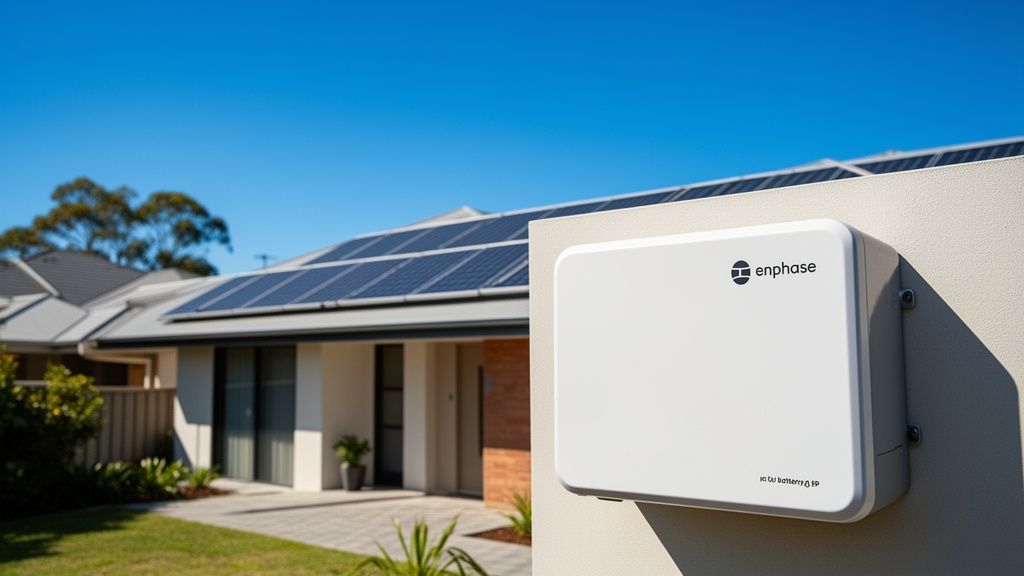
TL;DR: The Enphase Energy System with an IQ Battery 5P integrates solar generation and storage into a unified platform. It allows Australian and New Zealand homeowners to maximise self-consumption, reduce electricity bills, and maintain power during outages through a smart, modular design.
How does the Enphase IQ Battery 5P integrate into an existing solar setup?
The Enphase IQ Battery 5P connects directly into a standard Enphase microinverter-based solar system, forming a cohesive energy management platform for your home. Unlike traditional string inverter systems that send all DC power to a single point before conversion, Enphase uses microinverters under each solar panel. These microinverters convert DC power to AC power right on the roof, meaning your home runs on AC power throughout the system. The IQ Battery 5P uses this same AC architecture, making its integration straightforward. When the sun shines, your panels generate power. This power first supplies your home's immediate needs. Any surplus AC power then flows directly to the IQ Battery 5P for storage. This seamless AC coupling simplifies installation and avoids efficiency losses often seen in DC-coupled battery systems. The system prioritises using your own solar power, then stored battery power, before drawing expensive electricity from the grid.
The Role of Microinverters in System Harmony
Each solar panel in an Enphase system has its own microinverter, independently optimising power output. If one panel is shaded or dirty, it doesn't drag down the performance of the entire array. This modular design extends to the IQ Battery 5P. The battery itself contains multiple microinverters, allowing it to manage power flow with precision and resilience. Should one component in the battery unit fail, the other microinverters continue to operate, ensuring the battery still provides power. This approach improves overall system reliability and ensures maximum energy harvest from every panel, which directly benefits battery charging. Homeowners appreciate this robustness, especially in areas prone to grid instability.
How the IQ Gateway Manages Energy Flows
The Enphase IQ Gateway acts as the brain of the entire system, monitoring production, consumption, and battery state. It communicates with every microinverter and the IQ Battery 5P to make real-time decisions about where your power should go. For instance, if your electricity tariff offers cheaper rates overnight, the IQ Gateway can be programmed to charge the battery from the grid during those periods and then discharge it during expensive peak times. It provides detailed insights into your home's energy usage through the Enphase App, giving you full control and visibility. By 2026, the IQ Gateway continues to refine its algorithms, adapting to changing grid conditions and homeowner preferences, ensuring your system runs as efficiently as possible.
What are the key operational modes of the IQ Battery 5P in AU/NZ homes?
The Enphase IQ Battery 5P operates in several smart modes designed to maximise savings and energy independence for Australian and New Zealand households. Its primary goal is to ensure you use as much of your self-generated solar power as possible, reducing reliance on the grid. During daylight hours, any excess solar power that your home doesn't immediately use flows into the IQ Battery 5P for storage. Once fully charged, or if the home's demand is low, surplus energy can be exported to the grid, earning a feed-in tariff credit from your retailer. When the sun sets or your solar panels aren't producing enough power, the IQ Battery 5P automatically discharges its stored energy to power your home. This process helps avoid buying expensive peak-rate electricity from the grid, significantly cutting down on your power bills. The seamless transition between these modes means you rarely notice the battery working in the background.
Self-Consumption and Time-of-Use Optimisation
Most AU/NZ homes experience peak electricity prices in the late afternoon and evening, precisely when solar generation drops off. The IQ Battery 5P addresses this by storing daytime solar energy to discharge during these costly peak periods. The IQ Gateway continually learns your household's energy patterns and optimises battery charging and discharging accordingly. For homes on Time-of-Use tariffs, this strategy means shifting energy consumption from high-cost grid power to free or low-cost stored solar power. This smart management directly translates to lower quarterly electricity bills. A typical household in Queensland, for example, might save hundreds of dollars a year by avoiding peak rate charges, recouping their investment quicker.
Grid Independence and Backup Power Capabilities
Beyond daily savings, the IQ Battery 5P offers a crucial layer of energy resilience. In the event of a grid outage, the Enphase system can automatically switch into backup mode, provided a critical loads panel or full home backup is configured during installation. This allows your home to continue running essential appliances using stored battery power and any ongoing solar generation. This capability offers peace of mind, particularly for regions susceptible to extreme weather events or unreliable grid infrastructure. While the system can't power your entire home indefinitely, it prioritises critical loads, allowing you to maintain lights, refrigeration, and communication during blackouts. The modular nature means you can add more IQ Battery 5P units over time to increase your backup capacity.
What is the typical investment for an Enphase IQ Battery 5P system in AU/NZ by 2026?
The investment required for an Enphase IQ Battery 5P system in Australia and New Zealand by 2026 varies based on several factors, including the number of battery units, existing solar infrastructure, and installation complexity. While specific component costs fluctuate with market conditions, homeowners should budget for the battery units themselves, the necessary cabling, the IQ Gateway, and the authorised installation labour. As of 2026, a single IQ Battery 5P unit, known for its compact size and modularity, generally sits in the mid-to-high range for residential battery storage. It's important to remember that this cost is for a fully integrated, smart energy management system, not just a battery. Many homeowners opt for multiple 5P units to meet their specific energy storage needs, which scales the overall cost.

Cost Considerations and System Sizing
The overall cost depends on how many IQ Battery 5P units your home requires. An average Australian family with a 6.6kW solar system might consider one or two units to maximise self-consumption and provide some backup. Larger homes or those with significant evening energy usage might benefit from three or more units. Each additional unit increases the total cost but also enhances energy independence and backup capacity. Installation costs also play a role; connecting to an existing Enphase solar system is typically more straightforward than integrating with an older, non-Enphase setup, potentially reducing labour charges. Seeking multiple quotes from accredited Enphase installers ensures you get a competitive and accurate price for your specific requirements.
Government Incentives and Payback Periods
Australian and New Zealand governments, along with state and regional bodies, continue to offer various incentives for solar battery installations, which can help offset the initial investment. These can include rebates, interest-free loans, or feed-in tariff bonuses. For instance, state-based programs in Victoria or South Australia have previously offered substantial rebates for battery storage. Homeowners should research current incentives applicable to their location, as these schemes change. The payback period for an IQ Battery 5P system depends on your electricity usage, current electricity tariffs, and any available incentives. By significantly reducing grid electricity purchases and potentially earning feed-in credits, many homeowners find the investment pays for itself within several years, especially as electricity prices continue to rise across the region.
Key Takeaways
- The Enphase IQ Battery 5P integrates seamlessly with existing Enphase microinverter solar systems, utilising an AC-coupled architecture for efficiency.
- The system prioritises using solar power, then stored battery power, to reduce reliance on the grid and minimise peak-time electricity purchases.
- Homeowners gain grid independence and critical appliance backup during blackouts by configuring the system for energy resilience.
- Investment costs for an IQ Battery 5P system vary based on the number of units and installation complexity; seek multiple quotes from authorised installers.
- Government incentives and reduced electricity bills help shorten the payback period for the battery storage investment in AU/NZ.
Read More
For a comprehensive overview, check out our master guide: Read the Full Guide Here.