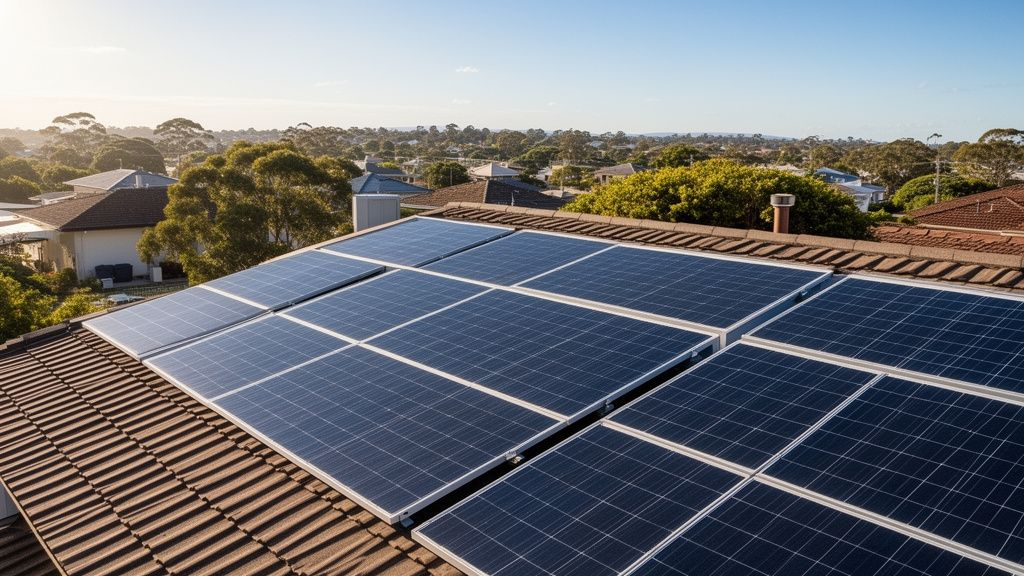
TL;DR: Australia's residential solar market has entered a mature phase where rooftop solar integration with modern battery storage is essential to manage evening peaks and maximize self-consumption. With updated legislative incentives such as the Small-scale Renewable Energy Scheme (SRES) and next-generation inverter hardware, households are gaining greater grid independence and financial savings.
The Evolution of Australia's Home Solar Infrastructure
Australia's transition to renewable energy has been remarkably rapid, driven by an extraordinary uptake of residential and commercial solar systems. By the year 2024, approximately four million rooftop solar photovoltaic (PV) systems had been installed across Australian homes and businesses. This massive deployment of decentralized generation has established the nation as a global leader in small-scale solar capacity. However, this solar boom has introduced a classic operational challenge. Solar panels generate their peak electrical output during the middle of the day when sunlight is most intense, whereas household energy demand typically peaks in the late afternoon and evening hours when residents return home, run appliances, and utilize climate control systems. This temporal mismatch means that without energy storage, a significant portion of clean, locally generated solar energy is exported back to the grid during the day, while households remain heavily reliant on grid electricity—often generated from fossil fuels—during peak evening periods.
To bridge this gap and optimize the value of rooftop assets, solar battery storage systems have emerged as a critical technology. By storing excess generation during peak daylight hours, batteries allow consumers to shift their solar consumption to the evening, reducing household electricity bills and alleviating pressure on the wider electricity grid. This transition to integrated solar-and-battery systems represents the next evolutionary phase of the Australian clean energy transition, shifting the focus from simple generation to intelligent, localized energy management.
How Solar and Battery Systems Work Together
The integration of solar panels and battery storage is highly synchronized, working through a unified home energy setup. During daylight hours, the solar panels capture solar radiation and generate Direct Current (DC) electricity. This electricity is routed to an inverter, which converts it into Alternating Current (AC) to power active household appliances in real-time. When the solar panels produce more electricity than the household requires, the surplus energy is directed to charge the solar battery system rather than being automatically exported back to the grid.
In the evening, or during periods of low sunlight, the solar panels stop generating electricity. At this point, the battery system takes over, discharging its stored energy to supply the household's power needs. This process significantly minimizes the volume of electricity that must be purchased from the utility grid at retail rates. Furthermore, during power outages, grid failures, or peak demand periods when electricity costs spike, the battery acts as a dependable, independent power source. This continuous loop of charging during peak generation and discharging during peak demand maximizes the efficiency of the rooftop solar investment, providing households with greater control over how, when, and at what cost their energy is consumed.
Technical Specifications: Nominal vs. Usable Battery Capacity
When evaluating a solar battery system, consumers must understand the technical distinction between nominal capacity and usable capacity, as this variance directly impacts real-world performance and financial return. The nominal capacity refers to the total theoretical amount of energy a battery can store under ideal conditions, which is typically the primary measurement displayed on product marketing specifications. For example, a battery marketed with a 10kWh nominal capacity is technically capable of holding that amount of energy when fully charged.
However, in practical applications, a battery cannot be completely discharged without risking severe damage to its internal cells, accelerating wear, and shortening its operational lifespan. To protect the physical integrity of the technology and ensure safe, reliable daily operation, manufacturers program the systems to prevent full discharge. This leads to the metric of usable capacity, which is the actual amount of stored solar energy that is available for a household or business to use. In real-world conditions, a solar battery with a nominal capacity of 10kWh may only deliver an actual usable capacity of approximately 8kWh to 9kWh. When comparing systems, calculating potential savings, or evaluating eligibility for incentive programs, consumers must base their calculations on usable capacity rather than nominal capacity, as incentive schemes are typically assessed on the usable capacity that can actually perform work for the household.
Government Schemes, Regulations, and the SRES Eligibility
The financial viability of residential solar and battery systems has been substantially improved by progressive regulatory updates in Australia. Following key amendments to the Renewable Energy (Electricity) Regulations 2001, solar batteries are now formally eligible under the federal Small-scale Renewable Energy Scheme (SRES). This inclusion is a significant milestone, as the SRES historically only incentivized the generation components of solar systems. By expanding the regulations to encompass energy storage, the federal government has made integrated solar-and-battery systems far more accessible to standard households and businesses.


The SRES mechanism helps offset the initial capital expenditure of purchasing a battery, which has historically been a major barrier to wider adoption. Currently, solar battery adoption across Australia remains relatively low, with only about one in 40 solar-equipped households choosing to install a battery system, primarily due to these high upfront costs. However, with the integration of batteries into the SRES framework, alongside regional programs such as the Cheaper Home Batteries Program, interest and adoption rates are experiencing a steady upward trajectory. These regulatory frameworks are designed to lower emissions, reduce reliance on peak gas and network infrastructure, and improve overall grid stability and energy resilience across the nation.
Inverter and Battery Technologies: GoodWe, Neovolt, and Beyond
Achieving maximum solar and storage efficiency requires high-performance hardware, and manufacturers have introduced highly advanced inverters and batteries to the Australian market. For instance, next-generation GoodWe technology includes the GW9.999KEHA-G20 single-phase inverter, which features a 10kW capacity, 200% oversizing capabilities, and 4 Maximum Power Point Trackers (MPPTs) designed to optimize solar harvest even under complex roof orientations or shading conditions. This is paired with scalable battery storage options like the GW8.3-BAT-D-G21, providing homeowners with a highly integrated energy management platform.
Similarly, Neovolt has revolutionized home energy storage with its comprehensive range of single-phase and three-phase hybrid inverters and batteries, including models such as the BW-INV-SPB5K, BW-INV-SPH5K, and the BW-BAT series. Other notable Australian-engineered options include the Walara G4P series, which is designed and engineered by a local team in South Australia to withstand the extreme environmental conditions of the Australian Red Centre, utilizing an ultra-rigid structure and 16BB high-efficiency cells. For consumers seeking heavy-duty backup, the DEYE ESS storage solution offers reliable PV and storage inverter systems backed by a 10-year warranty. Additionally, all-in-one solutions like the SAJ HS2 Series three-phase hybrid and the AlphaESS AC coupled solutions (G3-S5 & G3-B5) provide seamless, scalable, and efficient energy storage designed for both residential and commercial applications.
System Configurations: Residential, Commercial, and Stand-Alone Power Systems
Solar energy systems are highly customizable and can be tailored to meet different operational demands, categorized into residential, commercial, and off-grid configurations. Residential systems focus on maximizing self-consumption of clean energy throughout the day and evening, guiding homeowners through a straightforward process to reduce utility bills. Commercial systems place a heavier emphasis on strict safety guidelines, load matching, and demanding high-capacity components to handle massive business operations while lowering operating costs.
For remote locations, off-grid systems—also known as Stand-Alone Power Systems (SAPS)—operate completely independently of the national electricity grid. These systems function by generating electricity from solar panels to charge a battery bank directly. The power is stored within the battery as Direct Current (DC), and an inverter is used to convert this stored energy into Alternating Current (AC) for standard wall outlets. SAPS offer critical energy independence for regional properties where grid connection is financially or logistically impractical.
Choosing a Certified and Approved Solar Provider
Because a solar and battery system is a significant long-term investment, selecting an experienced and certified installer is paramount. Trusted companies like Solar Link Australia, which has been established and operating since 2010, emphasize customer satisfaction and system longevity. Consumers should look for providers certified as New Energy Tech Approved Solar Sellers (NETCC Approved) and Clean Energy Council (CEC) Approved Solar Retailers. These certifications guarantee that the provider adheres to strict industry standards, uses high-quality components, and provides reliable local support and warranties.
To make these systems more affordable, reputable providers often offer flexible financing solutions. Programs such as "Install Now Pay Later" allow households to install a high-quality solar package with payments starting from as little as $1.99 per day, ensuring that the transition to clean, self-sustaining solar energy does not require a burdensome upfront financial commitment.
Key Takeaways
- Integrated Power: Solar panels generate clean energy during the day, while batteries store the excess to supply power during evening peaks and outages.
- Capacity Metrics: Always compare usable capacity rather than nominal capacity, as usable capacity represents the actual energy available for household consumption.
- SRES Rebates: Recent amendments to the Renewable Energy Regulations 2001 make solar batteries eligible for SRES incentives, reducing upfront costs.
- Technology Leaders: Leading brands like GoodWe, Neovolt, Walara, and DEYE provide high-efficiency, durable hardware engineered for harsh Australian conditions.
- Approved Sellers: Ensure your installer holds CEC and NETCC certifications to guarantee quality service, compliance, and long-term warranty support.
Related Guides
- Understanding Solar Battery Basics: Nominal vs Usable Capacity and the SRES
- Western Australia's SWIS: Entering a New Energy Era with Rooftop Solar and Batteries
- Funding the Future: How the CEFC is Propelling Australia's Renewable Energy Infrastructure
- An In-Depth Look at Residential and Commercial Solar Technologies from Top Brands


