TL;DR: This regulatory update details the Clean Energy Regulator's latest national compliance crackdowns, the introduction of a new consumer energy technical regulator, and the state of Australia's carbon credit and battery storage markets in 2026.
Targeted Compliance and Crackdowns on Incomplete Solar Installations
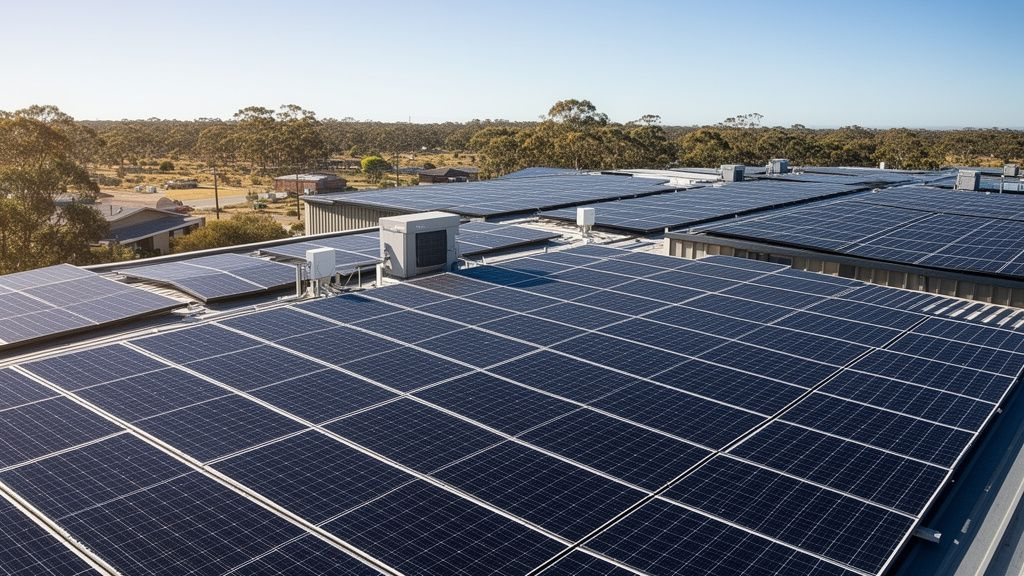
The Clean Energy Regulator (CER) has intensified its regulatory focus on the solar and battery sector. On 22 July 2026, the regulator released its latest Quarterly Compliance Update, showcasing targeted initiatives designed to safeguard the integrity of Australia's clean energy schemes. A major focus of this compliance drive is a nationwide crackdown on incomplete solar installations.
To ensure that consumers and the government receive fully compliant, safe, and operational solar PV installations, the CER is closely monitoring and auditing systems registered under the Small-scale Renewable Energy Scheme (SRES). This crackdown aims to prevent sub-standard workmanship, non-compliance with technical standards, and administrative issues surrounding incomplete installations. By enforcing strict eligibility requirements, the regulator ensures that only high-quality, fully completed projects generate Small-scale Technology Certificates (STCs), maintaining financial and technical trust in the scheme.
Introducing the Consumer Energy National Technical Regulator Role
As consumer energy resources (CER) continue to expand across Australian households and businesses, technical alignment has become a high priority. On 21 July 2026, a new role was announced for the Clean Energy Regulator as the national technical regulator for interoperable consumer energy resources in Australia.
In this new capacity, the CER is preparing to establish standards and guidelines governing the interoperability of residential and commercial clean energy systems. As more systems connect to the grid, ensuring that solar panels, battery storage, and electric vehicle chargers can seamlessly communicate and coordinate with distribution networks is critical. This national role represents a major step toward unifying the technical standards across different states and territories, creating a more resilient, modern, and consumer-friendly electrical grid.
Quarterly Carbon Market Insights and the Safeguard Mechanism
In addition to compliance updates, the Clean Energy Regulator has released market data highlighting progress across Australia's carbon and renewable energy markets. Key milestones tracked through the Q2 2026 Quarterly Carbon Market Report (QCMR) data workbook, released on 16 July 2026, and related Q1 data show:


- National Usable Battery Capacity: As of mid-May 2026, Australia had reached 11.4 GWh of usable battery capacity installed nationwide. This capacity includes residential, commercial, and utility-scale battery systems, highlighting rapid growth in energy storage.
- Record-Breaking ACCUs: In the first quarter of 2026, the regulator issued 5.5 million Australian Carbon Credit Units (ACCUs) under the ACCU Scheme. This represents the highest Q1 issuance on record, showing significant participation in carbon offset projects across the country.
- Safeguard Mechanism Performance: Following recent policy reforms, facilities covered under the Safeguard Mechanism achieved a combined reduction of 5.8 million tonnes of CO2-equivalent (Mt CO2-e) in emissions, illustrating the mechanism's role in driving industrial decarbonization.
The Sandeep Shinde Ineligibility Case Study
To emphasize its commitment to enforcing standards, the Clean Energy Regulator has taken strong action against individual installers who fail to meet SRES compliance requirements. On 13 July 2026, the CER declared solar PV installer Sandeep Shinde ineligible to install solar systems and batteries for the purposes of the SRES for a period of three years.
This declaration means that any solar system or battery installation overseen by Sandeep Shinde will be ineligible to participate in federal incentive schemes or generate financial benefits under the SRES. This enforcement action highlights that the CER will hold accredited individuals accountable for non-compliance, poor workmanship, or administrative failures, sending a clear message to the industry that quality control cannot be bypassed.
Key Takeaways
- Active Compliance Crackdown: Released on 22 July 2026, the CER's Quarterly Compliance Update outlines a major crackdown on incomplete solar systems to protect scheme integrity.
- Interoperability Governance: The Clean Energy Regulator is preparing for its new role as the national technical regulator for interoperable consumer energy resources, announced on 21 July 2026.
- Record Carbon Performance: Q1 2026 marked a record high of 5.5 million ACCUs issued, while Australia reached 11.4 GWh of usable battery capacity by mid-May 2026.
- Enforcement Measures: Non-compliant installers face severe penalties, as shown by the 3-year SRES eligibility ban imposed on Sandeep Shinde on 13 July 2026.


