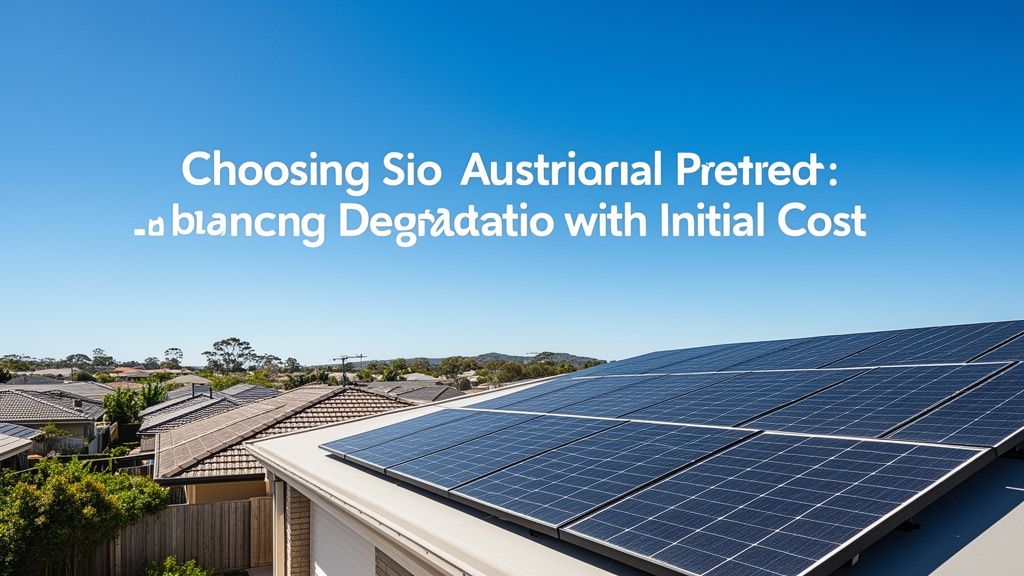
Solar Savings Down Under: Balancing Panel Degradation with Upfront Costs
Choosing solar panels for your Aussie home is a big decision, and it’s one that often leaves homeowners scratching their heads. You're trying to snag the best deal, maximise your long-term savings, and ensure your system stands up to our harsh Australian conditions. But here's a common dilemma many face: do you go for the cheaper panels now, or invest a bit more for panels that promise to perform better over two decades? It all boils down to finding the sweet spot between a panel's degradation rate and its initial cost.
What is Solar Panel Degradation, Mate?
Every solar panel, no matter how premium, will experience a gradual reduction in its power output over time. This is known as degradation. Think of it like a battery slowly losing its ability to hold a full charge. For solar panels, this typically happens at a very predictable rate each year.
Most reputable solar panel manufacturers offer a performance warranty, guaranteeing that their panels will still produce a certain percentage of their initial output after 20 or 25 years. A common warranty might state that panels will degrade by 0.5% in the first year and 0.4% each subsequent year, meaning they'll still be performing at around 85-90% of their original capacity after 25 years. Cheaper, lower-quality panels might have a higher degradation rate, perhaps 0.7-0.8% annually, meaning they'll produce significantly less power towards the end of their lifespan. This seemingly small difference can really add up in terms of lost energy generation and potential savings over two decades.
The Initial Cost: More Than Just the Price Tag
Of course, the first thing most Aussies look at is the price. Solar panel costs can vary widely depending on the brand, efficiency, manufacturing quality, and the length/strength of their warranties. A good quality, Tier 1 panel might cost anywhere from $250 to $350 each, while a more budget-friendly option could come in at $180 to $230 per panel. When you’re kitting out your whole roof, those differences quickly multiply into thousands of dollars.
It’s tempting to opt for the cheaper upfront system, especially with the immediate benefit of STCs (Small-scale Technology Certificates) helping to reduce that initial outlay. However, that lower price often comes with trade-offs, and a higher degradation rate is frequently one of them.
The Degradation-Cost Conundrum: A Long-Term View
Here's where the balancing act becomes crucial. Let's consider a hypothetical scenario for a typical 6.6kW solar system for an Australian home, made up of 20 x 330W panels:
Scenario A: Premium Panels
- Initial cost per panel: $300
- Total panel cost (excluding installation, inverter, etc.): $6,000
- Degradation rate: 0.4% per year after the first year (0.5% first year)
- Output after 25 years: ~88% of original capacity
Scenario B: Budget Panels
- Initial cost per panel: $200
- Total panel cost (excluding installation, inverter, etc.): $4,000
- Degradation rate: 0.7% per year after the first year (0.8% first year)
- Output after 25 years: ~80% of original capacity
While Scenario B saves you $2,000 upfront, the cumulative difference in energy production over 25 years can be substantial. If your premium panels are consistently producing 5-8% more power each year towards the latter half of their life compared to the budget option, that translates directly into more energy for your home or more feed-in tariff credits – putting more dollars back in your pocket. Over 25 years, that additional 5-8% output could easily generate thousands of dollars extra in electricity savings or revenue, far outweighing the initial $2,000 price difference.

Calculating Your Return: The Aussie Way
When assessing your options, it's wise to think beyond the immediate payback period and consider the "levelised cost of energy" (LCOE) over the system's entire lifespan. This means calculating the total cost of your system (including potential maintenance and replacement costs) divided by the total amount of electricity it's expected to produce over its lifetime. Panels with lower degradation rates will contribute significantly more electricity over 25 years, thus lowering your LCOE, even if their initial price is higher.
Factor in your current electricity prices, potential feed-in tariffs in your state, and how much of the generated power you'll likely self-consume. A panel that produces more power consistently is simply more valuable over time in the Australian energy market.
Beyond Degradation and Cost: Other Key Australian Considerations
While degradation and cost are central, don't forget these other crucial factors for our unique conditions:
- Warranties: Always check both the product warranty (covering manufacturing defects) and the performance warranty (guaranteeing output). A longer product warranty (15-25 years is increasingly common for premium panels) indicates greater confidence from the manufacturer.
- Manufacturer Reputation: Stick with established, Tier 1 manufacturers who have a proven track record, especially in Australia. They’re more likely to honour warranties decades down the track.
- Efficiency: Higher efficiency panels mean you can generate more power from a smaller roof space. While not directly about degradation, it contributes to overall value.
- Durability: Australian weather can be brutal – intense heat, hail, strong winds. Quality panels are built to withstand these conditions, protecting your investment.
Making the Right Choice for Your Aussie Home
Ultimately, there's no single "best" answer; the right choice for you depends on your budget, your long-term financial goals, and your priorities.
If you plan to stay in your home for 15-20+ years, investing in panels with a lower degradation rate, even if they cost a bit more upfront, will almost certainly pay off significantly in the long run. The incremental increase in electricity production year after year will lead to greater savings and a better return on your investment.
If your budget is extremely tight, or you anticipate moving within 5-7 years, a more budget-friendly option might seem appealing. However, even then, consider the resale value of your home; a higher-quality solar system can be a strong selling point.
The best approach is to get multiple quotes from reputable Australian solar installers. Ask them to clearly outline the panel brands they use, their degradation rates, and the specifics of their warranties. Have an honest conversation about your budget and your long-term plans. With this information, you can make an informed decision that truly balances initial cost with enduring performance, ensuring your solar investment serves you well for decades to come, right here in Australia.
Read More
For a comprehensive overview, check out our master guide: Read the Full Guide Here.