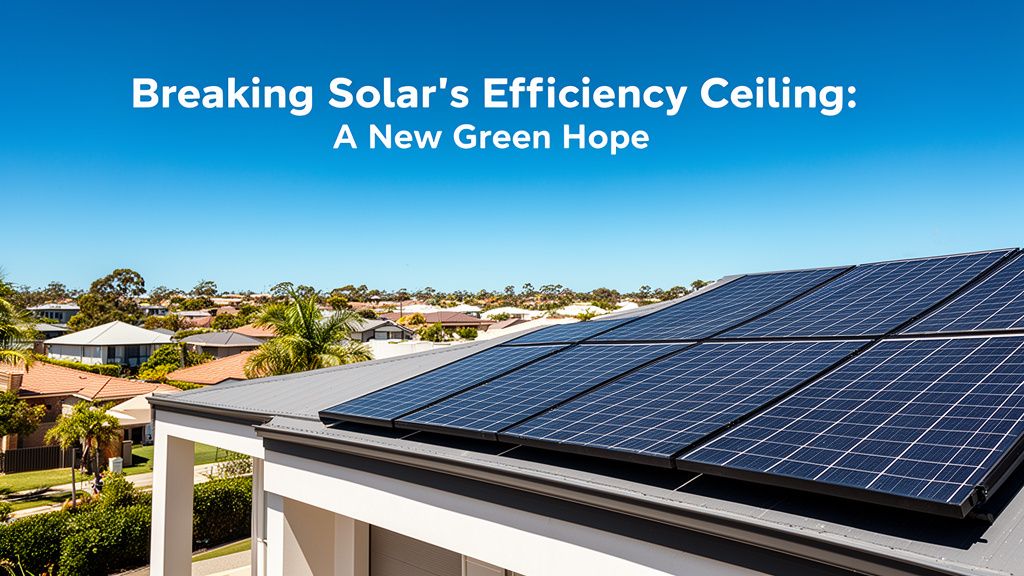
TL;DR: New solar technologies are shattering the long-standing "Shockley-Queisser limit" of around 33.7% theoretical efficiency for single-junction cells, promising a future where solar panels generate significantly more power from smaller areas. This breakthrough offers a major step towards cleaner, more affordable energy for Australian homes and businesses, revolutionising our approach to green power generation.
What Is the "Impossible" Solar Conversion Ceiling, and Why Has It Been a Challenge?
The "impossible" solar conversion ceiling refers primarily to the Shockley-Queisser limit, a theoretical maximum efficiency for converting sunlight into electricity using a single p-n junction solar cell. This fundamental physical limit, typically around 33.7% under ideal conditions, has long acted as a practical barrier for conventional silicon solar panels. While actual commercial panels achieve efficiencies closer to 20-22% due to real-world factors like material impurities, manufacturing defects, and energy losses, this limit dictates how much energy can ever be harvested from a single type of semiconductor material. The challenge arises because standard silicon cells can only efficiently absorb a specific range of light wavelengths; a significant portion of the solar spectrum, like infrared and ultraviolet light, simply passes through or generates heat instead of electricity, limiting overall energy capture.
The Efficiency-Cost Trade-off in Standard Solar Panels
The efficiency-cost trade-off is a critical consideration in the widespread adoption of current solar panel technology. Manufacturers have historically balanced achieving higher efficiencies with keeping production costs down, resulting in a sweet spot where most rooftop solar panels offer good value without pushing the technological envelope too far. For an average Australian household, a 6.6kW solar system using panels with 20% efficiency might cost between $4,000 and $8,000 installed, depending on rebates and location. Pushing standard silicon beyond this point often involves significantly more expensive manufacturing processes or exotic materials, driving up the per-watt cost disproportionately without a huge jump in output, making it less attractive for the average punter looking for a solid return on investment.
How the Limit Impacts Green Energy Goals
This efficiency limit has tangible implications for Australia's ambitious green energy goals. To achieve net-zero emissions, we need to generate vast amounts of clean electricity, and the Shockley-Queisser limit dictates how much rooftop space or land area is required to meet demand. For instance, if panels were only 10% efficient, you'd need twice the roof space or twice the solar farm footprint compared to 20% efficient panels to produce the same amount of power. This challenge becomes particularly pronounced in urban areas with limited roof space or for large-scale projects where land availability or environmental impact are concerns. Overcoming this ceiling means we could generate more power from less space, accelerating our transition away from fossil fuels.
How Are Researchers Pushing Beyond Traditional Solar Efficiency Limits?
Researchers are pushing beyond traditional solar efficiency limits by developing advanced materials and innovative cell architectures that circumvent the Shockley-Queisser barrier, primarily through multi-junction designs. The core principle involves stacking different semiconductor materials, each tuned to absorb a specific part of the solar spectrum that others miss. Instead of one material capturing only a narrow band of light, multiple layers work in concert, much like a prism separating light into colours, allowing for a much broader and more efficient capture of the sun's energy. This approach can include exotic materials like gallium arsenide for very high-efficiency space applications, but the most promising avenues for terrestrial use involve combining existing silicon technology with new compounds.
The Promise of Perovskite-Silicon Tandem Cells
The promise of perovskite-silicon tandem cells lies in their ability to combine the best attributes of both materials to create a significantly more efficient solar cell. Perovskites are a relatively new class of materials that are excellent at absorbing the high-energy blue and green parts of the solar spectrum, while traditional silicon is highly efficient at capturing the red and infrared light. By layering a perovskite cell on top of a conventional silicon cell, the perovskite captures the higher-energy photons, letting the lower-energy photons pass through to be absorbed by the silicon layer beneath. This "tandem" approach allows the solar cell to harvest energy from a much wider range of the solar spectrum, shattering the single-junction efficiency limit and demonstrating lab efficiencies well over 30%, with theoretical limits much higher.
Harnessing Different Wavelengths for Greater Output
Harnessing different wavelengths for greater output is fundamental to these next-generation solar technologies. Sunlight is composed of a broad spectrum of electromagnetic radiation, from high-energy ultraviolet to lower-energy infrared. A single-junction silicon cell can only efficiently convert a certain band of these wavelengths into electricity, with much of the rest either passing through or generating wasted heat. Tandem and multi-junction cells address this by having different layers, each acting as a specialised light filter and converter. For example, a top layer might capture blue light, a middle layer green, and a bottom layer red. This ensures that almost every photon hitting the panel contributes to electricity generation, dramatically increasing the overall conversion efficiency and generating more watts per square metre.
What Practical Benefits Will Higher Solar Efficiency Bring to Australian Homes and Businesses?
Higher solar efficiency will bring a multitude of practical benefits to Australian homes and businesses, primarily by maximising power generation from smaller footprints and enhancing economic returns. For homeowners, it means being able to install a more powerful system on a limited rooftop space, potentially generating enough electricity to cover all their household needs, charge an electric vehicle, and even run air conditioning without relying heavily on the grid. Businesses, particularly those with large energy demands and significant roof areas, could achieve near energy independence, drastically cutting operating costs and bolstering their green credentials. The reduced physical footprint also means less material use per watt, potentially lowering overall manufacturing and installation costs in the long run.
Maximising Rooftop Space and Reducing System Costs
Maximising rooftop space is a huge win for Australian homeowners, especially in urban and suburban areas where roof size can be a limiting factor. With panels delivering 25-30% efficiency or more, a 6.6kW system might require fewer panels, freeing up valuable roof real estate for other uses or allowing for an even larger system on the same area. This means more power generated from a smaller physical footprint. Over time, as these advanced technologies scale, the expectation is that the cost per watt will decrease. While initial module costs might be higher, the savings on installation labour (fewer panels to mount), racking, and wiring could partially offset this, ultimately contributing to a lower overall system cost and quicker payback period for the end-user.
Boosting Energy Independence and Grid Stability
Boosting energy independence and grid stability are significant long-term benefits that higher solar efficiency will deliver across Australia. For individual homes and businesses, greater efficiency allows them to produce more of their own electricity, reducing reliance on the centralised grid and making them less susceptible to fluctuating energy prices or outages. For the broader energy landscape, widespread adoption of highly efficient solar could significantly strengthen grid stability. By allowing more power generation closer to the point of consumption, it reduces strain on transmission lines and supports a more decentralised, resilient energy network. This shift will contribute to a more robust, sustainable, and reliable energy supply for the entire country, paving the way for a truly renewable future.


When Can Australians Expect to See These Advanced Solar Technologies on Their Roofs, and What Might They Cost?
Australians can realistically expect to see these advanced solar technologies starting to appear on their roofs within the next five to ten years, with wider adoption following thereafter. While laboratory breakthroughs are exciting, the journey from lab bench to commercial availability involves extensive testing, scaling up manufacturing, and reducing costs. Early versions, likely premium products, could emerge sooner, perhaps within three to five years, but widespread market penetration and competitive pricing typically take longer. Initially, these high-efficiency panels will command a higher price point, possibly 30-50% more than today's standard panels for similar output, but this premium will gradually decrease as production scales and technologies mature.
The Transition from Laboratory Breakthroughs to Market Availability
The transition from laboratory breakthroughs to widespread market availability is a complex process involving several critical stages. Initially, the focus is on achieving world-record efficiencies in a controlled lab environment. The next phase involves developing robust, scalable manufacturing processes that can produce these advanced cells consistently and affordably. This includes ensuring long-term durability, stability under Australian conditions (think scorching summers!), and compliance with all relevant safety standards. Pilot projects and small-scale commercial installations will then test these new panels in real-world scenarios. Only after these hurdles are cleared can we expect to see them readily available from your local solar installer, likely starting as premium options for those seeking the absolute best performance.
Initial Investment vs. Long-Term Savings for Early Adopters
For early adopters, the initial investment in these cutting-edge, high-efficiency solar panels will likely be higher than for conventional systems. Today, a standard 6.6kW system might cost between $4,000 and $8,000 after rebates. A comparable high-efficiency system using new technology could initially range from $8,000 to $15,000, depending on the technology and market maturity. However, the long-term savings for early adopters could be substantial. Generating significantly more power per square metre means a faster payback period, greater electricity bill savings over the system's lifetime, and enhanced energy independence. As efficiency rises, so does the potential for larger feed-in tariff credits or reduced reliance on grid power during peak demand, making the premium worthwhile for those who prioritise maximum output and quicker energy independence.
Key Takeaways
- New solar technologies like perovskite-silicon tandem cells are breaking the theoretical Shockley-Queisser efficiency limit of single-junction solar cells, pushing beyond 30% conversion efficiency.
- This breakthrough allows for significantly more power generation from a smaller physical footprint, making solar viable for more Australian homes and businesses with limited roof space.
- Higher efficiency panels will lead to greater energy independence, potentially lower overall system costs in the long run, and enhanced stability for Australia's energy grid.
- Australians can expect to see these advanced solar solutions emerge in the market within 5-10 years, initially as premium options, with prices expected to decrease with scale.
- The benefits for early adopters include faster payback periods and maximum electricity savings, despite a potentially higher initial investment compared to current standard solar systems.
Read More
For a comprehensive overview, check out our master guide: Read the Full Guide Here.


